AMC10 2021 A
AMC10 2021 A · Q20
AMC10 2021 A · Q20. It mainly tests Basic counting (rules of product/sum), Casework.
In how many ways can the sequence $1,2,3,4,5$ be rearranged so that no three consecutive terms are increasing and no three consecutive terms are decreasing?
有几种方法可以重新排列序列 $1,2,3,4,5$,使得没有三个连续项递增,也没有三个连续项递减?
(A)
10
10
(B)
18
18
(C)
24
24
(D)
32
32
(E)
44
44
Answer
Correct choice: (D)
正确答案:(D)
Solution
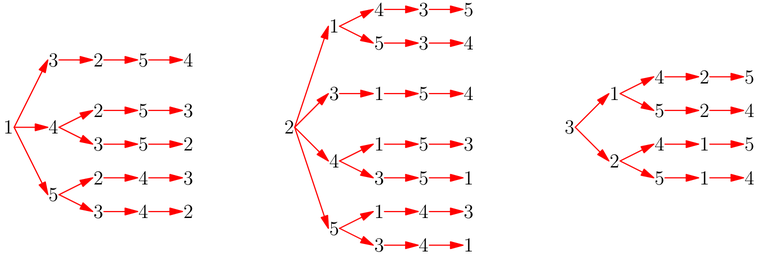
By symmetry with respect to $3,$ note that $(x_1,x_2,x_3,x_4,x_5)$ is a valid sequence if and only if $(6-x_1,6-x_2,6-x_3,6-x_4,6-x_5)$ is a valid sequence. We enumerate the valid sequences that start with $1,2,31,$ or $32,$ as shown below:
There are $16$ valid sequences that start with $1,2,31,$ or $32.$ By symmetry, there are $16$ valid sequences that start with $5,4,35,$ or $34.$ So, the answer is $16+16=\boxed{\textbf{(D)} ~32}.$
由于相对于 $3$ 的对称性,注意到 $(x_1,x_2,x_3,x_4,x_5)$ 是有效序列当且仅当 $(6-x_1,6-x_2,6-x_3,6-x_4,6-x_5)$ 是有效序列。我们枚举以 $1$、$2$、$31$ 或 $32$ 开头的有效序列,如下所示:
有 $16$ 个以 $1$、$2$、$31$ 或 $32$ 开头的有效序列。由对称性,有 $16$ 个以 $5$、$4$、$35$ 或 $34$ 开头的有效序列。因此答案是 $16+16=\boxed{\textbf{(D)} ~32}$。
Topics
Related Questions
Practice full AMC exams on amcdrill.
Try full-length practice and diagnostics at www.amcdrill.com.