AMC12 2011 A
AMC12 2011 A · Q25
AMC12 2011 A · Q25. It mainly tests Angle chasing, Triangles (properties).
Triangle $ABC$ has $\angle BAC = 60^{\circ}$, $\angle CBA \leq 90^{\circ}$, $BC=1$, and $AC \geq AB$. Let $H$, $I$, and $O$ be the orthocenter, incenter, and circumcenter of $\triangle ABC$, respectively. Assume that the area of pentagon $BCOIH$ is the maximum possible. What is $\angle CBA$?
三角形 $ABC$ 满足 $\angle BAC = 60^{\circ}$,$\angle CBA \leq 90^{\circ}$,$BC=1$,且 $AC \geq AB$。设 $H$、$I$、$O$ 分别为 $\triangle ABC$ 的垂心、内心和外心。若五边形 $BCOIH$ 的面积取到最大可能值,求 $\angle CBA$。
(A)
60^\circ
60^\circ
(B)
72^\circ
72^\circ
(C)
75^\circ
75^\circ
(D)
80^\circ
80^\circ
(E)
90^\circ
90^\circ
Answer
Correct choice: (D)
正确答案:(D)
Solution
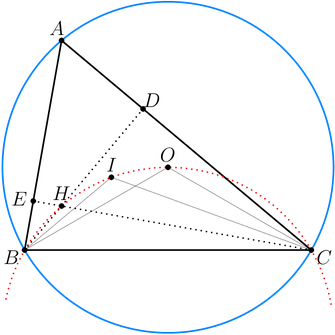
By the Inscribed Angle Theorem, \[\angle BOC = 2\angle BAC = 120^\circ .\]Let $D$ and $E$ be the feet of the altitudes of $\triangle ABC$ from $B$ and $C$, respectively. In $\triangle ACE$ we get $\angle ACE = 30^\circ$, and as exterior angle \[\angle BHC = 90^\circ + \angle ACE = 120^\circ .\]Because the lines $BI$ and $CI$ are bisectors of $\angle CBA$ and $\angle ACB$, respectively, it follows that\[\angle BIC = 90^\circ + \tfrac 12\angle A = 120^\circ .\]Thus the points $B, C, O, I$, and $H$ are all on a circle.
Further, since
\[\angle OCI = \angle OCB - \angle ICB = 30^\circ - \tfrac 12\angle C\]
\[\angle ICH = \angle ACE - \angle ACI = 30^\circ - \tfrac 12\angle C\]
we have $OI=IH$.
Because $[BCOIH]=[BCO]+[BOIH]$, it is sufficient to maximize the area of quadrilateral $BOIH$. If $P_1$, $P_2$ are two points in an arc of circle $BO$ with $BP_1<BP_2$, then the maximum area of $BOP_1P_2$ occurs when $BP_1=P_1P_2=P_2O$. Indeed, if $BP_1\neq P_1P_2$, then replacing $P_1$ by the point $P_1’$ located halfway in the arc of the circle $BP_2$ yields a triangle $BP_1’P_2$ with larger area than $\triangle BP_1P_2$, and the area of $\triangle BOP_2$ remains the same. Similarly, if $P_1P_2\neq P_2O$.
Therefore the maximum is achieved when $OI=IH=HB$, that is, when \[\angle OCI = \angle ICH = \angle HCB = \tfrac 13 \angle OCB = 10^\circ.\]Thus $\angle ACB = 40^\circ$ and $\angle CBA = 80^\circ$.
由圆周角定理,\[\angle BOC = 2\angle BAC = 120^\circ .\]设 $D$、$E$ 分别为从 $B$、$C$ 作高的垂足。在 $\triangle ACE$ 中有 $\angle ACE = 30^\circ$,并且作为外角
\[\angle BHC = 90^\circ + \angle ACE = 120^\circ .\]由于 $BI$、$CI$ 分别是 $\angle CBA$ 与 $\angle ACB$ 的角平分线,故
\[\angle BIC = 90^\circ + \tfrac 12\angle A = 120^\circ .\]因此点 $B, C, O, I$, 和 $H$ 都在同一圆上。
进一步,由于
\[\angle OCI = \angle OCB - \angle ICB = 30^\circ - \tfrac 12\angle C\]
\[\angle ICH = \angle ACE - \angle ACI = 30^\circ - \tfrac 12\angle C\]
可得 $OI=IH$。
因为 $[BCOIH]=[BCO]+[BOIH]$,只需最大化四边形 $BOIH$ 的面积。若 $P_1$, $P_2$ 是圆弧 $BO$ 上两点且 $BP_1<BP_2$,则 $BOP_1P_2$ 的最大面积在 $BP_1=P_1P_2=P_2O$ 时取得。确实,若 $BP_1\neq P_1P_2$,则将 $P_1$ 替换为位于圆弧 $BP_2$ 中点的点 $P_1’$,可使 $\triangle BP_1’P_2$ 的面积大于 $\triangle BP_1P_2$,而 $\triangle BOP_2$ 的面积保持不变。若 $P_1P_2\neq P_2O$ 亦同理。
因此最大值在 $OI=IH=HB$ 时取得,即当
\[\angle OCI = \angle ICH = \angle HCB = \tfrac 13 \angle OCB = 10^\circ.\]
于是 $\angle ACB = 40^\circ$,$\angle CBA = 80^\circ$。
Topics
Related Questions
Practice full AMC exams on amcdrill.
Try full-length practice and diagnostics at www.amcdrill.com.