AMC10 2006 B
AMC10 2006 B · Q5
AMC10 2006 B · Q5. It mainly tests Geometry misc.
A $2 \times 3$ rectangle and a $3 \times 4$ rectangle are contained within a square without overlapping at any interior point, and the sides of the square are parallel to the sides of the two given rectangles. What is the smallest possible area of the square?
一个 $2 \times 3$ 矩形和一个 $3 \times 4$ 矩形不重叠内部点地包含在一个正方形内,且正方形的边与两个矩形的边平行。正方形的最小可能面积是多少?
(A)
16
16
(B)
25
25
(C)
36
36
(D)
49
49
(E)
64
64
Answer
Correct choice: (B)
正确答案:(B)
Solution
The side length of the square is at least equal to the sum of the smaller dimensions of the rectangles, which is $2 + 3 = 5$.
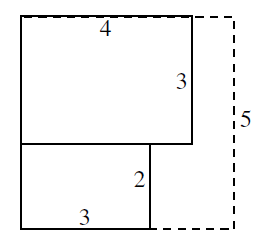
If the rectangles are placed as shown, it is in fact possible to contain them within a square of side length 5. Thus the smallest possible area is $5^2 = 25$.
正方形的边长至少等于两个矩形较小边之和,即 $2 + 3 = 5$。
如图所示放置矩形,确实可以放入边长为5的正方形内。因此最小面积为 $5^2 = 25$。
Topics
Related Questions
Practice full AMC exams on amcdrill.
Try full-length practice and diagnostics at www.amcdrill.com.