AMC12 2005 A
AMC12 2005 A · Q25
AMC12 2005 A · Q25. It mainly tests Combinatorial geometry (counting), Triangles (properties).
Let $S$ be the set of all points with coordinates $(x,y,z)$, where $x$, $y$, and $z$ are each chosen from the set $\{0,1,2\}$. How many equilateral triangles all have their vertices in $S$?
设 $S$ 是所有点 $(x,y,z)$ 的集合,其中 $x$, $y$, $z$ 都从集合 $\{0,1,2\}$ 中选取。有多少个等边三角形的三个顶点都在 $S$ 中?
(A)
72
72
(B)
76
76
(C)
80
80
(D)
84
84
(E)
88
88
Answer
Correct choice: (C)
正确答案:(C)
Solution
For this solution, we will just find as many equilateral triangles as possible, until it becomes intuitive that there are no more size of triangles left.
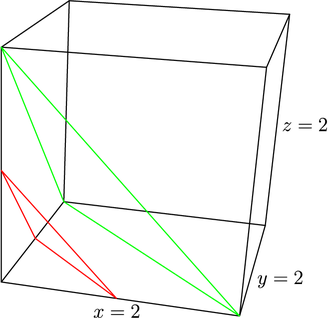
First, we observe that we can form an equilateral triangle with vertices in $S$ by taking any point in $S$ and connecting it to the $2$ adjacent points. This triangle will have a side length of $\sqrt{2}$; a quick further examination of this cube will show us that this is the only possible side length (the red triangle in the diagram below). Each of these triangles is determined by one vertex of the cube, so in one cube we have $8$ equilateral triangles. We have $8$ unit cubes, as well as the entire $2 \times 2 \times 2$ cube (giving the green triangle in the diagram), for a total of $8+1 = 9$ cubes, and thus $9 \cdot 8 = 72$ equilateral triangles.
(Note that connecting the centers of the faces will actually give an octahedron, not a cube, because it only has $6$ vertices.)
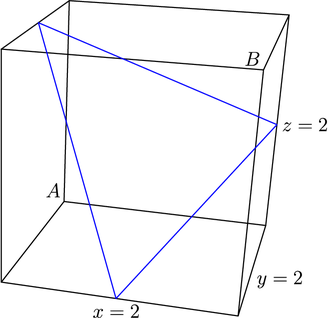
Now we look for any further equilateral triangles. Connecting the midpoints of $3$ non-adjacent, non-parallel edges indeed gives us more equilateral triangles (e.g. the blue triangle in the diagram below). Notice that picking these $3$ edges leaves $2$ vertices alone (labelled A and B in the diagram), and that picking any $2$ opposite vertices determines $2$ equilateral triangles. Hence there are $\frac{8 \cdot 2}{2} = 8$ of these equilateral triangles, so adding these to the triangles already found above gives a total of $72+8 = \boxed{\textbf{(C) }80}$.
在这个解法中,我们将尽可能找出所有等边三角形,直到可以直观地看出不再有其他大小的三角形为止。
首先观察到:取 $S$ 中任意一点,并将其与相邻的 $2$ 个点连接,就能形成一个顶点在 $S$ 中的等边三角形。该三角形的边长为 $\sqrt{2}$;进一步快速检查这个立方体可知,这是唯一可能的边长(下图中的红色三角形)。每个这样的三角形由立方体的一个顶点确定,因此在一个立方体中有 $8$ 个等边三角形。我们有 $8$ 个单位立方体,以及整个 $2 \times 2 \times 2$ 立方体(对应下图中的绿色三角形),共 $8+1 = 9$ 个立方体,因此共有 $9 \cdot 8 = 72$ 个等边三角形。
(注意:连接各个面的中心实际上得到的是一个八面体而不是立方体,因为它只有 $6$ 个顶点。)
接着寻找更多的等边三角形。连接 $3$ 条互不相邻且不平行的棱的中点,确实还能得到更多等边三角形(例如下图中的蓝色三角形)。注意选取这 $3$ 条棱会留下 $2$ 个孤立的顶点(图中标为 A 和 B),并且任取一对对顶点会确定 $2$ 个等边三角形。因此这类等边三角形共有 $\frac{8 \cdot 2}{2} = 8$ 个。将其加到前面找到的三角形中,总数为 $72+8 = \boxed{\textbf{(C) }80}$。
Topics
Related Questions
Practice full AMC exams on amcdrill.
Try full-length practice and diagnostics at www.amcdrill.com.