AMC10 2022 A
AMC10 2022 A · Q25
AMC10 2022 A · Q25. It mainly tests Algebra misc, Counting in geometry (lattice points).
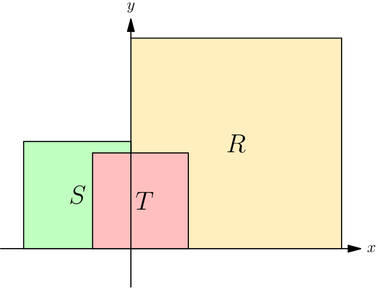
Let $R$, $S$, and $T$ be squares that have vertices at lattice points (i.e., points whose coordinates are both integers) in the coordinate plane, together with their interiors. The bottom edge of each square is on the $x$-axis. The left edge of $R$ and the right edge of $S$ are on the $y$-axis, and $R$ contains $\frac{9}{4}$ as many lattice points as does $S$. The top two vertices of $T$ are in $R \cup S$, and $T$ contains $\frac{1}{4}$ of the lattice points contained in $R \cup S.$ See the figure (not drawn to scale).
The fraction of lattice points in $S$ that are in $S \cap T$ is $27$ times the fraction of lattice points in $R$ that are in $R \cap T$. What is the minimum possible value of the edge length of $R$ plus the edge length of $S$ plus the edge length of $T$?
设$R$、$S$和$T$是坐标平面上的正方形,其顶点位于格点(即坐标均为整数的点)上,连同其内部。每个正方形的底边都在$x$轴上。$R$的左边和$S$的右边在$y$轴上,且$R$包含的格点数是$S$的$\frac{9}{4}$倍。$T$的顶端两个顶点在$R \cup S$中,且$T$包含的格点数是$R \cup S$中格点数的$\frac{1}{4}$。参见图(未按比例绘制)。
$S$中位于$S \cap T$的格点占$S$中格点的比例是$R$中位于$R \cap T$的格点占$R$中格点的比例的$27$倍。$R$的边长加上$S$的边长加上$T$的边长的最小可能值是多少?
(A)
336
336
(B)
337
337
(C)
338
338
(D)
339
339
(E)
340
340
Answer
Correct choice: (B)
正确答案:(B)
Solution
Let $r$ be the number of lattice points on the side length of square $R$, $s$ be the number of lattice points on the side length of square $S$, and $t$ be the number of lattice points on the side length of square $T$. Note that the actual lengths of the side lengths are the number of lattice points minus $1$, so we can work in terms of $r, s, t$ and subtract $3$ to get the actual answer at the end. Furthermore, note that the number of lattice points inside a rectangular region is equal to the number of lattice points in its width times the number of lattice points along its length.
Using this fact, the number of lattice points in $R$ is $r^2$, the number of lattice points in $S$ is $s^2$, and the number of lattice points in $T$ is $t^2$.
Now, by the first condition, we have \[r^2=\frac{9}{4}\cdot s^2 \implies r = \frac{3}{2}s \quad \quad \quad \quad \quad (1)\]
The second condition, the number of lattice points contained in $T$ is a fourth of the number of lattice points contained in $R \cup S$. The number of lattice points in $R \cup S$ is equal to the sum of the lattice points in their individually bounded regions, but the lattice points along the y-axis for the full length of square $S$ is shared by both of them, so we need to subtract that out.
In all, this condition yields us $t^2 = \frac{1}{4}\cdot(r^2 + s^2 - s )\implies t^2 = \frac{1}{4}\cdot\left(\frac{9}{4}\cdot s^2 + s^2 - s \right)$
$\implies t^2=\frac{1}{4}\cdot\frac{13s^2-4s}{4} \implies 16t^2= s(13s-4)$
Note from $(1)$ that $s$ is a multiple of $2$. We can write $s=2j$ and substitute:
$16t^2=2j(26j-4) \implies 4t^2=j(13j-2)$.
Note that $j$ must be divisible by two for the product to be divisible by 4. Thus we make another substitution, $j=2k$:
\[4t^2=2k(26k-2) \implies t^2 = k(13k-1) \quad \quad \quad \quad \quad (2)\]
Finally we look at the last condition; that the fraction of the lattice points inside $S$ that are inside $S \cap T$ is $27$ times the fraction of lattice points inside $r$ that are inside $R \cap T$.
Let $x$ be the number of lattice points along the bottom of the rectangle formed by $S \cap T$, and $y$ be the number of lattice points along the bottom of the the rectangle formed by $R \cap T$.
Therefore, the number of lattice points in $S\cap T$ is $xt$ and the number of lattice points in $R \cap T$ is $yt$.
Thus by this condition, $\frac{xt}{s^2} = 27 \cdot \frac{yt}{r^2} \implies \frac{x}{s^2} = 27 \cdot \frac{y}{\frac{9}{4}\cdot s^2} \implies x= 12y$
Finally, notice that $t=x+y-1=12y+y-1$ (subtracting overlap), and so we have \[t=13y-1 \quad \quad \quad \quad \quad (3)\]
Now notice that by $(3)$ , $t\equiv -1 \pmod{13}\implies t^2 \equiv 1 \pmod{13}$.
However, by $(2)$ , $t^2 \equiv k \cdot -1 \pmod{13}$. Therefore, $-k \equiv 1 \pmod{13} \implies k \equiv -1 \pmod{13}$
Also, by $(2)$ , we know $k$ must be a perfect square since $k$ is relatively prime to $13k-1$ (Euclids algorithm) and the two must multiply to a perfect square. Hence we know two conditions on $k$, and we can now guess and check to find the smallest that satisfies both.
We check $k=12$ first since its one less than a multiple of $13$, but this does not work. Next, we have $k=25$ which works because $25$ is a perfect square. Thus we have found the smallest $k$, and therefore the smallest $r, s, t$.
Now we just work backwards: $j= 2k = 50$ and $s=2j=100$. Then $r=\frac{3}{2}\cdot 100 = 150$. Finally, from $(2)$ , $t^2=25(13\cdot25-1) \implies t^2 = 25 \cdot 324 \implies t=5\cdot 18=90$.
Finally, the sum of each square’s side lengths is $r+s+t-3=340-3=337=\boxed{\textbf{(B) }337}$.
设正方形$R$的边上格点数为$r$,$S$的为$s$,$T$的为$t$。注意实际边长是格点数减$1$,所以我们可以先用$r, s, t$计算,最后减$3$得到实际答案。此外,矩形区域内的格点数等于其宽度格点数乘以长度格点数。
由此,$R$内的格点数为$r^2$,$S$为$s^2$,$T$为$t^2$。
根据第一个条件,\[r^2=\frac{9}{4}\cdot s^2 \implies r = \frac{3}{2}s \quad \quad \quad \quad \quad (1)\]
第二个条件,$T$包含的格点数是$R \cup S$包含格点数的四分之一。$R \cup S$的格点数等于各自区域格点数之和,但$y$轴上$S$全长的格点被两者共享,需要减去。
总计,此条件给出 $t^2 = \frac{1}{4}\cdot(r^2 + s^2 - s )\implies t^2 = \frac{1}{4}\cdot\left(\frac{9}{4}\cdot s^2 + s^2 - s \right)$
$\implies t^2=\frac{1}{4}\cdot\frac{13s^2-4s}{4} \implies 16t^2= s(13s-4)$
由$(1)$知,$s$是$2$的倍数。设$s=2j$代入:
$16t^2=2j(26j-4) \implies 4t^2=j(13j-2)$。
注意为了乘积能被$4$整除,$j$必须被$2$整除。于是再设$j=2k$:
\[4t^2=2k(26k-2) \implies t^2 = k(13k-1) \quad \quad \quad \quad \quad (2)\]
最后看最后一个条件:$S$内位于$S \cap T$的格点占$S$格点的比例是$R$内位于$R \cap T$的格点占$R$格点的比例的$27$倍。
设$x$为$S \cap T$形成的矩形底边格点数,$y$为$R \cap T$形成的矩形底边格点数。
因此,$S\cap T$的格点数为$xt$,$R \cap T$为$yt$。
由此条件,$\frac{xt}{s^2} = 27 \cdot \frac{yt}{r^2} \implies \frac{x}{s^2} = 27 \cdot \frac{y}{\frac{9}{4}\cdot s^2} \implies x= 12y$
最后,注意$t=x+y-1=12y+y-1$(减去重叠),于是 \[t=13y-1 \quad \quad \quad \quad \quad (3)\]
现在由$(3)$,$t\equiv -1 \pmod{13}\implies t^2 \equiv 1 \pmod{13}$。
然而,由$(2)$,$t^2 \equiv k \cdot -1 \pmod{13}$。因此,$-k \equiv 1 \pmod{13} \implies k \equiv -1 \pmod{13}$
此外,由$(2)$,$k$必须是完全平方数,因为$k$与$13k-1$互素(欧几里得算法),二者乘积是完全平方数。因此我们知道$k$的两个条件,现在可以猜测并检查找到满足两者且最小的$k$。
我们先检查$k=12$(比13的倍数少1),但无效。下一个是$k=25$,它有效,因为$25$是完全平方数。这样我们找到了最小的$k$,从而最小的$r, s, t$。
现在回推:$j= 2k = 50$,$s=2j=100$。则$r=\frac{3}{2}\cdot 100 = 150$。最后,由$(2)$,$t^2=25(13\cdot25-1) \implies t^2 = 25 \cdot 324 \implies t=5\cdot 18=90$。
最后,各正方形边长之和为$r+s+t-3=340-3=337=\boxed{\textbf{(B) }337}$。
Topics
Related Questions
Practice full AMC exams on amcdrill.
Try full-length practice and diagnostics at www.amcdrill.com.