AMC8 2006
AMC8 2006 · Q22
AMC8 2006 · Q22. It mainly tests Linear equations, Patterns & sequences (misc).
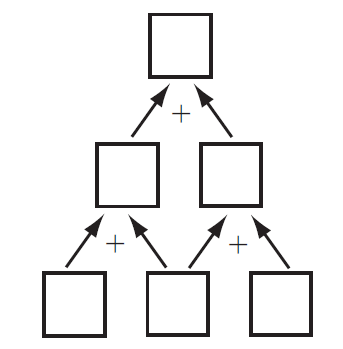
Three different one-digit positive integers are placed in the bottom row of cells. Numbers in adjacent cells are added and the sum is placed in the cell above them. In the second row, continue the same process to obtain a number in the top cell. What is the difference between the largest and smallest numbers possible in the top cell?
在底部一排单元格中放置三个不同的个位正整数。相邻单元格中的数字相加,将和放在它们上面的单元格中。在第二行,继续同样的过程,得到顶部的单元格中的数字。顶部单元格中可能的最大数和最小数的差是多少?
(A)
16
16
(B)
24
24
(C)
25
25
(D)
26
26
(E)
35
35
Answer
Correct choice: (D)
正确答案:(D)
Solution
(D) If the lower cells contain $A$, $B$ and $C$, then the second row will contain $A+B$ and $B+C$, and the top cell will contain $A+2B+C$. To obtain the smallest sum, place $1$ in the center cell and $2$ and $3$ in the outer ones. The top number will be $7$. For the largest sum, place $9$ in the center cell and $7$ and $8$ in the outer ones. This top number will be $33$. The difference is $33-7=26$.
(D)如果底部的三个格子分别为 $A$、$B$ 和 $C$,那么第二行将为 $A+B$ 和 $B+C$,顶部格子将为 $A+2B+C$。要得到最小和,把 $1$ 放在中间格,把 $2$ 和 $3$ 放在两侧格。顶部数字将是 $7$。要得到最大和,把 $9$ 放在中间格,把 $7$ 和 $8$ 放在两侧格。顶部数字将是 $33$。差为 $33-7=26$。
Topics
Related Questions
Practice full AMC exams on amcdrill.
Try full-length practice and diagnostics at www.amcdrill.com.