AMC8 2003
AMC8 2003 · Q22
AMC8 2003 · Q22. It mainly tests Area & perimeter.
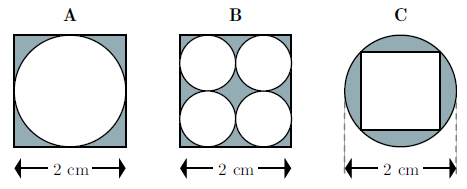
The following figures are composed of squares and circles. Which figure has a shaded region with largest area?
以下图形由正方形和圆组成。哪个图形的阴影区域面积最大?
(A)
A only
仅A
(B)
B only
仅B
(C)
C only
仅C
(D)
both A and B
A和B
(E)
all are equal
全等
Answer
Correct choice: (C)
正确答案:(C)
Solution
(C) For Figure A, the area of the square is $2^2 = 4\ \text{cm}^2$. The diameter of the circle is $2\ \text{cm}$, so the radius is $1\ \text{cm}$ and the area of the circle is $\pi\ \text{cm}^2$. So the area of the shaded region is $4 - \pi\ \text{cm}^2$.
For Figure B, the area of the square is also $4\ \text{cm}^2$. The radius of each of the four circles is $\frac{1}{2}\ \text{cm}$, and the area of each circle is $\left(\frac{1}{2}\right)^2\pi=\frac{1}{4}\pi\ \text{cm}^2$. The combined area of all four circles is $\pi\ \text{cm}^2$. So the shaded regions in A and B have the same area.
For Figure C, the radius of the circle is $1\ \text{cm}$, so the area of the circle is $\pi\ \text{cm}^2$. Because the diagonal of the inscribed square is the hypotenuse of a right triangle with legs of equal lengths, use the Pythagorean Theorem to determine the length $s$ of one side of the inscribed square. That is, $s^2+s^2=2^2=4$. So $s^2=2\ \text{cm}^2$, the area of the square. Therefore, the area of the shaded region is $\pi-2\ \text{cm}^2$. Because $\pi-2>1$ and $4-\pi<1$, the shaded region in Figure C has the largest area.
Note that the second figure consists of four small copies of the first figure. Because each of the four small squares has sides half the length of the sides of the big square, the area of each of the four small figures is $\frac{1}{4}$ the area of Figure A. Because there are four such small figures in Figure B, the shaded regions in A and B have the same area.
(C)对于图 A,正方形的面积是 $2^2=4\ \text{cm}^2$。圆的直径是 $2\ \text{cm}$,所以半径是 $1\ \text{cm}$,圆的面积是 $\pi\ \text{cm}^2$。因此阴影部分的面积是 $4-\pi\ \text{cm}^2$。
对于图 B,正方形的面积也为 $4\ \text{cm}^2$。四个圆中每个圆的半径是 $\frac{1}{2}\ \text{cm}$,每个圆的面积是 $\left(\frac{1}{2}\right)^2\pi=\frac{1}{4}\pi\ \text{cm}^2$。四个圆的总面积是 $\pi\ \text{cm}^2$。因此,A 与 B 中的阴影部分面积相同。
对于图 C,圆的半径是 $1\ \text{cm}$,所以圆的面积是 $\pi\ \text{cm}^2$。由于内接正方形的对角线是一个两直角边相等的直角三角形的斜边,使用勾股定理确定内接正方形一条边的长度 $s$。即 $s^2+s^2=2^2=4$。所以 $s^2=2\ \text{cm}^2$,这就是该正方形的面积。因此阴影部分的面积为 $\pi-2\ \text{cm}^2$。因为 $\pi-2>1$ 且 $4-\pi<1$,所以图 C 的阴影部分面积最大。
注意第二个图形由第一个图形的四个小复制组成。由于四个小正方形的边长都是大正方形边长的一半,因此每个小图形的面积是图 A 面积的 $\frac{1}{4}$。又因为图 B 中有四个这样的“小图形”,所以 A 与 B 的阴影部分面积相同。
Topics
Related Questions
Practice full AMC exams on amcdrill.
Try full-length practice and diagnostics at www.amcdrill.com.