AMC12 2023 B
AMC12 2023 B · Q21
AMC12 2023 B · Q21. It mainly tests 3D geometry (volume), Geometry misc.
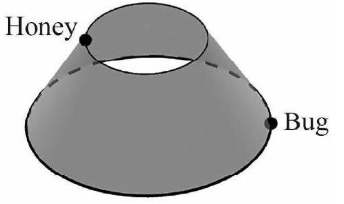
A lampshade is made in the form of the lateral surface of the frustum of a right circular cone. The height of the frustum is $3\sqrt3$ inches, its top diameter is $6$ inches, and its bottom diameter is $12$ inches. A bug is at the bottom of the lampshade and there is a glob of honey on the top edge of the lampshade at the spot farthest from the bug. The bug wants to crawl to the honey, but it must stay on the surface of the lampshade. What is the length in inches of its shortest path to the honey?
一个灯罩由右圆锥台的侧面构成。圆锥台的高度为 $3\sqrt3$ 英寸,上底直径为 $6$ 英寸,下底直径为 $12$ 英寸。一只虫子在灯罩底部,有一团蜂蜜在灯罩上边缘的最远离虫子的位置。虫子想爬到蜂蜜处,但必须留在灯罩表面上。它的最短路径长度是多少英寸?
(A)
6 + 3\pi
6 + 3\pi
(B)
6 + 6\pi
6 + 6\pi
(C)
6\sqrt3
6\sqrt3
(D)
6\sqrt5
6\sqrt5
(E)
6\sqrt3 + \pi
6\sqrt3 + \pi
Answer
Correct choice: (E)
正确答案:(E)
Solution
We augment the frustum to a circular cone.
Denote by $O$ the apex of the cone.
Denote by $A$ the bug and $B$ the honey.
By using the numbers given in this problem, the height of the cone is $6 \sqrt{3}$.
Thus, $OA = 12$ and $OB = 6$.
We unfold the lateral face. So we get a circular sector.
The radius is 12 and the length of the arc is $12\pi$.
Thus, the central angle of this circular sector is $180^\circ$.
Because $A$ and $B$ are opposite in the original frustum, in the unfolded circular cone, $\angle AOB = \frac{180^\circ}{2} = 90^\circ$.
Notice that a feasible path between $A$ and $B$ can only fall into the region with the range of radii between $OB = 6$ and $OA = 12$.
Therefore, we cannot directly connect $A$ and $B$ and must make a detour.
Denote by $AC$ a tangent to the circular sector with radius 6 that meets it at point $C$.
Therefore, the shortest path between $A$ and $B$ consists of a segment $AC$ and an arc from $C$ to $B$.
Because $OA = 12$, $OC = 6$ and $\angle OCA = 90^\circ$, we have $AC = \sqrt{OA^2 - OC^2} = 6 \sqrt{3}$ and $\angle AOC = 60^\circ$.
This implies $\angle COB = \angle AOB - \angle AOC = 30^\circ$.
Therefore, the length of the arc between $C$ and $B$ is $OB \cdot \pi \cdot \frac{\angle COB}{180^\circ} = \pi$.
Therefore, the shortest distance between $A$ and $B$ is $\boxed{\textbf{(E) } 6 \sqrt{3} + \pi}$.
我们将圆锥台扩展为一个圆锥。
用 $O$ 表示圆锥的顶点。
用 $A$ 表示虫子,$B$ 表示蜂蜜。
根据题目给出的数字,圆锥的高度为 $6 \sqrt{3}$。
因此,$OA = 12$,$OB = 6$。
展开侧面,我们得到一个圆扇形。
半径为 $12$,弧长为 $12\pi$。
因此,该圆扇形的中心角为 $180^\circ$。
因为 $A$ 和 $B$ 在原来的圆锥台上相对,在展开的圆锥中,$\angle AOB = \frac{180^\circ}{2} = 90^\circ$。
注意,从 $A$ 到 $B$ 的可行路径只能落在半径从 $OB = 6$ 到 $OA = 12$ 的区域内。
因此,不能直接连接 $A$ 和 $B$,必须绕道。
设 $AC$ 是到半径为 $6$ 的圆扇形的切线,在点 $C$ 处相交。
因此,从 $A$ 到 $B$ 的最短路径由线段 $AC$ 和从 $C$ 到 $B$ 的弧组成。
因为 $OA = 12$,$OC = 6$ 且 $\angle OCA = 90^\circ$,我们有 $AC = \sqrt{OA^2 - OC^2} = 6 \sqrt{3}$,且 $\angle AOC = 60^\circ$。
这意味着 $\angle COB = \angle AOB - \angle AOC = 30^\circ$。
因此,从 $C$ 到 $B$ 的弧长为 $OB \cdot \pi \cdot \frac{\angle COB}{180^\circ} = \pi$。
因此,$A$ 到 $B$ 的最短距离为 $\boxed{\textbf{(E) } 6 \sqrt{3} + \pi}$。
Topics
Related Questions
Practice full AMC exams on amcdrill.
Try full-length practice and diagnostics at www.amcdrill.com.