AMC12 2021 A
AMC12 2021 A · Q25
AMC12 2021 A · Q25. It mainly tests Counting divisors, Number theory misc.
Let $d(n)$ denote the number of positive integers that divide $n$, including $1$ and $n$. For example, $d(1)=1,d(2)=2,$ and $d(12)=6$. (This function is known as the divisor function.) Let\[f(n)=\frac{d(n)}{\sqrt [3]n}.\]There is a unique positive integer $N$ such that $f(N)>f(n)$ for all positive integers $n
e N$. What is the sum of the digits of $N?$
令 $d(n)$ 表示正整数 $n$ 的正整数除数个数,包括 $1$ 和 $n$。例如,$d(1)=1$,$d(2)=2$,$d(12)=6$。(此函数称为除数函数。)令
\[f(n)=\frac{d(n)}{\sqrt [3]n}.\]
存在唯一的正整数 $N$,使得 $f(N)>f(n)$ 对于所有正整数 $n
e N$。求 $N$ 的各位数字之和?
(A)
5
5
(B)
6
6
(C)
7
7
(D)
8
8
(E)
9
9
Answer
Correct choice: (E)
正确答案:(E)
Solution
We consider the prime factorization of $n:$ \[n=\prod_{i=1}^{k}p_i^{e_i}.\] By the Multiplication Principle, we have \[d(n)=\prod_{i=1}^{k}(e_i+1).\] Now, we rewrite $f(n)$ as \[f(n)=\frac{d(n)}{\sqrt [3]n}=\frac{\prod_{i=1}^{k}(e_i+1)}{\prod_{i=1}^{k}p_i^{e_i/3}}=\prod_{i=1}^{k}\frac{e_i+1}{p_i^{{e_i}/3}}.\] As $f(n)>0$ for all positive integers $n,$ note that $f(a)>f(b)$ if and only if $f(a)^3>f(b)^3$ for all positive integers $a$ and $b.$ So, $f(n)$ is maximized if and only if \[f(n)^3=\prod_{i=1}^{k}\frac{(e_i+1)^3}{p_i^{{e_i}}}\] is maximized.
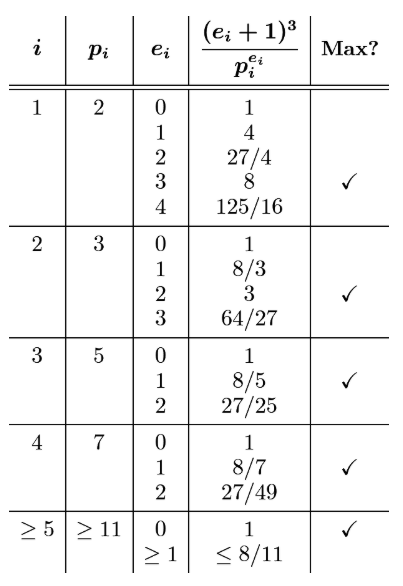
For each independent factor $\frac{(e_i+1)^3}{p_i^{e_i}}$ with a fixed prime $p_i,$ where $1\leq i\leq k,$ the denominator grows faster than the numerator, as exponential functions always grow faster than polynomial functions. Therefore, for each prime $p_i$ with $\left(p_1,p_2,p_3,p_4,\ldots\right)=\left(2,3,5,7,\ldots\right),$ we look for the nonnegative integer $e_i$ such that $\frac{(e_i+1)^3}{p_i^{e_i}}$ is a relative maximum:
Finally, the positive integer we seek is $N=2^3\cdot3^2\cdot5^1\cdot7^1=2520.$ The sum of its digits is $2+5+2+0=\boxed{\textbf{(E) }9}.$
Alternatively, once we notice that $3^2$ is a factor of $N,$ we can conclude that the sum of the digits of $N$ must be a multiple of $9.$ Only choice $\textbf{(E)}$ is possible.
我们考虑 $n$ 的质因数分解:
\[n=\prod_{i=1}^{k}p_i^{e_i}.\]
由乘法原理,我们有
\[d(n)=\prod_{i=1}^{k}(e_i+1).\]
现在,我们改写 $f(n)$ 为
\[f(n)=\frac{d(n)}{\sqrt [3]n}=\frac{\prod_{i=1}^{k}(e_i+1)}{\prod_{i=1}^{k}p_i^{e_i/3}}=\prod_{i=1}^{k}\frac{e_i+1}{p_i^{{e_i}/3}}.\]
由于 $f(n)>0$ 对于所有正整数 $n$,注意到 $f(a)>f(b)$ 当且仅当 $f(a)^3>f(b)^3$ 对于所有正整数 $a$ 和 $b$。因此,$f(n)$ 最大当且仅当
\[f(n)^3=\prod_{i=1}^{k}\frac{(e_i+1)^3}{p_i^{{e_i}}}\]最大化。
对于每个独立的因子 $\frac{(e_i+1)^3}{p_i^{e_i}}$,对于固定的质数 $p_i$,其中 $1\leq i\leq k$,分母增长比分子快,因为指数函数总是比多项式函数增长更快。因此,对于每个质数 $p_i$,其中 $\left(p_1,p_2,p_3,p_4,\ldots\right)=\left(2,3,5,7,\ldots\right)$,我们寻找非负整数 $e_i$ 使得 $\frac{(e_i+1)^3}{p_i^{e_i}}$ 是相对最大:
最后,所求正整数是 $N=2^3\cdot3^2\cdot5^1\cdot7^1=2520$。其各位数字之和是 $2+5+2+0=\boxed{\textbf{(E) }9}$。
或者,一旦我们注意到 $3^2$ 是 $N$ 的因子,我们可以得出 $N$ 的各位数字之和必须是 $9$ 的倍数。只有选择 $\textbf{(E)}$ 可能。
Topics
Related Questions
Practice full AMC exams on amcdrill.
Try full-length practice and diagnostics at www.amcdrill.com.