AMC12 2019 B
AMC12 2019 B · Q25
AMC12 2019 B · Q25. It mainly tests Triangles (properties), Area & perimeter.
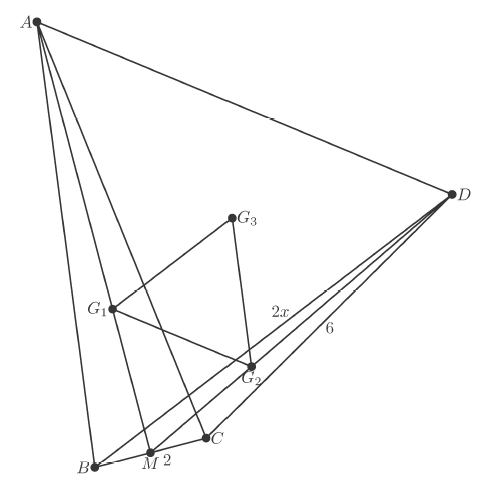
Let $ABCD$ be a convex quadrilateral with $BC = 2$ and $CD = 6$. Suppose that the centroids of $\triangle ABC$, $\triangle BCD$, and $\triangle ACD$ form the vertices of an equilateral triangle. What is the maximum possible area of $ABCD$?
设 $ABCD$ 为凸四边形,$BC = 2$,$CD = 6$。假设 $\triangle ABC$,$\triangle BCD$,$\triangle ACD$ 的质心构成一个等边三角形。$ABCD$ 的最大可能面积是多少?
(A)
27
27
(B)
$16\sqrt{3}$
$16\sqrt{3}$
(C)
$12 + 10\sqrt{3}$
$12 + 10\sqrt{3}$
(D)
$9 + 12\sqrt{3}$
$9 + 12\sqrt{3}$
(E)
30
30
Answer
Correct choice: (C)
正确答案:(C)
Solution
Answer (C): Let $G_1$, $G_2$, and $G_3$ be the centroids of $\triangle ABC$, $\triangle BCD$, and $\triangle ACD$, respectively. Then with points viewed as position vectors represented by ordered pairs,
\[
G_1=\frac13A+\frac13B+\frac13C,
\]
\[
G_2=\frac13B+\frac13C+\frac13D,
\]
\[
G_3=\frac13A+\frac13C+\frac13D.
\]
The directed edges of $\triangle G_1G_2G_3$ are $\overrightarrow{G_1G_2}=\frac13(D-A)$, $\overrightarrow{G_2G_3}=\frac13(A-B)$, and $\overrightarrow{G_3G_1}=\frac13(B-D)$. This triangle is equilateral if and only if $|D-A|=|A-B|=|B-D|$, which in turn is equivalent to the assertion that $\triangle ABD$ is equilateral. Let $\theta$ denote the measure of $\angle BCD$. Because $BC=2$ and $CD=6$, it follows that the area of $\triangle BCD$ is $\frac12\cdot BC\cdot CD\cdot\sin\theta=6\sin\theta$. By the Law of Cosines,
\[
BD^2=BC^2+CD^2-2\cdot BC\cdot CD\cdot\cos\theta=40-24\cos\theta.
\]
The area of the equilateral triangle $\triangle ABD$ is $\frac{\sqrt3}{4}BD^2=10\sqrt3-6\sqrt3\cos\theta$. Adding the areas of $\triangle ABD$ and $\triangle BCD$ gives the area of the quadrilateral $ABCD$:
\[
10\sqrt3-6\sqrt3\cos\theta+6\sin\theta
=10\sqrt3+12\left(-\frac{\sqrt3}{2}\cos\theta+\frac12\sin\theta\right)
=10\sqrt3+12\sin(\theta-60^\circ).
\]
This is maximized by taking $\theta=150^\circ$, in which case the area is $10\sqrt3+12$.
答案(C):设 $G_1$、$G_2$、$G_3$ 分别为 $\triangle ABC$、$\triangle BCD$、$\triangle ACD$ 的重心。将点看作由有序对表示的位置向量,则
\[
G_1=\frac13A+\frac13B+\frac13C,
\]
\[
G_2=\frac13B+\frac13C+\frac13D,
\]
\[
G_3=\frac13A+\frac13C+\frac13D.
\]
$\triangle G_1G_2G_3$ 的有向边为 $\overrightarrow{G_1G_2}=\frac13(D-A)$,$\overrightarrow{G_2G_3}=\frac13(A-B)$,以及 $\overrightarrow{G_3G_1}=\frac13(B-D)$。该三角形为等边三角形当且仅当 $|D-A|=|A-B|=|B-D|$,这又等价于 $\triangle ABD$ 为等边三角形。设 $\theta$ 为 $\angle BCD$ 的度数。由于 $BC=2$ 且 $CD=6$,$\triangle BCD$ 的面积为 $\frac12\cdot BC\cdot CD\cdot\sin\theta=6\sin\theta$。由余弦定理,
\[
BD^2=BC^2+CD^2-2\cdot BC\cdot CD\cdot\cos\theta=40-24\cos\theta.
\]
等边三角形 $\triangle ABD$ 的面积为 $\frac{\sqrt3}{4}BD^2=10\sqrt3-6\sqrt3\cos\theta$。将 $\triangle ABD$ 与 $\triangle BCD$ 的面积相加得到四边形 $ABCD$ 的面积:
\[
10\sqrt3-6\sqrt3\cos\theta+6\sin\theta
=10\sqrt3+12\left(-\frac{\sqrt3}{2}\cos\theta+\frac12\sin\theta\right)
=10\sqrt3+12\sin(\theta-60^\circ).
\]
当取 $\theta=150^\circ$ 时取到最大值,此时面积为 $10\sqrt3+12$。
Topics
Related Questions
Practice full AMC exams on amcdrill.
Try full-length practice and diagnostics at www.amcdrill.com.