AMC12 2018 B
AMC12 2018 B · Q23
AMC12 2018 B · Q23. It mainly tests Triangles (properties), Coordinate geometry.
Ajay is standing at point $A$ near Pontianak, Indonesia, $0^\circ$ latitude and $110^\circ$ E longitude. Billy is standing at point $B$ near Big Baldy Mountain, Idaho, USA, $45^\circ$ N latitude and $115^\circ$ W longitude. Assume that Earth is a perfect sphere with center $C$. What is the degree measure of $\angle ACB$?
Ajay 站在印度尼西亚 Pontianak 附近的点 $A$,纬度 $0^\circ$,经度 $110^\circ$ E。Billy 站在美国爱达荷州 Big Baldy Mountain 附近的点 $B$,纬度 $45^\circ$ N,经度 $115^\circ$ W。假设地球是以中心 $C$ 为球心的完美球体。求 $\angle ACB$ 的度量。
(A)
105
105
(B)
$112\frac{1}{2}$
$112\frac{1}{2}$
(C)
120
120
(D)
135
135
(E)
150
150
Answer
Correct choice: (C)
正确答案:(C)
Solution
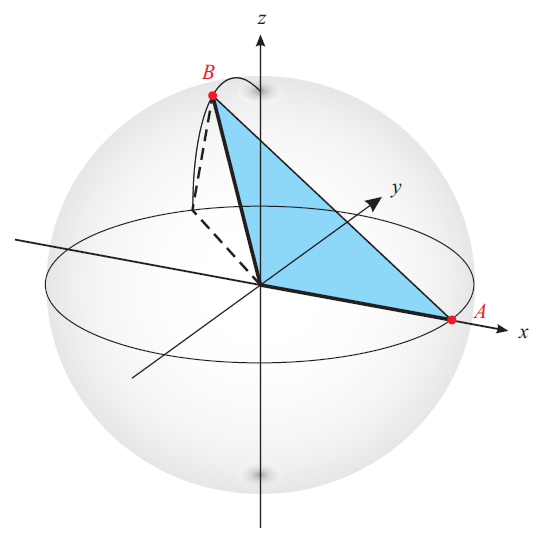
Answer (C): To travel from $A$ to $B$, one could circle $135^\circ$ east along the equator and then $45^\circ$ north. Construct an $x$-$y$-$z$ coordinate system with origin at Earth’s center $C$, the positive $x$-axis running through $A$, the positive $y$-axis running through the equator at $160^\circ$ west longitude, and the positive $z$-axis running through the North Pole. Set Earth’s radius to be $1$. The coordinates of $A$ are $(1,0,0)$. Let $b$ be the $y$-coordinate of $B$; note that $b>0$. Then the $x$-coordinate of $B$ will be $-b$, and the $z$-coordinate will be $\sqrt{2}b$. Because the distance from the center of Earth is $1$,
$$
\sqrt{(-b)^2+b^2+(\sqrt{2}b)^2}=1,
$$
so $b=\frac12$, and the coordinates are $\left(-\frac12,\frac12,\frac{\sqrt2}{2}\right)$. The distance $AB$ is therefore
$$
\sqrt{\left(\frac32\right)^2+\left(\frac12\right)^2+\left(\frac{\sqrt2}{2}\right)^2}=\sqrt3.
$$
Applying the Law of Cosines to $\triangle ACB$ gives
$$
3=1+1-2\cdot1\cdot1\cdot\cos\angle ACB,
$$
so $\cos\angle ACB=-\frac12$ and $\angle ACB=120^\circ$. An alternative to using the Law of Cosines to find $\cos\angle ACB$ is to compute the dot product of the unit vectors $(1,0,0)$ and $\left(-\frac12,\frac12,\frac{\sqrt2}{2}\right)$.
答案(C):从$A$到$B$,可以先沿赤道向东绕行$135^\circ$,再向北$45^\circ$。建立一个$x$-$y$-$z$坐标系,原点在地心$C$,正$x$轴经过$A$,正$y$轴经过西经$160^\circ$处的赤道,正$z$轴经过北极。设地球半径为$1$。点$A$的坐标为$(1,0,0)$。令$b$为$B$的$y$坐标;注意$b>0$。则$B$的$x$坐标为$-b$,$z$坐标为$\sqrt{2}b$。由于$B$到地心的距离为$1$,
$$
\sqrt{(-b)^2+b^2+(\sqrt{2}b)^2}=1,
$$
所以$b=\frac12$,从而$B$的坐标为$\left(-\frac12,\frac12,\frac{\sqrt2}{2}\right)$。因此距离$AB$为
$$
\sqrt{\left(\frac32\right)^2+\left(\frac12\right)^2+\left(\frac{\sqrt2}{2}\right)^2}=\sqrt3.
$$
对$\triangle ACB$应用余弦定理得
$$
3=1+1-2\cdot1\cdot1\cdot\cos\angle ACB,
$$
所以$\cos\angle ACB=-\frac12$,且$\angle ACB=120^\circ$。另一种不用余弦定理来求$\cos\angle ACB$的方法,是计算单位向量$(1,0,0)$与$\left(-\frac12,\frac12,\frac{\sqrt2}{2}\right)$的点积。
Topics
Related Questions
Practice full AMC exams on amcdrill.
Try full-length practice and diagnostics at www.amcdrill.com.