AMC12 2015 A
AMC12 2015 A · Q25
AMC12 2015 A · Q25. It mainly tests Sequences & recursion (algebra), Geometry misc.
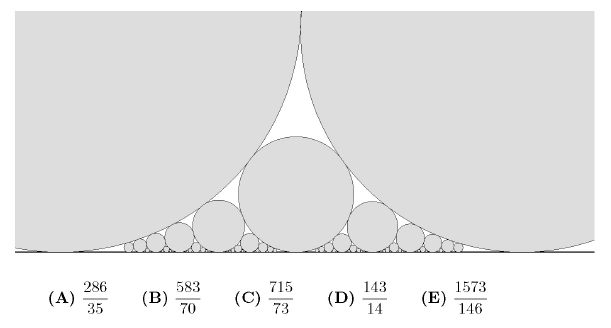
A collection of circles in the upper half-plane, all tangent to the $x$-axis, is constructed in layers as follows. Layer $L_0$ consists of two circles of radii $70^2$ and $73^2$ that are externally tangent. For $k\ge 1$, the circles in $\bigcup_{j=0}^{k-1} L_j$ are ordered according to their points of tangency with the $x$-axis. For every pair of consecutive circles in this order, a new circle is constructed externally tangent to each of the two circles in the pair. Layer $L_k$ consists of the $2^{k-1}$ circles constructed in this way. Let $S=\bigcup_{j=0}^{6} L_j$, and for every circle $C$ denote by $r(C)$ its radius. What is
\[
\sum_{C\in S}\frac{1}{\sqrt{r(C)}}\ ?
\]
在上半平面内构造一组圆,它们都与 $x$ 轴相切,按层次如下构造。第 $0$ 层 $L_0$ 由两个半径分别为 $70^2$ 和 $73^2$ 的圆组成,这两个圆外切。对 $k\ge 1$,将 $\bigcup_{j=0}^{k-1} L_j$ 中的圆按它们与 $x$ 轴的切点从左到右排序。对该顺序中每一对相邻的圆,构造一个新圆,使其分别与这两个圆外切。第 $k$ 层 $L_k$ 由这样构造出的 $2^{k-1}$ 个圆组成。令 $S=\bigcup_{j=0}^{6} L_j$,并对每个圆 $C$ 用 $r(C)$ 表示其半径。求
\[
\sum_{C\in S}\frac{1}{\sqrt{r(C)}}\ ?
\]
(A)
$\frac{286}{35}$
$\frac{286}{35}$
(B)
$\frac{583}{70}$
$\frac{583}{70}$
(C)
$\frac{715}{73}$
$\frac{715}{73}$
(D)
$\frac{143}{14}$
$\frac{143}{14}$
(E)
$\frac{1573}{146}$
$\frac{1573}{146}$
Answer
Correct choice: (D)
正确答案:(D)
Solution
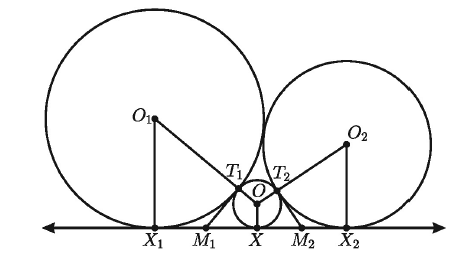
Answer (D): Suppose that circles $C_1$ and $C_2$ in the upper half-plane have centers $O_1$ and $O_2$ and radii $r_1$ and $r_2$, respectively. Assume that $C_1$ and $C_2$ are externally tangent and tangent to the $x$-axis at $X_1$ and $X_2$, respectively. Let $C$ with center $O$ and radius $r$ be the circle externally tangent to $C_1$ and $C_2$ and tangent to the $x$-axis. Let $X$ be the point of tangency of $C$ with the $x$-axis, and let $T_1$ and $T_2$ be the points of tangency of $C$ with $C_1$ and $C_2$, respectively. Let $M_1$ and $M_2$ be the points on the $x$-axis such that $M_1T_1 \perp O_1T_1$ and $M_2T_2 \perp O_2T_2$.
Because $M_1X_1$ and $M_1T_1$ are both tangent to $C_1$, it follows that $X_1M_1=M_1T_1$. Similarly, $M_1T_1$ and $M_1X$ are both tangent to $C$, and thus $M_1T_1=M_1X$. Because $\angle OT_1M_1$, $\angle M_1X_1O_1$, $\angle M_1T_1O$, and $\angle OXM_1$ are all right angles and $\angle T_1M_1X=\pi-\angle X_1M_1T_1$, it follows that quadrilaterals $O_1X_1M_1T_1$ and $M_1XOT_1$ are similar. Thus
\[
\frac{r_1}{X_1M_1}=\frac{O_1X_1}{X_1M_1}=\frac{M_1X}{XO}=\frac{X_1M_1}{r}.
\]
Therefore $X_1M_1=\sqrt{rr_1}$, and similarly $M_2X_2=\sqrt{rr_2}$. By the distance formula,
\[
(r_1+r_2)^2=(O_1O_2)^2=(X_1X_2)^2+(r_1-r_2)^2.
\]
Thus
\[
2\sqrt{r_1r_2}=X_1X_2=X_1M_1+M_1X+XM_2+M_2X_2
=2(X_1M_1+M_2X_2)=2\sqrt{r}(\sqrt{r_1}+\sqrt{r_2});
\]
that is,
\[
\frac{1}{\sqrt{r}}=\frac{1}{\sqrt{r_1}}+\frac{1}{\sqrt{r_2}}. \qquad (1)
\]
It follows that
\[
\sum_{C\in L_k}\frac{1}{\sqrt{r(C)}}=\sum_{C\in L_k}\left(\frac{1}{\sqrt{r(C_1)}}+\frac{1}{\sqrt{r(C_2)}}\right),
\]
where $C_1$ and $C_2$ are the consecutive circles in $\bigcup_{j=0}^{k-1}L_j$ that are tangent to $C$. Note that every circle in $\bigcup_{j=0}^{k-1}L_j$ appears twice in the sum on the right-hand side, except for the two circles in $L_0$, which appear only once. Thus
\[
\sum_{C\in L_k}\frac{1}{\sqrt{r(C)}}=
2\sum_{j=1}^{k-1}\ \sum_{C\in L_j}\frac{1}{\sqrt{r(C)}}+\sum_{C\in L_0}\frac{1}{\sqrt{r(C)}}.
\]
In particular, if $k=1$, then
\[
\sum_{C\in L_1}\frac{1}{\sqrt{r(C)}}=\sum_{C\in L_0}\frac{1}{\sqrt{r(C)}}=\frac{1}{70}+\frac{1}{73}.
\]
For simplicity let $x=\frac{1}{70}+\frac{1}{73}$. Let $k\ge 2$, and suppose by induction that for $1\le j\le k-1$,
\[
\sum_{C\in L_j}\frac{1}{\sqrt{r(C)}}=3^{j-1}x.
\]
It follows that
\[
\sum_{C\in L_k}\frac{1}{\sqrt{r(C)}}=
2\left(\sum_{j=1}^{k-1}3^{j-1}x\right)+x
=2x\left(\frac{3^{k-1}-1}{2}\right)+x=x3^{k-1}.
\]
Therefore
\[
\sum_{C\in S}\frac{1}{\sqrt{r(C)}}=
\sum_{k=0}^{6}\ \sum_{C\in L_k}\frac{1}{\sqrt{r(C)}}
=x+\sum_{k=1}^{6}x3^{k-1}
=x\left(1+\frac{3^6-1}{2}\right)
\]
\[
=x\left(\frac{3^6+1}{2}\right)
=\frac{143}{70\cdot 73}\left(\frac{730}{2}\right)=\frac{143}{14}.
\]
Note: Equation (1) is a special case of the Kissing Circles Theorem.
答案(D):设上半平面内的圆 $C_1$ 与 $C_2$ 的圆心分别为 $O_1$、$O_2$,半径分别为 $r_1$、$r_2$。假设 $C_1$ 与 $C_2$ 外切,并分别在 $X_1$、$X_2$ 处与 $x$ 轴相切。设圆 $C$ 的圆心为 $O$、半径为 $r$,且 $C$ 与 $C_1$、$C_2$ 外切并与 $x$ 轴相切。设 $X$ 为 $C$ 与 $x$ 轴的切点,$T_1$、$T_2$ 分别为 $C$ 与 $C_1$、$C_2$ 的切点。令 $M_1$、$M_2$ 为 $x$ 轴上的点,使得 $M_1T_1\perp O_1T_1$ 且 $M_2T_2\perp O_2T_2$。
由于 $M_1X_1$ 与 $M_1T_1$ 都是 $C_1$ 的切线,得 $X_1M_1=M_1T_1$。同理,$M_1T_1$ 与 $M_1X$ 都是圆 $C$ 的切线,因此 $M_1T_1=M_1X$。又因为 $\angle OT_1M_1$、$\angle M_1X_1O_1$、$\angle M_1T_1O$、$\angle OXM_1$ 均为直角,且 $\angle T_1M_1X=\pi-\angle X_1M_1T_1$,所以四边形 $O_1X_1M_1T_1$ 与 $M_1XOT_1$ 相似。因此
\[
\frac{r_1}{X_1M_1}=\frac{O_1X_1}{X_1M_1}=\frac{M_1X}{XO}=\frac{X_1M_1}{r}.
\]
从而 $X_1M_1=\sqrt{rr_1}$,同理 $M_2X_2=\sqrt{rr_2}$。由距离公式,
\[
(r_1+r_2)^2=(O_1O_2)^2=(X_1X_2)^2+(r_1-r_2)^2.
\]
因此
\[
2\sqrt{r_1r_2}=X_1X_2=X_1M_1+M_1X+XM_2+M_2X_2
=2(X_1M_1+M_2X_2)=2\sqrt{r}(\sqrt{r_1}+\sqrt{r_2});
\]
即
\[
\frac{1}{\sqrt{r}}=\frac{1}{\sqrt{r_1}}+\frac{1}{\sqrt{r_2}}。 \qquad (1)
\]
于是
\[
\sum_{C\in L_k}\frac{1}{\sqrt{r(C)}}=\sum_{C\in L_k}\left(\frac{1}{\sqrt{r(C_1)}}+\frac{1}{\sqrt{r(C_2)}}\right),
\]
其中 $C_1$ 与 $C_2$ 是集合 $\bigcup_{j=0}^{k-1}L_j$ 中与 $C$ 相切的相邻两圆。注意到 $\bigcup_{j=0}^{k-1}L_j$ 中每个圆在右端求和中出现两次,但 $L_0$ 中的两个圆只出现一次。因此
\[
\sum_{C\in L_k}\frac{1}{\sqrt{r(C)}}=
2\sum_{j=1}^{k-1}\ \sum_{C\in L_j}\frac{1}{\sqrt{r(C)}}+\sum_{C\in L_0}\frac{1}{\sqrt{r(C)}}。
\]
特别地,当 $k=1$ 时,
\[
\sum_{C\in L_1}\frac{1}{\sqrt{r(C)}}=\sum_{C\in L_0}\frac{1}{\sqrt{r(C)}}=\frac{1}{70}+\frac{1}{73}.
\]
为简便起见,令 $x=\frac{1}{70}+\frac{1}{73}$。令 $k\ge 2$,并用归纳法假设对 $1\le j\le k-1$ 有
\[
\sum_{C\in L_j}\frac{1}{\sqrt{r(C)}}=3^{j-1}x.
\]
则
\[
\sum_{C\in L_k}\frac{1}{\sqrt{r(C)}}=
2\left(\sum_{j=1}^{k-1}3^{j-1}x\right)+x
=2x\left(\frac{3^{k-1}-1}{2}\right)+x=x3^{k-1}.
\]
因此
\[
\sum_{C\in S}\frac{1}{\sqrt{r(C)}}=
\sum_{k=0}^{6}\ \sum_{C\in L_k}\frac{1}{\sqrt{r(C)}}
=x+\sum_{k=1}^{6}x3^{k-1}
\]
\[
=x\left(1+\frac{3^6-1}{2}\right)
=x\left(\frac{3^6+1}{2}\right)
=\frac{143}{70\cdot 73}\left(\frac{730}{2}\right)=\frac{143}{14}.
\]
注:公式 (1) 是“相吻圆定理”(Kissing Circles Theorem)的一个特例。
Topics
Related Questions
Practice full AMC exams on amcdrill.
Try full-length practice and diagnostics at www.amcdrill.com.