AMC12 2013 B
AMC12 2013 B · Q16
AMC12 2013 B · Q16. It mainly tests Circle theorems, Polygons.
Let $ABCDE$ be an equiangular convex pentagon of perimeter $1$. The pairwise intersections of the lines that extend the sides of the pentagon determine a five-pointed star polygon. Let $s$ be the perimeter of this star. What is the difference between the maximum and the minimum possible values of $s$?
设$ABCDE$为一个周长为$1$的等角凸五边形。将五边形各边所在的直线向外延长,这些直线两两相交所确定的交点构成一个五角星形多边形。设该星形的周长为$s$。问$s$的最大可能值与最小可能值之差是多少?
(A)
0
0
(B)
\frac{1}{2}
\frac{1}{2}
(C)
\frac{\sqrt{5}-1}{2}
\frac{\sqrt{5}-1}{2}
(D)
\frac{\sqrt{5}+1}{2}
\frac{\sqrt{5}+1}{2}
(E)
\sqrt{5}
\sqrt{5}
Answer
Correct choice: (A)
正确答案:(A)
Solution
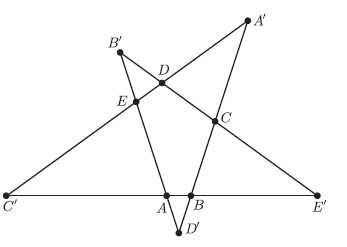
Answer (A): The sum of the internal angles of the pentagon $ABCDE$ is $3\cdot 180^\circ=540^\circ$ and by assumption all internal angles are equal, so they are all equal to $\frac{1}{5}(540^\circ)=108^\circ$. Therefore the supplementary angles at each of the vertices are all equal to $180^\circ-108^\circ=72^\circ$. It follows that all the triangles making up the points of the star are isosceles triangles with angles measuring $72^\circ$, $72^\circ$, and $36^\circ$. Label the rest of the vertices of the star as in the figure. By the above argument, there is a constant $c$ such that $A'C=A'D=c\cdot CD$ and similar expressions for the other four points of the star. Therefore the required perimeter equals
\[
A'C+A'D+B'D+B'E+C'A+C'E+D'A+D'B+E'B+E'C
=2c(CD+DE+EA+AB+BC)=2c,
\]
and therefore the maximum and minimum values are the same and their difference is $0$.
Note: The constant $c$ equals $\frac{1}{2}\csc\left(\frac{\pi}{10}\right)=\frac{1}{2}(\sqrt{5}+1)$.
答案(A):五边形$ABCDE$的内角和为$3\cdot 180^\circ=540^\circ$,并且由题设五个内角都相等,所以每个内角都等于$\frac{1}{5}(540^\circ)=108^\circ$。因此每个顶点处的补角都等于$180^\circ-108^\circ=72^\circ$。于是构成星形各尖角的三角形都是等腰三角形,其三个角分别为$72^\circ$、$72^\circ$和$36^\circ$。按图所示标出星形其余各顶点。由上述论证,存在常数$c$使得$A'C=A'D=c\cdot CD$,并且星形另外四个尖角也有类似的关系。因此所求周长为
\[
A'C+A'D+B'D+B'E+C'A+C'E+D'A+D'B+E'B+E'C
=2c(CD+DE+EA+AB+BC)=2c,
\]
所以最大值与最小值相同,它们的差为$0$。
注:常数$c$为$\frac{1}{2}\csc\left(\frac{\pi}{10}\right)=\frac{1}{2}(\sqrt{5}+1)$。
Topics
Related Questions
Practice full AMC exams on amcdrill.
Try full-length practice and diagnostics at www.amcdrill.com.