AMC12 2013 B
AMC12 2013 B · Q13
AMC12 2013 B · Q13. It mainly tests Sequences & recursion (algebra), Triangles (properties).
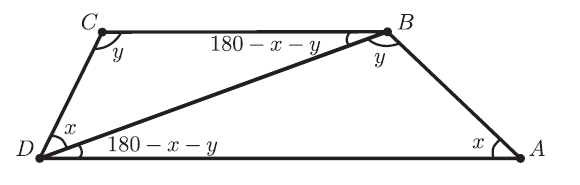
The internal angles of quadrilateral ABCD form an arithmetic progression. Triangles ABD and DCB are similar with $\angle DBA = \angle DCB$ and $\angle ADB = \angle CBD$. Moreover, the angles in each of these two triangles also form an arithmetic progression. In degrees, what is the largest possible sum of the two largest angles of ABCD?
四边形ABCD的内角形成一个等差数列。三角形ABD和DCB相似,且$\angle DBA = \angle DCB$,$\angle ADB = \angle CBD$。此外,这两个三角形中的角度也形成等差数列。ABCD的两个最大角之和的最大可能值为多少度?
(A)
210
210
(B)
220
220
(C)
230
230
(D)
240
240
(E)
250
250
Answer
Correct choice: (D)
正确答案:(D)
Solution
Answer (D): Let the degree measures of the angles be as shown in the figure. The angles of a triangle form an arithmetic progression if and only if the median angle is $60^\circ$, so one of $x$, $y$, or $180-x-y$ must be equal to $60$. By symmetry of the role of the triangles $ABD$ and $DCB$, assume that $x\le y$. Because $x\le y<180-x$ and $x<180-y\le 180-x$, it follows that the arithmetic progression of the angles in $ABCD$ from smallest to largest must be either $x,y,180-y,180-x$ or $x,180-y,y,180-x$. Thus either $x+180-y=2y$, in which case $3y=x+180$; or $x+y=2(180-y)$, in which case $3y=360-x$. Neither of these is compatible with $y=60$ (the former forces $x=0$ and the latter forces $x=180$), so either $x=60$ or $x+y=120$.
First suppose that $x=60$. If $3y=x+180$, then $y=80$, and the sequence of angles in $ABCD$ is $(x,y,180-y,180-x)=(60,80,100,120)$. If $3y=360-x$, then $y=100$, and the sequence of angles in $ABCD$ is $(x,180-y,y,180-x)=(60,80,100,120)$. Finally, suppose that $x+y=120$. If $3y=x+180$, then $y=75$, and the sequence of angles in $ABCD$ is $(x,y,180-y,180-x)=(45,75,105,135)$. If $3y=360-x$, then $y=120$ and $x=0$, which is impossible.
Therefore, the sum in degrees of the two largest possible angles is $105+135=240$.
答案(D):设各角的度数如图所示。三角形的三个角成等差数列当且仅当中间那个角为 $60^\circ$,因此 $x$、$y$、或 $180-x-y$ 之一必须等于 $60$。由三角形 $ABD$ 与 $DCB$ 的对称性,不妨设 $x\le y$。因为 $x\le y<180-x$ 且 $x<180-y\le 180-x$,可知四边形 $ABCD$ 的四个角从小到大组成的等差数列只能是 $x,y,180-y,180-x$ 或 $x,180-y,y,180-x$。于是要么 $x+180-y=2y$,即 $3y=x+180$;要么 $x+y=2(180-y)$,即 $3y=360-x$。这两种情况都不可能与 $y=60$ 同时成立(前者迫使 $x=0$,后者迫使 $x=180$),因此要么 $x=60$,要么 $x+y=120$。
先设 $x=60$。若 $3y=x+180$,则 $y=80$,此时 $ABCD$ 的角序列为 $(x,y,180-y,180-x)=(60,80,100,120)$。若 $3y=360-x$,则 $y=100$,此时 $ABCD$ 的角序列为 $(x,180-y,y,180-x)=(60,80,100,120)$。再设 $x+y=120$。若 $3y=x+180$,则 $y=75$,此时 $ABCD$ 的角序列为 $(x,y,180-y,180-x)=(45,75,105,135)$。若 $3y=360-x$,则 $y=120$ 且 $x=0$,不可能。
因此,可能出现的两个最大角之和为 $105+135=240$。
Topics
Related Questions
Practice full AMC exams on amcdrill.
Try full-length practice and diagnostics at www.amcdrill.com.