AMC12 2013 A
AMC12 2013 A · Q23
AMC12 2013 A · Q23. It mainly tests Transformations, Geometry misc.
ABCD is a square of side length $\sqrt{3+1}$. Point P is on AC such that AP = $\sqrt{2}$. The square region bounded by ABCD is rotated 90$^\circ$ counterclockwise with center P, sweeping out a region whose area is $\frac{1}{c}(a\pi + b)$, where a, b, and c are positive integers and gcd(a, b, c) = 1. What is a + b + c ?
ABCD 是一个边长为 $\sqrt{3+1}$ 的正方形。点 P 在 AC 上使得 AP = $\sqrt{2}$。以 P 为中心将 ABCD 围成的正方形区域逆时针旋转 90$^\circ$,扫过的区域面积为 $\frac{1}{c}(a\pi + b)$,其中 a, b, c 为正整数且 gcd(a, b, c) = 1。求 a + b + c ?
(A)
15
15
(B)
17
17
(C)
19
19
(D)
21
21
(E)
23
23
Answer
Correct choice: (C)
正确答案:(C)
Solution
Answer (C):
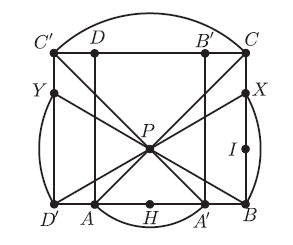
Assume that the vertices of $ABCD$ are labeled in counterclockwise order. Let $A'$, $B'$, $C'$, and $D'$ be the images of $A$, $B$, $C$, and $D$, respectively, under the rotation. Because $\triangle A'PA$ and $\triangle C'PC$ are isosceles right triangles, points $A'$ and $C'$ are on lines $AB$ and $CD$, respectively. Moreover, because $AP=\sqrt{2}$ and $PC=AC-AP=\sqrt{2}(\sqrt{3}+1)-\sqrt{2}=\sqrt{6}$, it follows that $AA'=\sqrt{2}AP=2$ and $CC'=\sqrt{2}CP=2\sqrt{3}$. By symmetry, points $B'$ and $D'$ are on lines $CD$ and $AB$, respectively. Let $X\ne B$ and $Y\ne D'$ be the intersections of $BC$ and $C'D'$, respectively, with the circle centered at $P$ with radius $PB$. Note that $PD'=PD=PB$, so this circle also contains $D'$. Therefore the required region consists of sectors $APA'$, $BPX$, $CPC'$, and $YPD'$, and triangles $BPA'$, $CPX$, $YPC'$, and $APD'$.
Sector $APA'$ has area $\frac14\cdot(\sqrt{2})^2\pi=\frac{\pi}{2}$, and sector $CPC'$ has area $\frac14\cdot(\sqrt{6})^2\pi=\frac{3\pi}{2}$. Let $H$ and $I$ be the midpoints of $AA'$ and $BX$, respectively. Then $PH=AH=\frac{\sqrt{2}}{2}AP=1$, and $PI=HB=AB-AH=\sqrt{3}$. Thus $\triangle BPH$ is a 30-60-90° triangle, implying that $PB=2$ and $\triangle XPB$ is equilateral. Therefore congruent sectors $BPX$ and $YPD'$ each have area $\frac16\cdot2^2\pi=\frac{2\pi}{3}$.
Congruent triangles $BPA'$ and $D'PA$ each have altitude $PH=1$ and base $A'B=AB-AH-HA'=\sqrt{3}-1$, so each has area $\frac12(\sqrt{3}-1)$. Congruent triangles $CPX$ and $C'PY$ each have altitude $PI=\sqrt{3}$ and base $XC=BC-BX=\sqrt{3}-1$, so each has area $\frac12(3-\sqrt{3})$.
The area of the entire region is
$$
\frac{\pi}{2}+\frac{3\pi}{2}+2\cdot\frac{2\pi}{3}+2\left(\frac{\sqrt{3}-1}{2}\right)+2\left(\frac{3-\sqrt{3}}{2}\right)=\frac{10\pi+6}{3},
$$
and $a+b+c=10+6+3=19$.
答案(C):
假设 $ABCD$ 的顶点按逆时针顺序标记。设 $A'$, $B'$, $C'$, $D'$ 分别为点 $A$, $B$, $C$, $D$ 在该旋转下的像。因为 $\triangle A'PA$ 和 $\triangle C'PC$ 是等腰直角三角形,所以点 $A'$ 与 $C'$ 分别在直线 $AB$ 与 $CD$ 上。此外,由于 $AP=\sqrt{2}$ 且 $PC=AC-AP=\sqrt{2}(\sqrt{3}+1)-\sqrt{2}=\sqrt{6}$,可得 $AA'=\sqrt{2}AP=2$,$CC'=\sqrt{2}CP=2\sqrt{3}$。由对称性,点 $B'$ 与 $D'$ 分别在直线 $CD$ 与 $AB$ 上。令 $X\ne B$、$Y\ne D'$ 分别为 $BC$ 与 $C'D'$ 和以 $P$ 为圆心、$PB$ 为半径的圆的交点。注意到 $PD'=PD=PB$,因此该圆也经过 $D'$。所以所求区域由扇形 $APA'$, $BPX$, $CPC'$, $YPD'$ 以及三角形 $BPA'$, $CPX$, $YPC'$, $APD'$ 组成。
扇形 $APA'$ 的面积为 $\frac14\cdot(\sqrt{2})^2\pi=\frac{\pi}{2}$,扇形 $CPC'$ 的面积为 $\frac14\cdot(\sqrt{6})^2\pi=\frac{3\pi}{2}$。设 $H$ 与 $I$ 分别为 $AA'$ 与 $BX$ 的中点,则 $PH=AH=\frac{\sqrt{2}}{2}AP=1$,且 $PI=HB=AB-AH=\sqrt{3}$。因此 $\triangle BPH$ 是 $30$-$60$-$90^\circ$ 三角形,从而 $PB=2$ 且 $\triangle XPB$ 为正三角形。所以全等扇形 $BPX$ 与 $YPD'$ 的面积各为 $\frac16\cdot2^2\pi=\frac{2\pi}{3}$。
全等三角形 $BPA'$ 与 $D'PA$ 的高均为 $PH=1$,底为 $A'B=AB-AH-HA'=\sqrt{3}-1$,所以每个面积为 $\frac12(\sqrt{3}-1)$。全等三角形 $CPX$ 与 $C'PY$ 的高均为 $PI=\sqrt{3}$,底为 $XC=BC-BX=\sqrt{3}-1$,所以每个面积为 $\frac12(3-\sqrt{3})$。
整个区域的面积为
$$
\frac{\pi}{2}+\frac{3\pi}{2}+2\cdot\frac{2\pi}{3}+2\left(\frac{\sqrt{3}-1}{2}\right)+2\left(\frac{3-\sqrt{3}}{2}\right)=\frac{10\pi+6}{3},
$$
并且 $a+b+c=10+6+3=19$。
Topics
Related Questions
Practice full AMC exams on amcdrill.
Try full-length practice and diagnostics at www.amcdrill.com.