AMC12 2012 A
AMC12 2012 A · Q22
AMC12 2012 A · Q22. It mainly tests Circle theorems, Geometry misc.
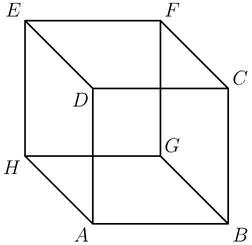
Distinct planes $p_1,p_2,....,p_k$ intersect the interior of a cube $Q$. Let $S$ be the union of the faces of $Q$ and let $P =\bigcup_{j=1}^{k}p_{j}$. The intersection of $P$ and $S$ consists of the union of all segments joining the midpoints of every pair of edges belonging to the same face of $Q$. What is the difference between the maximum and minimum possible values of $k$?
不同的平面 $p_1,p_2,....,p_k$ 与立方体 $Q$ 的内部相交。设 $S$ 为 $Q$ 的各个面的并集,且 $P =\bigcup_{j=1}^{k}p_{j}$。$P$ 与 $S$ 的交集由所有线段的并集组成,这些线段连接 $Q$ 的同一面上任意一对边的中点。$k$ 的最大可能值与最小可能值之差是多少?
(A)
8
8
(B)
12
12
(C)
20
20
(D)
23
23
(E)
24
24
Answer
Correct choice: (C)
正确答案:(C)
Solution
We need two different kinds of planes that only intersect $Q$ at the mentioned segments (we call them traces in this solution). These will be all the possible $p_j$'s.
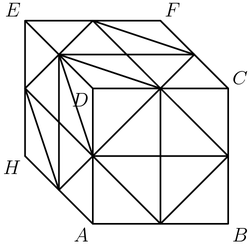
First, there are two kinds of segments joining the midpoints of every pair of edges belonging to the same face of $Q$: long traces are those connecting the midpoint of opposite sides of the same face of $Q$, and short traces are those connecting the midpoint of adjacent sides of the same face of $Q$.
Suppose $p_j$ contains a short trace $t_1$ of a face of $Q$. Then it must also contain some trace $t_2$ of an adjacent face of $Q$, where $t_2$ share a common endpoint with $t_1$. So, there are three possibilities for $t_2$, each of which determines a plane $p_j$ containing both $t_1$ and $t_2$.
Case 1: $t_2$ makes an acute angle with $t_1$. In this case, $p_j \cap Q$ is an equilateral triangle made by three short traces. There are $8$ of them, corresponding to the $8$ vertices.
Case 2: $t_2$ is a long trace. $p \cap Q$ is a rectangle. Each pair of parallel faces of $Q$ contributes $4$ of these rectangles so there are $12$ such rectangles.
Case 3: $t_2$ is the short trace other than the one described in case 1, i.e. $t_2$ makes an obtuse angle with $t_1$. It is possible to prove that $p \cap Q$ is a regular hexagon (See note #1 for a proof) and there are $4$ of them.
Case 4: $p_j$ contains no short traces. This can only make $p_j \cap Q$ be a square enclosed by long traces. There are $3$ such squares.
In total, there are $8+12+4+3=27$ possible planes in $P$. So the maximum of $k$ is $27$.
On the other hand, the most economic way to generate these long and short traces is to take all the planes in case 3 and case 4. Overall, they intersect at each trace exactly once (there is a quick way to prove this. See note #2 below.) and also covered all the $6\times 4 + 4\times 3 = 36$ traces. So the minimum of $k$ is $7$. The answer to this problem is then $27-7=20$ ... $\framebox{C}$.
Note 1: Indeed, let $t_1=AB$ where $B=t_1\cap t_2$, and $C$ be the other endpoint of $t_2$ that is not $B$. Draw a line through $C$ parallel to $t_1$. This line passes through the center $O$ of the cube and therefore we see that the reflection of $A,B,C$, denoted by $A', B', C'$, respectively, lie on the same plane containing $A,B,C$. Thus $p_j \cap Q$ is the regular hexagon $ABCA'B'C'$. To count the number of these hexagons, just notice that each short trace uniquely determine a hexagon (by drawing the plane through this trace and the center), and that each face has $4$ short traces. Therefore, there are $4$ such hexagons.
Note 2: The quick way to prove the fact that none of the planes described in case 3 and case 4 share the same trace is as follows: each of these plane contains the center and therefore the intersection of each pair of them is a line through the center, which obviously does not contain any traces.
我们需要找出两类不同的平面,它们与 $Q$ 的交集只在题目所述的线段处相交(在本解中称这些线段为“迹”)。这些就是所有可能的 $p_j$。
首先,连接 $Q$ 的同一面上任意一对边的中点的线段有两种:长迹是连接同一面上相对边中点的线段,短迹是连接同一面上相邻边中点的线段。
设 $p_j$ 含有 $Q$ 的某一面的一个短迹 $t_1$。则它也必须含有与该面相邻的另一个面的某条迹 $t_2$,且 $t_2$ 与 $t_1$ 共享一个端点。因此,$t_2$ 有三种可能,每一种都唯一确定一个同时包含 $t_1$ 与 $t_2$ 的平面 $p_j$。
情形 1:$t_2$ 与 $t_1$ 成锐角。此时 $p_j \cap Q$ 是由三条短迹组成的正三角形。这样的三角形有 $8$ 个,对应于 $8$ 个顶点。
情形 2:$t_2$ 是一条长迹。此时 $p \cap Q$ 是一个矩形。$Q$ 的每一对平行面贡献 $4$ 个这样的矩形,因此共有 $12$ 个。
情形 3:$t_2$ 是除情形 1 所述之外的另一条短迹,即 $t_2$ 与 $t_1$ 成钝角。可以证明 $p \cap Q$ 是一个正六边形(证明见注 1),且这样的六边形有 $4$ 个。
情形 4:$p_j$ 不包含任何短迹。这只能使 $p_j \cap Q$ 成为由长迹围成的正方形。这样的正方形有 $3$ 个。
总计共有 $8+12+4+3=27$ 个可能出现在 $P$ 中的平面,因此 $k$ 的最大值为 $27$。
另一方面,生成这些长迹与短迹的最“经济”的方法是取情形 3 与情形 4 中的所有平面。它们对每条迹都恰好相交一次(可用一个简便方法证明,见注 2),并且覆盖了全部 $6\times 4 + 4\times 3 = 36$ 条迹。因此 $k$ 的最小值为 $7$。所以本题答案为 $27-7=20$ ... $\framebox{C}$。
注 1:令 $t_1=AB$,其中 $B=t_1\cap t_2$,并令 $C$ 为 $t_2$ 的另一个端点(不等于 $B$)。过 $C$ 作一条与 $t_1$ 平行的直线。该直线经过立方体的中心 $O$,因此 $A,B,C$ 关于 $O$ 的对称点分别为 $A', B', C'$,它们与 $A,B,C$ 同在包含 $A,B,C$ 的平面上。于是 $p_j \cap Q$ 为正六边形 $ABCA'B'C'$。要计数这些六边形,只需注意每条短迹都唯一确定一个六边形(过该短迹与中心作平面),且每个面有 $4$ 条短迹。因此共有 $4$ 个这样的六边形。
注 2:证明情形 3 与情形 4 中的任意两平面不会共享同一条迹的简便方法如下:这些平面都包含立方体中心,因此任意两平面的交线都经过中心,显然不可能包含任何迹。
Topics
Related Questions
Practice full AMC exams on amcdrill.
Try full-length practice and diagnostics at www.amcdrill.com.