AMC12 2009 A
AMC12 2009 A · Q23
AMC12 2009 A · Q23. It mainly tests Quadratic equations, Graphs (coordinate plane).
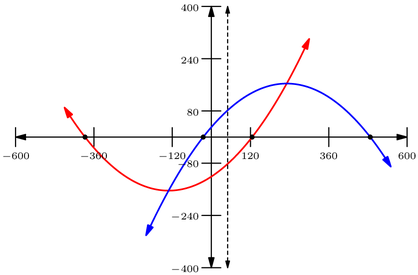
Functions $f$ and $g$ are quadratic, $g(x) = - f(100 - x)$, and the graph of $g$ contains the vertex of the graph of $f$. The four $x$-intercepts on the two graphs have $x$-coordinates $x_1$, $x_2$, $x_3$, and $x_4$, in increasing order, and $x_3 - x_2 = 150$. Then $x_4 - x_1 = m + n\sqrt p$, where $m$, $n$, and $p$ are positive integers, and $p$ is not divisible by the square of any prime. What is $m + n + p$?
函数 $f$ 和 $g$ 均为二次函数,且 $g(x) = - f(100 - x)$,并且 $g$ 的图像经过 $f$ 的图像的顶点。两条图像共有四个 $x$ 轴截距,其 $x$ 坐标按从小到大依次为 $x_1, x_2, x_3, x_4$,且 $x_3 - x_2 = 150$。则 $x_4 - x_1 = m + n\sqrt p$,其中 $m$、$n$、$p$ 为正整数,且 $p$ 不被任何质数的平方整除。求 $m + n + p$。
(A)
602
602
(B)
652
652
(C)
702
702
(D)
752
752
(E)
802
802
Answer
Correct choice: (D)
正确答案:(D)
Solution
The two quadratics are $180^{\circ}$ rotations of each other about $(50,0)$. Since we are only dealing with differences of roots, we can translate them to be symmetric about $(0,0)$. Now $x_3 = - x_2 = 75$ and $x_4 = - x_1$. Say our translated versions of $f$ and $g$ are $p$ and $q$, respectively, so that $p(x) = - q( - x)$. Let $x_3 = 75$ be a root of $p$ and $x_2 = - 75$ a root of $q$ by symmetry. Note that since they each contain each other's vertex, $x_1$, $x_2$, $x_3$, and $x_4$ must be roots of alternating polynomials, so $x_1$ is a root of $p$ and $x_4$ a root of $q$
\[p(x) = a(x - 75)(x - x_1)\]
\[q(x) = - a(x + 75)(x + x_1)\]
The vertex of $p(x)$ is half the sum of its roots, or $\frac {75 + x_1}{2}$. We are told that the vertex of one quadratic lies on the other, so
\begin{eqnarray*} p\left(\frac {75 + x_1}{2}\right) & = & a\left(\frac {75 - x_1}{2}\right)\left(\frac { - 75 + x_1}{2}\right) \\ & = & - \frac {a}{4}(x_1 - 75)^2 \\ - \frac {a}{4}(x_1 - 75)^2 & = & q\left(\frac {75 + x_1}{2}\right) \\ & = & - a\left(\frac {x_1 + 225}{2}\right)\left(\frac {3x_1 + 75}{2}\right) \\ & = & - \frac {a}{4}(x_1 + 225)(3x_1 + 75) \end{eqnarray*}
Let $x_1 = 75u$ and divide through by $75^2$, since it will drastically simplify computations. We know $u < - 1$ and that $(u - 1)^2 = (3u + 1)(u + 3)$, or
\begin{eqnarray*} 0 & = & (3u + 1)(u + 3) - (u - 1)^2 \\ & = & 3u^2 + 10u + 3 - (u^2 - 2u + 1) \\ & = & 2u^2 + 12u + 2 \\ & = & u^2 + 6u + 1 \end{eqnarray*}
So $u = \frac { - 6\pm\sqrt {32}}{2} = - 3\pm2\sqrt2$. Since $u < - 1$, $u = - 3 - 2\sqrt2$.
The answer is $x_4 - x_1 = (-x_1) - x_1 = - 150u = 450 + 300\sqrt {2}$, and $450 + 300 + 2 = 752\ \mathbf{(D)}$.
这两个二次函数的图像关于点 $(50,0)$ 互为 $180^{\circ}$ 旋转。由于只涉及根的差,我们可平移使其关于 $(0,0)$ 对称。于是 $x_3 = - x_2 = 75$ 且 $x_4 = - x_1$。设平移后的 $f$、$g$ 分别为 $p$、$q$,则 $p(x) = - q( - x)$。由对称性令 $x_3 = 75$ 为 $p$ 的一个根,$x_2 = - 75$ 为 $q$ 的一个根。注意到它们各自包含对方的顶点,因此 $x_1, x_2, x_3, x_4$ 必须交替地分别为两个多项式的根,所以 $x_1$ 是 $p$ 的根而 $x_4$ 是 $q$ 的根。
\[p(x) = a(x - 75)(x - x_1)\]
\[q(x) = - a(x + 75)(x + x_1)\]
$ p(x)$ 的顶点横坐标为其两根的平均数,即 $\frac {75 + x_1}{2}$。题设给出一个二次函数的顶点在另一个上,因此
\begin{eqnarray*} p\left(\frac {75 + x_1}{2}\right) & = & a\left(\frac {75 - x_1}{2}\right)\left(\frac { - 75 + x_1}{2}\right) \\ & = & - \frac {a}{4}(x_1 - 75)^2 \\ - \frac {a}{4}(x_1 - 75)^2 & = & q\left(\frac {75 + x_1}{2}\right) \\ & = & - a\left(\frac {x_1 + 225}{2}\right)\left(\frac {3x_1 + 75}{2}\right) \\ & = & - \frac {a}{4}(x_1 + 225)(3x_1 + 75) \end{eqnarray*}
令 $x_1 = 75u$ 并两边同除以 $75^2$(可大幅简化计算)。已知 $u < - 1$,且
\[(u - 1)^2 = (3u + 1)(u + 3),\]
即
\begin{eqnarray*} 0 & = & (3u + 1)(u + 3) - (u - 1)^2 \\ & = & 3u^2 + 10u + 3 - (u^2 - 2u + 1) \\ & = & 2u^2 + 12u + 2 \\ & = & u^2 + 6u + 1 \end{eqnarray*}
所以 $u = \frac { - 6\pm\sqrt {32}}{2} = - 3\pm2\sqrt2$。由于 $u < - 1$,取 $u = - 3 - 2\sqrt2$。
所求为
\[x_4 - x_1 = (-x_1) - x_1 = - 150u = 450 + 300\sqrt {2},\]
因此 $450 + 300 + 2 = 752\ \mathbf{(D)}$。
Topics
Related Questions
Practice full AMC exams on amcdrill.
Try full-length practice and diagnostics at www.amcdrill.com.