AMC12 2005 A
AMC12 2005 A · Q15
AMC12 2005 A · Q15. It mainly tests Triangles (properties), Circle theorems.
Let $\overline{AB}$ be a diameter of a circle and $C$ be a point on $\overline{AB}$ with $2 \cdot AC = BC$. Let $D$ and $E$ be points on the circle such that $\overline{DC} \perp \overline{AB}$ and $\overline{DE}$ is a second diameter. What is the ratio of the area of $\triangle DCE$ to the area of $\triangle ABD$?
设 $\overline{AB}$ 为圆的直径,$C$ 为 $\overline{AB}$ 上的点且 $2 \cdot AC = BC$。$D$ 和 $E$ 为圆上的点,使得 $\overline{DC} \perp \overline{AB}$ 且 $\overline{DE}$ 为另一条直径。$\triangle DCE$ 的面积与 $\triangle ABD$ 的面积之比是多少?
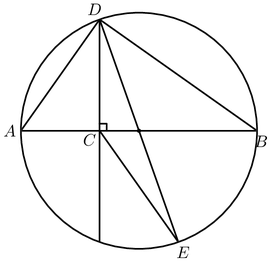
(A)
\frac{1}{6}
\frac{1}{6}
(B)
\frac{1}{4}
\frac{1}{4}
(C)
\frac{1}{3}
\frac{1}{3}
(D)
\frac{1}{2}
\frac{1}{2}
(E)
\frac{2}{3}
\frac{2}{3}
Answer
Correct choice: (C)
正确答案:(C)
Solution
Notice that the bases of both triangles are diameters of the circle. Hence the ratio of the areas is just the ratio of the heights of the triangles, or $\frac{CF}{CD}$ ($F$ is the foot of the perpendicular from $C$ to $DE$).
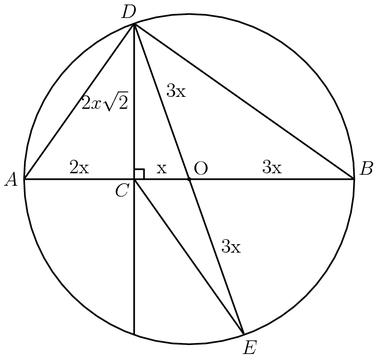
Call the radius $r$. Then $AC = \frac 13(2r) = \frac 23r$, $CO = \frac 13r$. Using the Pythagorean Theorem in $\triangle OCD$, we get $\frac{1}{9}r^2 + CD^2 = r^2 \Longrightarrow CD = \frac{2\sqrt{2}}3r$.
Now we have to find $CF$. Notice $\triangle OCD \sim \triangle OFC$, so we can write the proportion:
By the Pythagorean Theorem in $\triangle OFC$, we have $\left(\frac{1}{9}r\right)^2 + CF^2 = \left(\frac{1}{3}r\right)^2 \Longrightarrow CF = \sqrt{\frac{8}{81}r^2} = \frac{2\sqrt{2}}{9}r$.
Our answer is $\frac{CF}{CD} = \frac{\frac{2\sqrt{2}}{9}r}{\frac{2\sqrt{2}}{3}r} = \frac 13 \Longrightarrow \mathrm{(C)}$.
Let the center of the circle be $O$.
Note that $2 \cdot AC = BC \Rightarrow 3 \cdot AC = AB$.
$O$ is midpoint of $AB \Rightarrow \frac{3}{2}AC = AO \Rightarrow CO = \frac{1}{3}AO \Rightarrow CO = \frac{1}{6} AB$.
$O$ is midpoint of $DE \Rightarrow$ Area of $\triangle DCE = 2 \cdot$ Area of $\triangle DCO = 2 \cdot (\frac{1}{6} \cdot$ Area of $\triangle ABD) = \frac{1}{3} \cdot$ Area of $\triangle ABD \Longrightarrow \mathrm{(C)}$.
Let $r$ be the radius of the circle. Note that $AC+BC = 2r$ so $AC = \frac{2}{3}r$.
By Power of a Point Theorem, $CD^2= AC \cdot BC = 2\cdot AC^2$, and thus $CD = \sqrt{2} \cdot AC = \frac{2\sqrt{2}}{3}r$
Then the area of $\triangle ABD$ is $\frac{1}{2} AB \cdot CD = \frac{2\sqrt{2}}{3}r^2$. Similarly, the area of $\triangle DCE$ is $\frac{1}{2}(r-AC) \cdot 2 \cdot CD = \frac{2\sqrt{2}}{9}r^2$, so the desired ratio is $\frac{\frac{2\sqrt{2}}{9}r^2}{\frac{2\sqrt{2}}{3}r^2} = \frac{1}{3} \Longrightarrow \mathrm{(C)}$
Let the center of the circle be $O$.
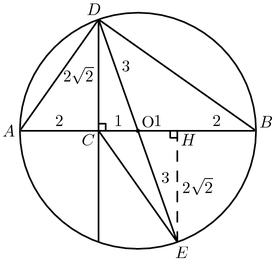
Without loss of generality, let the radius of the circle be equal to $3$. Thus, $AO=3$ and $OB=3$. As a consequence of $2(AC)=BC$, $AC=2$ and $CO=1$. Also, we know that $DO$ and $OE$ are both equal to $3$ due to the fact that they are both radii. Thus from the Pythagorean Theorem, we have DC being equal to $\sqrt{3^2-1^2}$ or $2\sqrt{2}$. Now we know that the area of $[ABD]$ is equal to $\frac{(3+2+1)(2\sqrt{2})}{2}$ or $6\sqrt{2}$. Know we need to find the area of $[DCE]$. By simple inspection $[COD]$ $\cong$ $[HOE]$ due to angles being equal and CPCTC. Thus $HE=2\sqrt{2}$ and $OH=1$. Know we know the area of $[CHE]=\frac{(1+1)(2\sqrt{2})}{2}$ or $2\sqrt{2}$. We also know that the area of $[OHE]=\frac{(1)(2\sqrt{2})}{2}$ or $\sqrt{2}$. Thus the area of $[COE]=2\sqrt{2}-\sqrt{2}$ or $\sqrt{2}$. We also can calculate the area of $[DOC]$ to be $\frac{(1)(2\sqrt{2})}{2}$ or $\sqrt{2}$. Thus $[DCE]$ is equal to $[COE]$ + $[DOC]$ or $\sqrt{2}+\sqrt{2}$ or $2\sqrt{2}$. The ratio between $[DCE]$ and $[ABD]$ is equal to $\frac{2\sqrt{2}}{6\sqrt{2}}$ or $\frac{1}{3}$ $\Longrightarrow \mathrm{(C)}$.
We will use the shoelace formula. Our origin is the center of the circle. Denote the ordered pair for $D (x,y)$, and notice how $E$ is a 180 degree rotation of $D$, using the rotation matrix formula we get $E = (-x,-y)$. WLOG say that this circle has radius $3$. We can now find points $A$, $B$, and $C$ which are $(-3,0)$, $(3,0)$, and $(-1,0)$ respectively.
By shoelace the area of $CED$ is $Y$, and the area of $ADB$ is $3Y$. Using division we get that the answer is $\mathrm{(C)}$.
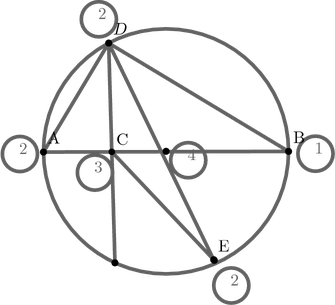
We set point $A$ as a mass of 2. This means that point $B$ has a mass of $1$ since $2\times{AC} = 1\times{BC}$. This implies that point $C$ has a mass of $2+1 = 3$ and the center of the circle has a mass of $3+1 = 4$. After this, we notice that points $D$ and $E$ both must have a mass of $2$ since $2+2 = 4$ and they are both radii of the circle.
To find the ratio of the areas, we do the reciprocal of the multiplication of the mass points of DCE and the multiplication of ABD divided by each other. Which is simply $\frac{3\times2\times2}{2\times2\times1}$ which is $\boxed{\frac{1}{3}}$ (the reciprocal of 3)
注意到两个三角形的底边都是圆的直径。因此面积之比等于对应高之比,即 $\frac{CF}{CD}$($F$ 为从 $C$ 向 $DE$ 作垂线的垂足)。
设半径为 $r$。则 $AC = \frac 13(2r) = \frac 23r$,$CO = \frac 13r$。在 $\triangle OCD$ 中用勾股定理得 $\frac{1}{9}r^2 + CD^2 = r^2 \Longrightarrow CD = \frac{2\sqrt{2}}3r$。
接下来求 $CF$。注意 $\triangle OCD \sim \triangle OFC$,因此可列比例:
在 $\triangle OFC$ 中用勾股定理得 $\left(\frac{1}{9}r\right)^2 + CF^2 = \left(\frac{1}{3}r\right)^2 \Longrightarrow CF = \sqrt{\frac{8}{81}r^2} = \frac{2\sqrt{2}}{9}r$。
所求比值为 $\frac{CF}{CD} = \frac{\frac{2\sqrt{2}}{9}r}{\frac{2\sqrt{2}}{3}r} = \frac 13 \Longrightarrow \mathrm{(C)}$。
Topics
Related Questions
Practice full AMC exams on amcdrill.
Try full-length practice and diagnostics at www.amcdrill.com.