AMC12 2003 B
AMC12 2003 B · Q16
AMC12 2003 B · Q16. It mainly tests Circle theorems, Area & perimeter.
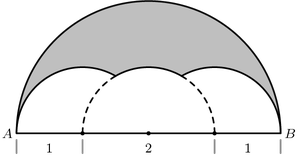
Three semicircles of radius $1$ are constructed on diameter $\overline{AB}$ of a semicircle of radius $2$. The centers of the small semicircles divide $\overline{AB}$ into four line segments of equal length, as shown. What is the area of the shaded region that lies within the large semicircle but outside the smaller semicircles?
在半径为 $2$ 的半圆的直径 $\overline{AB}$ 上作三个半径为 $1$ 的半圆。小半圆的圆心将 $\overline{AB}$ 分成四段等长线段,如图所示。求阴影区域的面积:该区域位于大半圆内但在小半圆外。
(A)
$\pi - \sqrt{3}$
$\pi - \sqrt{3}$
(B)
$\pi - \sqrt{2}$
$\pi - \sqrt{2}$
(C)
$\pi + \frac{\sqrt{2}}{2}$
$\pi + \frac{\sqrt{2}}{2}$
(D)
$\pi + \frac{\sqrt{3}}{2}$
$\pi + \frac{\sqrt{3}}{2}$
(E)
$\frac{7}{6}\pi - \frac{\sqrt{3}}{2}$
$\frac{7}{6}\pi - \frac{\sqrt{3}}{2}$
Answer
Correct choice: (E)
正确答案:(E)
Solution
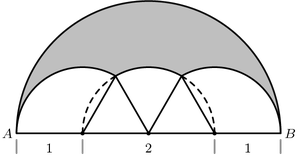
By drawing four lines from the intersect of the semicircles to their centers, we have split the white region into $\frac{5}{6}$ of a circle with radius $1$ and two equilateral triangles with side length $1$.
This gives the area of the white region as $\frac{5}{6}\pi+\frac{2\cdot\sqrt3}{4}=\frac{5}{6}\pi+\frac{\sqrt3}{2}$.
The area of the shaded region is the area of the white region subtracted from the area of the large semicircle. This is equivalent to $2\pi-\left(\frac{5}{6}\pi+\frac{\sqrt3}{2}\right)=\frac{7}{6}\pi-\frac{\sqrt3}{2}$.
Thus the answer is $\boxed{\textbf{(E)}\ \frac{7}{6}\pi-\frac{\sqrt3}{2}}$.
The reason why it is $\frac{5}{6}$ of a circle and why the triangles are equilateral are because, first, the radii are the same and they make up the equilateral triangles.
Secondly, the reason it is $\frac{5}{6}$ of a circle is because the middle sector has a degree of $180-2 \cdot 60 = 60$ and thus $\frac{60}{360}=\frac{1}{6}$ of a circle.
The other two have areas of $\frac{180-60}{360}=\frac{1}{3}$ of a triangle each.
Therefore, the total fraction of the circle(since they have the same radii) is $\frac{1}{6} + 2 \cdot \frac{1}{3} = \frac{1}{6} + \frac{4}{6} = \frac{5}{6}.$
通过从半圆交点向各自圆心画四条线,我们把白色区域分割成一个半径为 $1$ 的圆的 $\frac{5}{6}$,以及两个边长为 $1$ 的等边三角形。
因此白色区域面积为 $\frac{5}{6}\pi+\frac{2\cdot\sqrt3}{4}=\frac{5}{6}\pi+\frac{\sqrt3}{2}$。
阴影区域面积等于大半圆面积减去白色区域面积,即
\[2\pi-\left(\frac{5}{6}\pi+\frac{\sqrt3}{2}\right)=\frac{7}{6}\pi-\frac{\sqrt3}{2}.\]
因此答案是 $\boxed{\textbf{(E)}\ \frac{7}{6}\pi-\frac{\sqrt3}{2}}$。
之所以是圆的 $\frac{5}{6}$,以及三角形是等边的原因是:首先,半径相同,它们构成等边三角形。
其次,之所以是圆的 $\frac{5}{6}$,是因为中间的扇形圆心角为 $180-2 \cdot 60 = 60$,因此它占整圆的 $\frac{60}{360}=\frac{1}{6}$。
另外两个扇形各自的面积占比为 $\frac{180-60}{360}=\frac{1}{3}$。
因此总的圆面积占比(因为它们半径相同)为 $\frac{1}{6} + 2 \cdot \frac{1}{3} = \frac{1}{6} + \frac{4}{6} = \frac{5}{6}.$
Topics
Related Questions
Practice full AMC exams on amcdrill.
Try full-length practice and diagnostics at www.amcdrill.com.