AMC12 2003 A
AMC12 2003 A · Q13
AMC12 2003 A · Q13. It mainly tests Geometry misc, Constructive proofs / constructions.
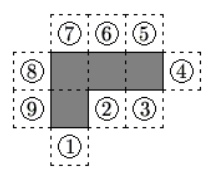
The polygon enclosed by the solid lines in the figure consists of 4 congruent squares joined edge-to-edge. One more congruent square is attached to an edge at one of the nine positions indicated. How many of the nine resulting polygons can be folded to form a cube with one face missing?
图中由实线围成的多边形由 $4$ 个全等的正方形边对边连接而成。再将一个全等正方形附着在所示九个位置之一的边上。九种得到的多边形中,有多少种可以折叠成一个缺少一个面的立方体?
(A)
2
2
(B)
3
3
(C)
4
4
(D)
5
5
(E)
6
6
Answer
Correct choice: (E)
正确答案:(E)
Solution
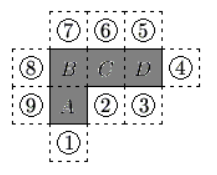
Let the squares be labeled $A$, $B$, $C$, and $D$.
When the polygon is folded, the "right" edge of square $A$ becomes adjacent to the "bottom edge" of square $C$, and the "bottom" edge of square $A$ becomes adjacent to the "bottom" edge of square $D$.
So, any "new" square that is attatched to those edges will prevent the polygon from becoming a cube with one face missing.
Therefore, squares $1$, $2$, and $3$ will prevent the polygon from becoming a cube with one face missing.
Squares $4$, $5$, $6$, $7$, $8$, and $9$ will allow the polygon to become a cube with one face missing when folded.
Thus the answer is $\boxed{\mathrm{(E)}\ 6}$.
Another way to think of it is that a cube missing one face has $5$ of its $6$ faces. Since the shape has $4$ faces already, we need another face. The only way to add another face is if the added square does not overlap any of the others. $1$,$2$, and $3$ overlap, while squares $4$ to $9$ do not. The answer is $\boxed{\mathrm{(E)}\ 6}$
If you're good at visualizing, you can imagine each box and fold up the shape into a 3D shape. This solution is only recommended if you are either in a hurry or extremely skilled at visualizing. We find out that $4,5,6,7,8$ and $9$ work. Therefore, the answer is $\boxed{\mathrm{(E)}\ 6}$. ~Sophia866
将这四个正方形标记为 $A$、$B$、$C$、$D$。
当该多边形折叠时,正方形 $A$ 的“右边”会与正方形 $C$ 的“下边”相邻,而正方形 $A$ 的“下边”会与正方形 $D$ 的“下边”相邻。
因此,任何附着在这些边上的“新”正方形都会阻止该多边形折叠成一个缺少一个面的立方体。
所以,位置 $1$、$2$、$3$ 的正方形会阻止该多边形折叠成一个缺少一个面的立方体。
位置 $4$、$5$、$6$、$7$、$8$、$9$ 的正方形在折叠时都允许该多边形成为一个缺少一个面的立方体。
因此答案是 $\boxed{\mathrm{(E)}\ 6}$。
另一种思路是:缺少一个面的立方体有 $6$ 个面中的 $5$ 个。该图形已有 $4$ 个面,因此还需要再加一个面。添加一个面的唯一方式是所加的正方形在折叠后不与其他面重叠。位置 $1$、$2$、$3$ 会重叠,而位置 $4$ 到 $9$ 不会。答案是 $\boxed{\mathrm{(E)}\ 6}$
如果你很擅长空间想象,可以把每种情况都想象成折成三维形状。我们发现 $4,5,6,7,8$ 和 $9$ 可行。因此答案是 $\boxed{\mathrm{(E)}\ 6}$. ~Sophia866
Topics
Related Questions
Practice full AMC exams on amcdrill.
Try full-length practice and diagnostics at www.amcdrill.com.