AMC12 2001 A
AMC12 2001 A · Q18
AMC12 2001 A · Q18. It mainly tests Circle theorems, Ratios in geometry.
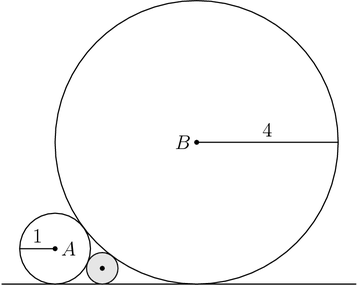
A circle centered at $A$ with a radius of 1 and a circle centered at $B$ with a radius of 4 are externally tangent. A third circle is tangent to the first two and to one of their common external tangents as shown. What is the radius of the third circle?
以 $A$ 为圆心半径为 1 的圆与以 $B$ 为圆心半径为 4 的圆外切。第三个圆与前两个圆以及它们的一条公共外公切线相切,如图所示。第三个圆的半径是多少?
(A)
$\frac{1}{3}$
$\frac{1}{3}$
(B)
$\frac{2}{5}$
$\frac{2}{5}$
(C)
$\frac{5}{12}$
$\frac{5}{12}$
(D)
$\frac{4}{9}$
$\frac{4}{9}$
(E)
$\frac{1}{2}$
$\frac{1}{2}$
Answer
Correct choice: (D)
正确答案:(D)
Solution
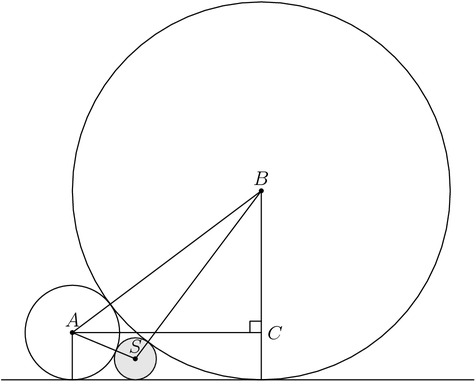
In the triangle $ABC$ we have $AB = 1+4 = 5$ and $BC=4-1 = 3$, thus by the Pythagorean theorem we have $AC=4$.
Let $r$ be the radius of the small circle, and let $s$ be the perpendicular distance from $S$ to $\overline{AC}$. Moreover, the small circle is tangent to both other circles, hence we have $SA=1+r$ and $SB=4+r$.
We have $SA = \sqrt{s^2 + (1-r)^2}$ and $SB=\sqrt{(4-s)^2 + (4-r)^2}$. Hence we get the following two equations:
\begin{align*} s^2 + (1-r)^2 & = (1+r)^2 \\ (4-s)^2 + (4-r)^2 & = (4+r)^2 \end{align*}
Simplifying both, we get
\begin{align*} s^2 & = 4r \\ (4-s)^2 & = 16r \end{align*}
As in our case both $r$ and $s$ are positive, we can divide the second one by the first one to get $\left( \frac{4-s}s \right)^2 = 4$.
Now there are two possibilities: either $\frac{4-s}s=-2$, or $\frac{4-s}s=2$.
In the first case clearly $s<0$, which puts the center on the wrong side of $A$, so this is not the correct case.
(Note: This case corresponds to the other circle that is tangent to both given circles and the common tangent line. By coincidence, due to the $4:1$ ratio between radii of $A$ and $B$, this circle turns out to have the same radius as circle $B$, with center directly left of center $B$, and tangent to $B$ directly above center $A$.)
The second case solves to $s=\frac 43$. We then have $4r = s^2 = \frac {16}9$, hence $r = \boxed{\frac 49}$.
More generally, for two large circles of radius $a$ and $b$, the radius $c$ of the small circle is $c = \frac{ab}{\left(\sqrt{a}+\sqrt{b}\right)^2} = \frac{1}{\left(1/\sqrt{a}+1/\sqrt{b}\right)^2}$.
Equivalently, we have that $1/\sqrt{c} = 1/\sqrt{a} + 1/\sqrt{b}$.
The horizontal line is the equivalent of a circle of curvature $0$, thus we can apply Descartes' Circle Formula.
The four circles have curvatures $0, 1, \frac 14$, and $\frac 1r$.
We have $2\left(0^2+1^2+\frac {1}{4^2}+\frac{1}{r^2}\right)=\left(0+1+\frac 14+\frac 1r\right)^2$
Simplifying, we get $\frac{34}{16}+\frac{2}{r^2}=\frac{25}{16}+\frac{5}{2r}+\frac{1}{r^2}$
\[\frac{1}{r^2}-\frac{5}{2r}+\frac{9}{16}=0\]
\[\frac{16}{r^2}-\frac{40}{r}+9=0\]
\[\left(\frac{4}{r}-9\right)\left(\frac{4}{r}-1\right)=0\]
Obviously $r$ cannot equal $4$, therefore $r = \boxed{\frac 49}$.
As in solution 1, in triangle $ABC$ we have $AB = 1+4 = 5$ and $BC=4-1 = 3$, thus by the Pythagorean theorem or pythagorean triples in general, we have $AC=4$.
Let $r$ be the radius. Let $s$ be the perpendicular intersecting point $S$ and line $BC$. $AC=s$ because $s,$ both perpendicular radii, and $AC$ form a rectangle. We just have to find $AC$ in terms of $r$ and solve for $r$ now. From the Pythagorean theorem and subtracting to get lengths, we get $AC=s=4=\sqrt{(r+1)^2 - (1-r)^2} + \sqrt{(r+4)^2 - (4-r)^2}$, which is simply $4=\sqrt{4r}+\sqrt{16r} \implies \sqrt{r}=\frac{2}{3} \implies r= \boxed{\textbf{(D) } \frac{4}{9}}.$
https://youtu.be/zOwYoFOUg2U
在三角形 $ABC$ 中,$AB = 1+4 = 5$ 且 $BC=4-1 = 3$,因此由勾股定理得 $AC=4$。
设小圆的半径为 $r$,设从 $S$ 到 $\overline{AC}$ 的垂直距离为 $s$。另外,小圆与另外两个圆都相切,因此有 $SA=1+r$ 且 $SB=4+r$。
有 $SA = \sqrt{s^2 + (1-r)^2}$ 且 $SB=\sqrt{(4-s)^2 + (4-r)^2}$。因此得到方程组:
\begin{align*} s^2 + (1-r)^2 & = (1+r)^2 \\ (4-s)^2 + (4-r)^2 & = (4+r)^2 \end{align*}
化简得
\begin{align*} s^2 & = 4r \\ (4-s)^2 & = 16r \end{align*}
由于本题中 $r$ 与 $s$ 都为正,可将第二式除以第一式得到 $\left( \frac{4-s}s \right)^2 = 4$。
于是有两种可能:$\frac{4-s}s=-2$ 或 $\frac{4-s}s=2$。
第一种情况下显然 $s<0$,会使圆心落在 $A$ 的错误一侧,因此不符合。
(注:这种情况对应于另一个同时与两已知圆及公切线相切的圆。由于 $A$ 与 $B$ 的半径比为 $4:1$,巧合地该圆的半径与圆 $B$ 相同,圆心在 $B$ 的正左方,并在 $A$ 的正上方与 $B$ 相切。)
第二种情况解得 $s=\frac 43$。于是 $4r = s^2 = \frac {16}9$,从而 $r = \boxed{\frac 49}$。
更一般地,对于两个大圆半径分别为 $a$ 与 $b$,小圆半径 $c$ 为 $c = \frac{ab}{\left(\sqrt{a}+\sqrt{b}\right)^2} = \frac{1}{\left(1/\sqrt{a}+1/\sqrt{b}\right)^2}$。
等价地,有 $1/\sqrt{c} = 1/\sqrt{a} + 1/\sqrt{b}$。
水平直线等价于曲率为 $0$ 的圆,因此可应用笛卡尔圆定理。
四个圆的曲率分别为 $0, 1, \frac 14$, 以及 $\frac 1r$。
有 $2\left(0^2+1^2+\frac {1}{4^2}+\frac{1}{r^2}\right)=\left(0+1+\frac 14+\frac 1r\right)^2$
化简得 $\frac{34}{16}+\frac{2}{r^2}=\frac{25}{16}+\frac{5}{2r}+\frac{1}{r^2}$
\[\frac{1}{r^2}-\frac{5}{2r}+\frac{9}{16}=0\]
\[\frac{16}{r^2}-\frac{40}{r}+9=0\]
\[\left(\frac{4}{r}-9\right)\left(\frac{4}{r}-1\right)=0\]
显然 $r$ 不可能等于 $4$,因此 $r = \boxed{\frac 49}$。
如解法 1,在三角形 $ABC$ 中有 $AB = 1+4 = 5$ 且 $BC=4-1 = 3$,因此由勾股定理或勾股数组可得 $AC=4$。
设半径为 $r$。设 $s$ 为垂线与点 $S$ 及直线 $BC$ 的交点。由于 $s$、两条垂直半径与 $AC$ 构成矩形,所以 $AC=s$。现在只需用 $r$ 表示 $AC$ 并解出 $r$。由勾股定理并通过相减得到长度,有
$AC=s=4=\sqrt{(r+1)^2 - (1-r)^2} + \sqrt{(r+4)^2 - (4-r)^2}$,即
$4=\sqrt{4r}+\sqrt{16r} \implies \sqrt{r}=\frac{2}{3} \implies r= \boxed{\textbf{(D) } \frac{4}{9}}.$
https://youtu.be/zOwYoFOUg2U
Topics
Related Questions
Practice full AMC exams on amcdrill.
Try full-length practice and diagnostics at www.amcdrill.com.