AMC10 2024 B
AMC10 2024 B · Q21
AMC10 2024 B · Q21. It mainly tests Systems of equations, Coordinate geometry.
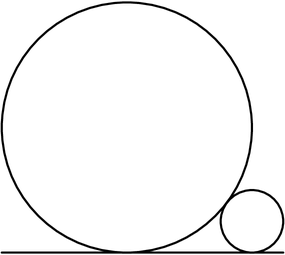
Two straight pipes (circular cylinders), with radii $1$ and $\frac{1}{4}$, lie parallel and in contact on a flat floor. The figure below shows a head-on view. What is the sum of the possible radii of a third parallel pipe lying on the same floor and in contact with both?
两条直管(圆柱体),半径分别为$1$和$\frac{1}{4}$,平行放置并在平坦的地板上接触。下图显示了正面视图。第三条平行管放置在同一地板上,与两者都接触,可能的半径之和是多少?
(A)
\frac{1}{9}
\frac{1}{9}
(B)
1
1
(C)
\frac{10}{9}
\frac{10}{9}
(D)
\frac{11}{9}
\frac{11}{9}
(E)
\frac{19}{9}
\frac{19}{9}
Answer
Correct choice: (C)
正确答案:(C)
Solution
Notice that the sum of radii of two circles tangent to each other will equal to the distance from center to center. Set the center of the big circle be at $(0,1).$ Since both circles are tangent to a line (in this case, $y=0$), the y-coordinates of the centers are just its radius.
Hence, the center of the smaller circle is at $\left(x_2, \frac14\right)$. From the the sum of radii and distance formula, we have:
\[1+\frac14 = \sqrt{x_2^2 + \left(\frac34\right)^2} \Rightarrow x_2 = 1.\]
So, the coordinates of the center of the smaller circle are $(1, \frac14).$ Now, let $(x_3,r_3)$ be the coordinates of the new circle. Then, from the fact that sum of radii of this circle and the circle with radius $1$ is equal to the distance from the two centers, you have:
\[\sqrt{(x_3-0)^2+(r_3-1)^2} = 1+r_3.\]
Similarly, from the fact that the sum of radii of this circle and the circle with radius $\frac14$, you have:
\[\sqrt{(x_3-1)^2+\left(r_3-\frac14\right)^2}= \frac14 + r_3.\]
Squaring the first equation, you have:
\[x_3^2+r_3^2-2r_3+1=1+2r_3+r_3^2 \Rightarrow 4r_3=x_3^2 \Rightarrow x_3=2\sqrt{r_3}.\]
Squaring the second equation, you have:
\[x_3^2-2x_3+1+r_3^2-\frac{r_3}{2}+\frac{1}{16}=\frac{1}{16}+\frac{r_3}{2}+r_3^2 \Rightarrow x_3^2-2x_3+1=r_3\]
Plugging in from the first equation we have
\[r_3-1=x_3^2-2x_3=4r_3-4\sqrt{r_3} \Rightarrow 3r_3-4\sqrt{r_3}+1=0 \Rightarrow (3\sqrt{r_3}-1)(\sqrt{r_3}-1)=0 \Rightarrow r_3=1, \frac19.\]
Summing these two yields $\boxed{\frac{10}{9}}.$
注意到两个相切的圆的半径和等于两圆心之间的距离。设大圆心在$(0,1)$。由于两个圆都与一条直线(此处为$y=0$)相切,圆心的$y$坐标就是其半径。
因此,小圆心在$\left(x_2, \frac14\right)$。由半径和与距离公式,得:
\[1+\frac14 = \sqrt{x_2^2 + \left(\frac34\right)^2} \Rightarrow x_2 = 1.\]
所以,小圆心坐标为$(1, \frac14)$。现在,设新圆心坐标为$(x_3,r_3)$。由其与半径$1$的圆的半径和等于两圆心距离,得:
\[\sqrt{(x_3-0)^2+(r_3-1)^2} = 1+r_3.\]
类似地,与半径$\frac14$的圆:
\[\sqrt{(x_3-1)^2+\left(r_3-\frac14\right)^2}= \frac14 + r_3.\]
对第一式平方:
\[x_3^2+r_3^2-2r_3+1=1+2r_3+r_3^2 \Rightarrow 4r_3=x_3^2 \Rightarrow x_3=2\sqrt{r_3}.\]
对第二式平方:
\[x_3^2-2x_3+1+r_3^2-\frac{r_3}{2}+\frac{1}{16}=\frac{1}{16}+\frac{r_3}{2}+r_3^2 \Rightarrow x_3^2-2x_3+1=r_3\]
代入第一式:
\[r_3-1=x_3^2-2x_3=4r_3-4\sqrt{r_3} \Rightarrow 3r_3-4\sqrt{r_3}+1=0 \Rightarrow (3\sqrt{r_3}-1)(\sqrt{r_3}-1)=0 \Rightarrow r_3=1, \frac19.\]
两者之和为$\boxed{\frac{10}{9}}$。
Topics
Related Questions
Practice full AMC exams on amcdrill.
Try full-length practice and diagnostics at www.amcdrill.com.