AMC10 2018 B
AMC10 2018 B · Q17
AMC10 2018 B · Q17. It mainly tests Quadratic equations, Triangles (properties).
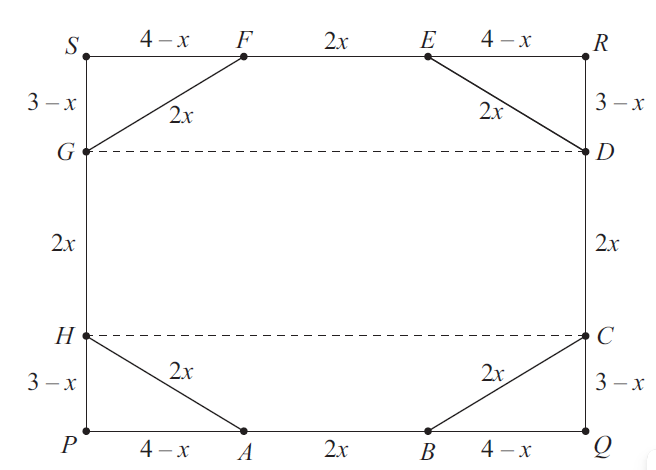
In rectangle \(PQRS\), \(PQ = 8\) and \(QR = 6\). Points \(A\) and \(B\) lie on \(\overline{PQ}\), points \(C\) and \(D\) lie on \(\overline{QR}\), points \(E\) and \(F\) lie on \(\overline{RS}\), and points \(G\) and \(H\) lie on \(\overline{SP}\) so that \(AP = BQ < 4\) and the convex octagon \(ABCDEFEGH\) is equilateral. The length of a side of this octagon can be expressed in the form \(k + m\sqrt{n}\), where \(k, m,\) and \(n\) are integers and \(n\) is not divisible by the square of any prime. What is \(k+m+n\)?
在矩形 \(PQRS\) 中,\(PQ = 8\),\(QR = 6\)。点 \(A\) 和 \(B\) 在 \(\overline{PQ}\) 上,点 \(C\) 和 \(D\) 在 \(\overline{QR}\) 上,点 \(E\) 和 \(F\) 在 \(\overline{RS}\) 上,点 \(G\) 和 \(H\) 在 \(\overline{SP}\) 上,使得 \(AP = BQ < 4\),且凸八边形 \(ABCDEFEGH\) 是等边的。这个八边形的边长可以表示为 \(k + m\sqrt{n}\) 的形式,其中 \(k, m, n\) 是整数,且 \(n\) 不能被任何质数的平方整除。求 \(k+m+n\)?
(A)
1
1
(B)
7
7
(C)
21
21
(D)
92
92
(E)
106
106
Answer
Correct choice: (B)
正确答案:(B)
Solution
Answer (B): Because $AP<4=\frac12 PQ$, it follows that $A$ is closer to $P$ than it is to $Q$ and that $A$ is between points $P$ and $B$. Because $AP=BQ$, $AH=BC$, and angles $APH$ and $BQC$ are right angles, $\triangle APH\cong\triangle BQC$. Thus $PH=QC$, and $PQCH$ is a rectangle. Because $CD=HG$, it follows that $HCDG$ is also a rectangle. Thus $GDRS$ is a rectangle and $DR=GS$, and it follows that $\triangle ERD\cong\triangle FSG$. Therefore segment $EF$ is centered in $RS$ just as congruent segment $AB$ is centered in $PQ$. Therefore $\triangle ERD\cong\triangle BQC$, and $CD$ is also centered in $QR$. Let $2x$ be the side length $AB=BC=CD=DE=EF=FG=GH=HA$ of the regular octagon; then $AP=BQ=4-x$ and $QC=RD=3-x$. Applying the Pythagorean Theorem to $\triangle BQC$ yields $(4-x)^2+(3-x)^2=(2x)^2$, which simplifies to $2x^2+14x-25=0$. Thus $x=\frac12\cdot(-7\pm3\sqrt{11})$, and because $x>0$, it follows that $2x=-7+3\sqrt{11}$. Hence $k+m+n=-7+3+11=7$.
答案(B):因为$AP<4=\frac12 PQ$,可知$A$到$P$比到$Q$更近,并且$A$位于点$P$与$B$之间。由于$AP=BQ$、$AH=BC$,且$\angle APH$与$\angle BQC$都是直角,所以$\triangle APH\cong\triangle BQC$。因此$PH=QC$,且$PQCH$是矩形。又因为$CD=HG$,可知$HCDG$也是矩形。于是$GDRS$是矩形且$DR=GS$,从而$\triangle ERD\cong\triangle FSG$。因此线段$EF$在$RS$中居中,正如全等线段$AB$在$PQ$中居中一样。因此$\triangle ERD\cong\triangle BQC$,并且$CD$也在$QR$中居中。设正八边形的边长$AB=BC=CD=DE=EF=FG=GH=HA$为$2x$;则$AP=BQ=4-x$,$QC=RD=3-x$。对$\triangle BQC$应用勾股定理得$(4-x)^2+(3-x)^2=(2x)^2$,化简为$2x^2+14x-25=0$。因此$x=\frac12\cdot(-7\pm3\sqrt{11})$,由于$x>0$,可得$2x=-7+3\sqrt{11}$。所以$k+m+n=-7+3+11=7$。
Topics
Related Questions
Practice full AMC exams on amcdrill.
Try full-length practice and diagnostics at www.amcdrill.com.