AMC10 2008 A
AMC10 2008 A · Q10
AMC10 2008 A · Q10. It mainly tests Pythagorean theorem, Coordinate geometry.
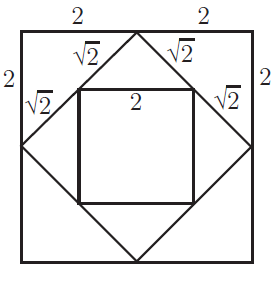
Each of the sides of a square $S_1$ with area 16 is bisected, and a smaller square $S_2$ is constructed using the bisection points as vertices. The same process is carried out on $S_2$ to construct an even smaller square $S_3$. What is the area of $S_3$?
正方形$S_1$的面积为16,每条边被二等分,利用这些二等分点作为顶点构造一个更小的正方形$S_2$。对$S_2$重复相同过程构造更小的正方形$S_3$。$S_3$的面积是多少?
(A)
$\frac{1}{2}$
$\frac{1}{2}$
(B)
1
1
(C)
2
2
(D)
3
3
(E)
4
4
Answer
Correct choice: (E)
正确答案:(E)
Solution
Answer (E): The sides of $S_1$ have length $4$, so by the Pythagorean Theorem the sides of $S_2$ have length $\sqrt{2^2+2^2}=2\sqrt{2}$. By similar reasoning the sides of $S_3$ have length $\sqrt{(\sqrt{2})^2+(\sqrt{2})^2}=2$. Thus the area of $S_3$ is $2^2=4$.
答案(E):$S_1$ 的边长为 $4$,因此由勾股定理可得 $S_2$ 的边长为 $\sqrt{2^2+2^2}=2\sqrt{2}$。同理,$S_3$ 的边长为 $\sqrt{(\sqrt{2})^2+(\sqrt{2})^2}=2$。因此 $S_3$ 的面积为 $2^2=4$。
Topics
Related Questions
Practice full AMC exams on amcdrill.
Try full-length practice and diagnostics at www.amcdrill.com.