/

AMC12 2012 A

You are not logged in. After submit, your report may not be available on other devices. Login

AMC12 · 2012 (A)

Q1
A bug crawls along a number line, starting at $-2$. It crawls to $-6$, then turns around and crawls to $5$. How many units does the bug crawl altogether?
一只虫子沿着数轴爬行,从 $-2$ 开始。它爬到 $-6$,然后转身爬到 $5$。虫子总共爬了多少单位距离?
Correct Answer: E
Crawling from $-2$ to $-6$ takes it a distance of $4$ units. Crawling from $-6$ to $5$ takes it a distance of $11$ units. Add $4$ and $11$ to get $\boxed{\textbf{(E)}\ 15}$
从 $-2$ 爬到 $-6$ 的距离是 $4$ 个单位。从 $-6$ 爬到 $5$ 的距离是 $11$ 个单位。将 $4$ 和 $11$ 相加得到 $\boxed{\textbf{(E)}\ 15}$
solution
Q2
Cagney can frost a cupcake every 20 seconds and Lacey can frost a cupcake every 30 seconds. Working together, how many cupcakes can they frost in 5 minutes?
Cagney 每 20 秒可以给一个纸杯蛋糕上糖霜,Lacey 每 30 秒可以给一个纸杯蛋糕上糖霜。他们一起工作,5 分钟内可以给多少个纸杯蛋糕上糖霜?
Correct Answer: D
Cagney can frost one in $20$ seconds, and Lacey can frost one in $30$ seconds. Working together, they can frost one in $\frac{20\cdot30}{20+30} = \frac{600}{50} = 12$ seconds. In $300$ seconds ($5$ minutes), they can frost $\boxed{\textbf{(D)}\ 25}$ cupcakes.
Cagney 给一个上糖霜需要 $20$ 秒,Lacey 给一个上糖霜需要 $30$ 秒。一起工作时,他们给一个上糖霜需要 $\frac{20\cdot30}{20+30} = \frac{600}{50} = 12$ 秒。在 $300$ 秒($5$ 分钟)内,他们可以给 $\boxed{\textbf{(D)}\ 25}$ 个纸杯蛋糕上糖霜。
Q3
A box $2$ centimeters high, $3$ centimeters wide, and $5$ centimeters long can hold $40$ grams of clay. A second box with twice the height, three times the width, and the same length as the first box can hold $n$ grams of clay. What is $n$?
一个高 $2$ 厘米、宽 $3$ 厘米、长 $5$ 厘米的盒子可以装 $40$ 克粘土。第二个盒子的高度是第一个的两倍,宽度是三倍,长度与第一个盒子相同,可以装 $n$ 克粘土。$n$ 是多少?
Correct Answer: D
The first box has volume $2\times3\times5=30\text{ cm}^3$, and the second has volume $(2\times2)\times(3\times3)\times(5)=180\text{ cm}^3$. The second has a volume that is $6$ times greater, so it holds $6\times40=\boxed{\textbf{(D)}\ 240}$ grams.
第一个盒子的体积是 $2\times3\times5=30\text{ cm}^3$,第二个盒子的体积是 $(2\times2)\times(3\times3)\times(5)=180\text{ cm}^3$。第二个盒子的体积是第一个的 $6$ 倍,所以它能装 $6\times40=\boxed{\textbf{(D)}\ 240}$ 克。
Q4
In a bag of marbles, $\frac{3}{5}$ of the marbles are blue and the rest are red. If the number of red marbles is doubled and the number of blue marbles stays the same, what fraction of the marbles will be red?
一袋弹珠中,$\frac{3}{5}$ 的弹珠是蓝色的,其余是红色的。如果红色弹珠的数量加倍而蓝色弹珠的数量保持不变,那么红色弹珠将占弹珠总数的几分之几?
Correct Answer: C
Assume that there are 5 total marbles in the bag. The actual number does not matter, since all we care about is the ratios, and the only operation performed on the marbles in the bag is doubling. There are 3 blue marbles in the bag and 2 red marbles. If you double the amount of red marbles, there will still be 3 blue marbles but now there will be 4 red marbles. Thus, the answer is $\boxed{\textbf{(C)}\ \frac{4}{7}}$.
假设袋中共有 5 颗弹珠。实际数量并不重要,因为我们只关心比例,而且对袋中弹珠进行的唯一操作是加倍。 袋中有 3 颗蓝色弹珠和 2 颗红色弹珠。如果将红色弹珠数量加倍,蓝色弹珠仍为 3 颗,但红色弹珠变为 4 颗。因此答案是 $\boxed{\textbf{(C)}\ \frac{4}{7}}$。
Q5
A fruit salad consists of blueberries, raspberries, grapes, and cherries. The fruit salad has a total of $280$ pieces of fruit. There are twice as many raspberries as blueberries, three times as many grapes as cherries, and four times as many cherries as raspberries. How many cherries are there in the fruit salad?
一份水果沙拉由蓝莓、覆盆子、葡萄和樱桃组成。这份水果沙拉共有 $280$ 块水果。覆盆子的数量是蓝莓的两倍,葡萄的数量是樱桃的三倍,樱桃的数量是覆盆子的四倍。水果沙拉中有多少块樱桃?
Correct Answer: D
So let the number of blueberries be $b,$ the number of raspberries be $r,$ the number of grapes be $g,$ and finally the number of cherries be $c.$ Observe that since there are $280$ pieces of fruit, \[b+r+g+c=280.\] Since there are twice as many raspberries as blueberries, \[2b=r.\] The fact that there are three times as many grapes as cherries implies, \[3c=g.\] Because there are four times as many cherries as raspberries, we deduce the following: \[4r=c.\] Note that we are looking for $c.$ So, we try to rewrite all of the other variables in terms of $c.$ The third equation gives us the value of $g$ in terms of $c$ already. We divide the fourth equation by $4$ to get that $r=\frac{c}{4}.$ Finally, substituting this value of $r$ into the first equation provides us with the equation $b=\frac{c}{8}$ and substituting yields: \[\frac{c}{4}+\frac{c}{8}+3c+c=280\] Multiply this equation by $8$ to get: \[2c+c+24c+8c=8\cdot 280,\] \[35c=8\cdot 280,\] \[c=64.\] \[\boxed{D}\]
设蓝莓的数量为 $b,$ 覆盆子的数量为 $r,$ 葡萄的数量为 $g,$ 樱桃的数量为 $c.$ 注意到共有 $280$ 块水果, \[b+r+g+c=280.\] 由于覆盆子的数量是蓝莓的两倍, \[2b=r.\] 葡萄的数量是樱桃的三倍意味着, \[3c=g.\] 因为樱桃的数量是覆盆子的四倍,我们得到: \[4r=c.\] 注意我们要找的是 $c.$ 因此尝试把其他变量都用 $c$ 表示。 第三个方程已经给出了用 $c$ 表示的 $g$。将第四个方程除以 $4$ 得到 $r=\frac{c}{4}.$ 最后,把这个 $r$ 的值代入第一个方程可得 $b=\frac{c}{8}$,并代入得到: \[\frac{c}{4}+\frac{c}{8}+3c+c=280\] 将该方程乘以 $8$ 得: \[2c+c+24c+8c=8\cdot 280,\] \[35c=8\cdot 280,\] \[c=64.\] \[\boxed{D}\]
Q6
The sums of three whole numbers taken in pairs are 12, 17, and 19. What is the middle number?
三个整数两两相加的和分别为 12、17 和 19。中间的那个数是多少?
Correct Answer: D
Let the three numbers be equal to $a$, $b$, and $c$. We can now write three equations: $a+b=12$ $b+c=17$ $a+c=19$ Adding these equations together, we get that $2(a+b+c)=48$ and $a+b+c=24$ Substituting the original equations into this one, we find $c+12=24$ $a+17=24$ $b+19=24$ Therefore, our numbers are 12, 7, and 5. The middle number is $\boxed{\textbf{(D)}\ 7}$
设这三个数为 $a$, $b$, $c$。我们可以写出三个方程: $a+b=12$ $b+c=17$ $a+c=19$ 将这些方程相加,得到 $2(a+b+c)=48$,因此 $a+b+c=24$ 将原方程代入这个式子,我们得到 $c+12=24$ $a+17=24$ $b+19=24$ 因此,这三个数是 12、7 和 5。中间的数是 $\boxed{\textbf{(D)}\ 7}$
Q7
Mary divides a circle into 12 sectors. The central angles of these sectors, measured in degrees, are all integers and they form an arithmetic sequence. What is the degree measure of the smallest possible sector angle?
玛丽将一个圆分成12个扇形。这些扇形的圆心角(以度为单位)都是整数,并且形成一个等差数列。最小的扇形角度数可能是多少?
Correct Answer: C
Let $a_1$ be the first term of the arithmetic progression and $a_{12}$ be the last term of the arithmetic progression. From the formula of the sum of an arithmetic progression (or arithmetic series), we have $12*\frac{a_1+a_{12}}{2}=360$, which leads us to $a_1 + a_{12} = 60$. $a_{12}$, the largest term of the progression, can also be expressed as $a_1+11d$, where $d$ is the common difference. Since each angle measure must be an integer, $d$ must also be an integer. We can isolate $d$ by subtracting $a_1$ from $a_{12}$ like so: $a_{12}-a_1=a_1+11d-a_1=11d$. Since $d$ is an integer, the difference between the first and last terms, $11d$, must be divisible by $11.$ Since the total difference must be less than $60$, we can start checking multiples of $11$ less than $60$ for the total difference between $a_1$ and $a_{12}$. We start with the largest multiple, because the maximum difference will result in the minimum value of the first term. If the difference is $55$, $a_1=\frac{60-55}{2}=2.5$, which is not an integer, nor is it one of the five options given. If the difference is $44$, $a_1=\frac{60-44}{2}$, or $\boxed{\textbf{(C)}\ 8}$
设等差数列的首项为$a_1$,末项为$a_{12}$。由等差数列(等差级数)求和公式可得 $12*\frac{a_1+a_{12}}{2}=360$,从而 $a_1 + a_{12} = 60$。等差数列的最大项 $a_{12}$ 也可表示为 $a_1+11d$,其中 $d$ 为公差。由于每个角度都必须是整数,$d$ 也必须是整数。将 $a_1$ 从 $a_{12}$ 中减去可得:$a_{12}-a_1=a_1+11d-a_1=11d$。因为 $d$ 是整数,首末两项之差 $11d$ 必须能被 $11$ 整除。由于总差必须小于 $60$,我们检查小于 $60$ 的 $11$ 的倍数作为 $a_1$ 与 $a_{12}$ 的差。我们从最大的倍数开始,因为差越大首项越小。若差为 $55$,则 $a_1=\frac{60-55}{2}=2.5$,不是整数,也不在给出的五个选项中。若差为 $44$,则 $a_1=\frac{60-44}{2}$,即 $\boxed{\textbf{(C)}\ 8}$。
Q8
An iterative average of the numbers 1, 2, 3, 4, and 5 is computed the following way. Arrange the five numbers in some order. Find the mean of the first two numbers, then find the mean of that with the third number, then the mean of that with the fourth number, and finally the mean of that with the fifth number. What is the difference between the largest and smallest possible values that can be obtained using this procedure?
对数字 1、2、3、4 和 5 进行迭代平均,方法如下:将这五个数按某种顺序排列。先求前两个数的平均数,再将该平均数与第三个数求平均,再将所得结果与第四个数求平均,最后将所得结果与第五个数求平均。用此过程可能得到的最大值与最小值之差是多少?
Correct Answer: C
The iterative average of any 5 integers $a,b,c,d,e$ is defined as: \[\frac{\frac{\frac{\frac{a+b} 2+c} 2+d} 2+e} 2=\frac{a+b+2c+4d+8e}{16}\] Plugging in $1,2,3,4,5$ for $a,b,c,d,e$, we see that in order to maximize the fraction, $a=1,b=2,c=3,d=4,e=5$, and in order to minimize the fraction, $a=5,b=4,c=3,d=2,e=1$. After plugging in these values and finding the positive difference of the two fractions, we arrive with $\frac{34}{16} \Rightarrow \frac{17}{8}$, which is our answer of $\boxed{\textbf{(C)}}$
任意 5 个整数 $a,b,c,d,e$ 的迭代平均定义为: \[\frac{\frac{\frac{\frac{a+b} 2+c} 2+d} 2+e} 2=\frac{a+b+2c+4d+8e}{16}\] 将 $1,2,3,4,5$ 分别代入 $a,b,c,d,e$,可见为了使该分数最大,取 $a=1,b=2,c=3,d=4,e=5$, 为了使该分数最小,取 $a=5,b=4,c=3,d=2,e=1$。 代入并求两者的正差,得到 $\frac{34}{16} \Rightarrow \frac{17}{8}$,因此答案为 $\boxed{\textbf{(C)}}$。
Q9
A year is a leap year if and only if the year number is divisible by 400 (such as 2000) or is divisible by 4 but not 100 (such as 2012). The 200th anniversary of the birth of novelist Charles Dickens was celebrated on February 7, 2012, a Tuesday. On what day of the week was Dickens born?
一年是闰年当且仅当该年份能被 400 整除(如 2000 年),或能被 4 整除但不能被 100 整除(如 2012 年)。小说家查尔斯·狄更斯诞辰 200 周年纪念日是 2012 年 2 月 7 日(星期二)。狄更斯出生那天是星期几?
Correct Answer: A
In this solution we refer to moving to the left as decreasing the year or date number and moving to the right as increasing the year or date number. Every non-leap year we move to the right results in moving one day to the right because $365\equiv 1\pmod 7$. Every leap year we move to the right results in moving $2$ days to the right since $366\equiv 2\pmod 7$. A leap year is usually every four years, so 200 years would have $\frac{200}{4}$ = $50$ leap years, but the problem says that 1900 does not count as a leap year. Therefore there would be 151 regular years and 49 leap years, so $1(151)+2(49)$ = $249$ days back. Since $249 \equiv 4\ (\text{mod}\ 7)$, four days back from Tuesday would be $\boxed{\textbf{(A)}\ \text{Friday}}$.
在本解答中,我们把向左移动理解为年份或日期数减小,向右移动理解为年份或日期数增大。每向右跨过一个非闰年,星期向右移动一天,因为 $365\equiv 1\pmod 7$。每向右跨过一个闰年,星期向右移动 $2$ 天,因为 $366\equiv 2\pmod 7$。闰年通常每四年一次,所以 200 年应有 $\frac{200}{4}$ = $50$ 个闰年,但题目说明 1900 年不算闰年。 因此共有 151 个平年和 49 个闰年,所以向左回退的天数为 $1(151)+2(49)$ = $249$ 天。由于 $249 \equiv 4\ (\text{mod}\ 7)$,从星期二向左回退四天是 $\boxed{\textbf{(A)}\ \text{Friday}}$。
Q10
A triangle has area $30$, one side of length $10$, and the median to that side of length $9$. Let $\theta$ be the acute angle formed by that side and the median. What is $\sin{\theta}$?
一个三角形的面积为 $30$,有一边长为 $10$,且到该边的中线长为 $9$。设 $\theta$ 为该边与中线所成的锐角。求 $\sin{\theta}$。
Correct Answer: D
$AB$ is the side of length $10$, and $CD$ is the median of length $9$. The altitude of $C$ to $AB$ is $6$ because the 0.5(altitude)(base)=Area of the triangle. $\theta$ is $\angle CDE$. To find $\sin{\theta}$, just use opposite over hypotenuse with the right triangle $\triangle DCE$. This is equal to $\frac69=\boxed{\textbf{(D)}\ \frac23}$.
设 $AB$ 为长度为 $10$ 的边,$CD$ 为长度为 $9$ 的中线。因为 $\frac12(底)(高)=30$,所以从 $C$ 到 $AB$ 的高为 $6$。$\theta$ 为 $\angle CDE$。在直角三角形 $\triangle DCE$ 中,$\sin{\theta}$ 等于对边比斜边,即 $\frac69=\boxed{\textbf{(D)}\ \frac23}$。
solution
Q11
Alex, Mel, and Chelsea play a game that has $6$ rounds. In each round there is a single winner, and the outcomes of the rounds are independent. For each round the probability that Alex wins is $\frac{1}{2}$, and Mel is twice as likely to win as Chelsea. What is the probability that Alex wins three rounds, Mel wins two rounds, and Chelsea wins one round?
Alex、Mel 和 Chelsea 玩一个有 $6$ 轮的游戏。每轮有一个获胜者,且各轮结果相互独立。每轮 Alex 获胜的概率为 $\frac{1}{2}$,并且 Mel 获胜的可能性是 Chelsea 的两倍。求 Alex 赢 $3$ 轮、Mel 赢 $2$ 轮、Chelsea 赢 $1$ 轮的概率。
Correct Answer: B
If $m$ is the probability Mel wins and $c$ is the probability Chelsea wins, $m=2c$ and $m+c=\frac12$. From this we get $m=\frac13$ and $c=\frac16$. For Alex to win three, Mel to win two, and Chelsea to win one, in that order, is $\frac{1}{2^3\cdot3^2\cdot6}=\frac{1}{432}$. Multiply this by the number of permutations (orders they can win) which is $\frac{6!}{3!2!1!}=60.$ \[\frac{1}{432}\cdot60=\frac{60}{432}=\boxed{\textbf{(B)}\ \frac{5}{36}}\]
设 Mel 获胜的概率为 $m$,Chelsea 获胜的概率为 $c$,则 $m=2c$ 且 $m+c=\frac12$。由此得 $m=\frac13$,$c=\frac16$。若按顺序 Alex 赢三轮、Mel 赢两轮、Chelsea 赢一轮,则概率为 $\frac{1}{2^3\cdot3^2\cdot6}=\frac{1}{432}$。再乘以排列数(他们获胜顺序的种数)$\frac{6!}{3!2!1!}=60$。 \[\frac{1}{432}\cdot60=\frac{60}{432}=\boxed{\textbf{(B)}\ \frac{5}{36}}\]
Q12
A square region $ABCD$ is externally tangent to the circle with equation $x^2+y^2=1$ at the point $(0,1)$ on the side $CD$. Vertices $A$ and $B$ are on the circle with equation $x^2+y^2=4$. What is the side length of this square?
正方形区域 $ABCD$ 在边 $CD$ 上的点 $(0,1)$ 处与圆 $x^2+y^2=1$ 外切。顶点 $A$ 和 $B$ 在圆 $x^2+y^2=4$ 上。求该正方形的边长。
Correct Answer: D
The circles have radii of $1$ and $2$. Draw the triangle shown in the figure above and write expressions in terms of $s$ (length of the side of the square) for the sides of the triangle. Because $AO$ is the radius of the larger circle, which is equal to $2$, we can write the Pythagorean Theorem. \begin{align*} \left( \frac{s}{2} \right) ^2 + (s+1)^2 &= 2^2\\ \frac14 s^2 + s^2 + 2s + 1 &= 4\\ \frac54 s^2 +2s - 3 &= 0\\ 5s^2 + 8s - 12 &=0 \end{align*} Use the quadratic formula. \[s = \frac{-8+\sqrt{8^2-4(5)(-12)}}{10} = \frac{-8+\sqrt{304}}{10} = \frac{-8+4\sqrt{19}}{10} = \boxed{\textbf{(D)}\ \frac{2\sqrt{19}-4}{5}}\]
两个圆的半径分别为 $1$ 和 $2$。画出上图所示的三角形,并用 $s$(正方形边长)表示该三角形的边。因为 $AO$ 是大圆的半径,等于 $2$,可用勾股定理: \begin{align*} \left( \frac{s}{2} \right) ^2 + (s+1)^2 &= 2^2\\ \frac14 s^2 + s^2 + 2s + 1 &= 4\\ \frac54 s^2 +2s - 3 &= 0\\ 5s^2 + 8s - 12 &=0 \end{align*} 用二次公式: \[s = \frac{-8+\sqrt{8^2-4(5)(-12)}}{10} = \frac{-8+\sqrt{304}}{10} = \frac{-8+4\sqrt{19}}{10} = \boxed{\textbf{(D)}\ \frac{2\sqrt{19}-4}{5}}\]
solution
Q13
Paula the painter and her two helpers each paint at constant, but different, rates. They always start at 8:00 AM, and all three always take the same amount of time to eat lunch. On Monday the three of them painted 50% of a house, quitting at 4:00 PM. On Tuesday, when Paula wasn't there, the two helpers painted only 24% of the house and quit at 2:12 PM. On Wednesday Paula worked by herself and finished the house by working until 7:12 P.M. How long, in minutes, was each day's lunch break?
画家 Paula 和她的两个助手各自以恒定但不同的速率作画。他们总是在上午 8:00 开始,而且三个人每天吃午饭所用的时间都相同。周一三人画完了一栋房子的 50%,并在下午 4:00 停工。周二 Paula 不在时,两位助手只画了房子的 24%,并在下午 2:12 停工。周三 Paula 独自工作,一直干到晚上 7:12 才完成整栋房子。问每天的午饭休息时间是多少分钟?
Correct Answer: D
Let Paula work at a rate of $p$, the two helpers work at a combined rate of $h$, and the time it takes to eat lunch be $L$, where $p$ and $h$ are in house/hours and L is in hours. Then the labor on Monday, Tuesday, and Wednesday can be represented by the three following equations: \[(8-L)(p+h)=50\] \[(6.2-L)h=24\] \[(11.2-L)p=26\] With three equations and three variables, we need to find the value of $L$. Adding the second and third equations together gives us $6.2h+11.2p-L(p+h)=50$. Subtracting the first equation from this new one gives us $-1.8h+3.2p=0$, so we get $h=\frac{16}{9}p$. Plugging into the second equation: \[(6.2-L)\frac{16}{9}p=24\] \[(6.2-L)p=\frac{27}{2}\] We can then subtract this from the third equation: \[5p=26-\frac{27}{2}\] \[p=\frac{5}{2}\] Plugging $p$ into our third equation gives: \[L=\frac{4}{5}\] Converting $L$ from hours to minutes gives us $L=48$ minutes, which is $\boxed{\textbf{(D)}\ 48}$.
设 Paula 的工作速率为 $p$,两位助手合计的工作速率为 $h$,吃午饭所用时间为 $L$,其中 $p$ 与 $h$ 的单位为(房子/小时),$L$ 的单位为小时。则周一、周二、周三的工作量可分别表示为以下三个方程: \[(8-L)(p+h)=50\] \[(6.2-L)h=24\] \[(11.2-L)p=26\] 有三个方程和三个未知量,我们需要求出 $L$。 将第二个与第三个方程相加得到 $6.2h+11.2p-L(p+h)=50$。用这个新方程减去第一个方程得到 $-1.8h+3.2p=0$,因此 $h=\frac{16}{9}p$。 代入第二个方程: \[(6.2-L)\frac{16}{9}p=24\] \[(6.2-L)p=\frac{27}{2}\] 再用第三个方程减去它: \[5p=26-\frac{27}{2}\] \[p=\frac{5}{2}\] 将 $p$ 代入第三个方程得:\[L=\frac{4}{5}\] 把 $L$ 从小时换算成分钟得到 $L=48$ 分钟,即 $\boxed{\textbf{(D)}\ 48}$。
Q14
The closed curve in the figure is made up of 9 congruent circular arcs each of length $\frac{2\pi}{3}$, where each of the centers of the corresponding circles is among the vertices of a regular hexagon of side 2. What is the area enclosed by the curve?
图中的闭合曲线由 9 段全等的圆弧组成,每段圆弧的长度为 $\frac{2\pi}{3}$,且这些圆弧所对应圆的圆心都位于边长为 2 的正六边形的顶点中。求该曲线所围成的面积。
stem
Correct Answer: E
We can draw the hexagon between the centers of the circles, and compute its area. The hexagon is made of $6$ equilateral triangles each with length $2$, so the area is: \[\frac{\sqrt{3}}{4} \cdot 2^2 \cdot 6=6 \sqrt{3}.\] Then, we add the areas of the three sectors outside the hexagon: \[\frac 23 \pi \cdot 3=2\pi.\] We now subtract the areas of the three sectors inside the hexagon but outside the figure (which is $\pi$) to get the area enclosed in the curved figure: \[6 \sqrt{3}+2\pi-\pi=\pi+6\sqrt{3}.\] Hence, our answer is $\boxed{\textbf{(E)}\ \pi+6\sqrt{3}},$ and we are done. \[\] (Minor edits, made by dbnl.)
我们可以在这些圆的圆心之间画出正六边形,并计算其面积。该六边形由 $6$ 个边长为 $2$ 的等边三角形组成,因此面积为: \[\frac{\sqrt{3}}{4} \cdot 2^2 \cdot 6=6 \sqrt{3}.\] 然后,加上六边形外侧的三个扇形面积: \[\frac 23 \pi \cdot 3=2\pi.\] 再减去六边形内部但在图形外的三个扇形面积(为 $\pi$),得到曲线图形所围面积: \[6 \sqrt{3}+2\pi-\pi=\pi+6\sqrt{3}.\] 因此答案为 $\boxed{\textbf{(E)}\ \pi+6\sqrt{3}},$ 结束。 \[\] (由 dbnl 做了少量修改。)
solution
Q15
A $3 \times 3$ square is partitioned into $9$ unit squares. Each unit square is painted either white or black with each color being equally likely, chosen independently and at random. The square is then rotated $90\,^{\circ}$ clockwise about its center, and every white square in a position formerly occupied by a black square is painted black. The colors of all other squares are left unchanged. What is the probability the grid is now entirely black?
一个 $3 \times 3$ 的正方形被分割成 $9$ 个单位正方形。每个单位正方形被涂成白色或黑色,两种颜色等可能,且彼此独立、随机选择。然后将整个正方形绕其中心顺时针旋转 $90\,^{\circ}$,并把所有处在“原先由黑色正方形占据的位置”上的白色正方形涂成黑色。其余正方形颜色保持不变。问此时整个网格全为黑色的概率是多少?
Correct Answer: A
First, look for invariants. The center, unaffected by rotation, must be black. So automatically, the chance is less than $\frac{1}{2}.$ Note that a $90^{\circ}$ rotation requires that black squares be across from each other across a vertical or horizontal axis. As such, $2$ squares directly across from each other must be black in the $4$ edge squares. Since there are $2$ configurations for this to be possible (top and bottom, right and left), this is a chance of \[\left (\frac{1}{2} \cdot \frac{1}{2} \right )+ \left (\frac{1}{2} \cdot \frac{1}{2} \right )=\frac{1}{2}\] However, by PIE, subtract the chance all 4 are black and both configurations are met: $\frac{1}{2}- \left (\frac{1}{2} \cdot \frac{1}{2} \right ) \cdot \left (\frac{1}{2} \cdot \frac{1}{2} \right )=\frac{7}{16}$. Through symmetrical reasoning, the corners also have a $\frac{7}{16}$ chance of having a configuration that yields all black corners. Then, the chance that all squares black is the intersection of all these probabilities: $\frac{1}{2} \left (\frac{7}{16} \right ) \left (\frac{7}{16} \right ) = \boxed{\textbf{(A)}\ \frac{49}{512}}$ Also, if you have little to no time and are guessing, notice there are a total of $2^9 = 512$ ways to permutate the colors on the square (Each square can be white or black, so there are 2 possibilities for each of the 9 squares). Thus, the answer must be in some form of $\frac{\text{the number of good cases}}{\text{the total number of cases}}$, so E is not possible. Also, since the number of good cases must be an integer, C is not possible. From there, your chances of guessing the right answer are slightly higher. ~Extremelysupercooldude
先找不变量。中心格在旋转下位置不变,因此它必须是黑色。所以概率必然小于 $\frac{1}{2}.$ 注意一次 $90^{\circ}$ 旋转要求黑色格在竖直或水平轴的对称位置上成对出现。 因此,在 4 个边格中,正对的 2 个格必须为黑色。满足这一点有 2 种配置(上与下,或左与右),其概率为 \[\left (\frac{1}{2} \cdot \frac{1}{2} \right )+ \left (\frac{1}{2} \cdot \frac{1}{2} \right )=\frac{1}{2}\] 但用容斥原理(PIE),要减去 4 个边格全黑、从而两种配置同时满足的概率: $\frac{1}{2}- \left (\frac{1}{2} \cdot \frac{1}{2} \right ) \cdot \left (\frac{1}{2} \cdot \frac{1}{2} \right )=\frac{7}{16}$。由对称性,四个角格也有 $\frac{7}{16}$ 的概率满足使四个角最终全黑的配置。 于是所有格全黑的概率为这些事件的交集: $\frac{1}{2} \left (\frac{7}{16} \right ) \left (\frac{7}{16} \right ) = \boxed{\textbf{(A)}\ \frac{49}{512}}$ 另外,如果你时间不够只能猜,注意共有 $2^9 = 512$ 种给网格着色的方式(9 个格每个有黑白两种可能)。因此答案必须形如 $\frac{\text{满足条件的情况数}}{\text{总情况数}}$,所以 E 不可能。并且满足条件的情况数必须是整数,所以 C 不可能。这样猜对的概率会稍微高一些。 ~Extremelysupercooldude
Q16
Circle $C_1$ has its center $O$ lying on circle $C_2$. The two circles meet at $X$ and $Y$. Point $Z$ in the exterior of $C_1$ lies on circle $C_2$ and $XZ=13$, $OZ=11$, and $YZ=7$. What is the radius of circle $C_1$?
圆 $C_1$ 的圆心 $O$ 位于圆 $C_2$ 上。两圆相交于点 $X$ 和 $Y$。点 $Z$ 在 $C_1$ 的外部,且位于圆 $C_2$ 上,并且 $XZ=13$,$OZ=11$,$YZ=7$。圆 $C_1$ 的半径是多少?
Correct Answer: E
Let $r$ denote the radius of circle $C_1$. Note that quadrilateral $ZYOX$ is cyclic. By Ptolemy's Theorem, we have $11XY=13r+7r$ and $XY=20r/11$. Let $t$ be the measure of angle $YOX$. Since $YO=OX=r$, the law of cosines on triangle $YOX$ gives us $\cos t =-79/121$. Again since $ZYOX$ is cyclic, the measure of angle $YZX=180-t$. We apply the law of cosines to triangle $ZYX$ so that $XY^2=7^2+13^2-2(7)(13)\cos(180-t)$. Since $\cos(180-t)=-\cos t=79/121$ we obtain $XY^2=12000/121$. But $XY^2=400r^2/121$ so that $r=\boxed{(E)\sqrt{30}}$.
设 $r$ 表示圆 $C_1$ 的半径。注意四边形 $ZYOX$ 是圆内接四边形。由托勒密定理,有 $11XY=13r+7r$,因此 $XY=20r/11$。设 $t$ 为角 $YOX$ 的度数。由于 $YO=OX=r$,在三角形 $YOX$ 上应用余弦定理得到 $\cos t =-79/121$。又因为 $ZYOX$ 是圆内接四边形,所以角 $YZX=180-t$。对三角形 $ZYX$ 应用余弦定理,得 $XY^2=7^2+13^2-2(7)(13)\cos(180-t)$。由于 $\cos(180-t)=-\cos t=79/121$,得到 $XY^2=12000/121$。但 $XY^2=400r^2/121$,所以 $r=\boxed{(E)\sqrt{30}}$。
Q17
Let $S$ be a subset of $\{1,2,3,\dots,30\}$ with the property that no pair of distinct elements in $S$ has a sum divisible by $5$. What is the largest possible size of $S$?
设 $S$ 是集合 $\{1,2,3,\dots,30\}$ 的子集,且 $S$ 中任意一对不同元素之和都不能被 $5$ 整除。$S$ 的最大可能大小是多少?
Correct Answer: B
Of the integers from $1$ to $30$, there are six each of $0,1,2,3,4\ (\text{mod}\ 5)$. We can create several rules to follow for the elements in subset $S$. No element can be $1\ (\text{mod}\ 5)$ if there is an element that is $4\ (\text{mod}\ 5)$. No element can be $2\ (\text{mod}\ 5)$ if there is an element that is $3\ (\text{mod}\ 5)$. Thus we can pick 6 elements from either $1\ (\text{mod}\ 5)$ or $4\ (\text{mod}\ 5)$ and 6 elements from either $2\ (\text{mod}\ 5)$ or $3\ (\text{mod}\ 5)$ for a total of $6+6=12$ elements. Considering $0\ (\text{mod}\ 5)$, there can be one element that is so because it will only be divisible by $5$ if paired with another element that is $0\ (\text{mod}\ 5)$. The final answer is $\boxed{\textbf{(B)}\ 13}$.
在从 $1$ 到 $30$ 的整数中,模 $5$ 余 $0,1,2,3,4\ (\text{mod}\ 5)$ 的各有 $6$ 个。我们可以为子集 $S$ 的元素制定若干规则:如果存在一个元素是 $4\ (\text{mod}\ 5)$,则不能有元素是 $1\ (\text{mod}\ 5)$;如果存在一个元素是 $3\ (\text{mod}\ 5)$,则不能有元素是 $2\ (\text{mod}\ 5)$。因此,我们可以从 $1\ (\text{mod}\ 5)$ 或 $4\ (\text{mod}\ 5)$ 中任选一类取 $6$ 个元素,并从 $2\ (\text{mod}\ 5)$ 或 $3\ (\text{mod}\ 5)$ 中任选一类取 $6$ 个元素,总共 $6+6=12$ 个。再考虑 $0\ (\text{mod}\ 5)$ 的情况,最多只能取其中 $1$ 个元素,因为只有与另一个 $0\ (\text{mod}\ 5)$ 的元素配对时和才会被 $5$ 整除。最终答案是 $\boxed{\textbf{(B)}\ 13}$。
Q18
Triangle $ABC$ has $AB=27$, $AC=26$, and $BC=25$. Let $I$ be the intersection of the internal angle bisectors of $\triangle ABC$. What is $BI$?
三角形 $ABC$ 满足 $AB=27$,$AC=26$,$BC=25$。设 $I$ 为 $\triangle ABC$ 的内部角平分线的交点。求 $BI$。
Correct Answer: A
Inscribe circle $C$ of radius $r$ inside triangle $ABC$ so that it meets $AB$ at $Q$, $BC$ at $R$, and $AC$ at $S$. Note that angle bisectors of triangle $ABC$ are concurrent at the center $O$(also $I$) of circle $C$. Let $x=QB$, $y=RC$ and $z=AS$. Note that $BR=x$, $SC=y$ and $AQ=z$. Hence $x+z=27$, $x+y=25$, and $z+y=26$. Subtracting the last 2 equations we have $x-z=-1$ and adding this to the first equation we have $x=13$. By Heron's formula for the area of a triangle we have that the area of triangle $ABC$ is $\sqrt{39(14)(13)(12)}$. On the other hand the area is given by $(1/2)25r+(1/2)26r+(1/2)27r$. Then $39r=\sqrt{39(14)(13)(12)}$ so that $r^2=56$. Since the radius of circle $O$ is perpendicular to $BC$ at $R$, we have by the pythagorean theorem $BO^2=BI^2=r^2+x^2=56+169=225$ so that $BI=\boxed{\textbf{(A) } 15}$.
在三角形 $ABC$ 内作半径为 $r$ 的内切圆 $C$,分别与 $AB$ 交于 $Q$,与 $BC$ 交于 $R$,与 $AC$ 交于 $S$。注意三角形 $ABC$ 的角平分线交于圆 $C$ 的圆心 $O$(也就是 $I$)。设 $x=QB$,$y=RC$,$z=AS$。注意 $BR=x$,$SC=y$,$AQ=z$。因此 $x+z=27$,$x+y=25$,$z+y=26$。用后两式相减得 $x-z=-1$,再与第一式相加得 $x=13$。 由海伦公式,三角形 $ABC$ 的面积为 $\sqrt{39(14)(13)(12)}$。另一方面,面积也等于 $(1/2)25r+(1/2)26r+(1/2)27r$。于是 $39r=\sqrt{39(14)(13)(12)}$,从而 $r^2=56$。 由于圆心 $O$ 的半径在 $R$ 处垂直于 $BC$,由勾股定理 $BO^2=BI^2=r^2+x^2=56+169=225$,所以 $BI=\boxed{\textbf{(A) } 15}$。
Q19
Adam, Benin, Chiang, Deshawn, Esther, and Fiona have internet accounts. Some, but not all, of them are internet friends with each other, and none of them has an internet friend outside this group. Each of them has the same number of internet friends. In how many different ways can this happen?
Adam、Benin、Chiang、Deshawn、Esther 和 Fiona 有互联网账户。他们之中有些(但不是全部)彼此是互联网朋友,并且他们都没有这个组外的互联网朋友。他们每个人拥有相同数量的互联网朋友。这种情况可以有多少种不同的方式发生?
Correct Answer: B
Note that if $n$ is the number of friends each person has, then $n$ can be any integer from $1$ to $4$, inclusive, truly. One person can have at most 4 friends since they cannot be all friends (stated in the problem). Also note that the cases of $n=1$ and $n=4$ are the same, since a map showing a solution for $n=1$ can correspond one-to-one with a map of a solution for $n=4$ by simply making every pair of friends non-friends and vice versa. The same can be said of configurations with $n=2$ when compared to configurations of $n=3$. Thus, we have two cases to examine, $n=1$ and $n=2$, and we count each of these combinations twice. (Note: If you aren’t familiar with one-to-one correspondences, think of it like this: the number of ways to choose 4 friends is equal to number of ways to exclude one friend from your friend group. Hence, since the number of ways to choose 1 friend is the same thing as choosing 1 to not be friends with, $n=1$ and $n=4$ have the same number of ways. Similarly, $n=2$ and $n=3$ have the same number of ways as well. ~peelybonehead) For $n=1$, if everyone has exactly one friend, that means there must be $3$ pairs of friends, with no other interconnections. The first person has $5$ choices for a friend. There are $4$ people left. The next person has $3$ choices for a friend. There are two people left, and these remaining two must be friends. Thus, there are $15$ configurations with $n=1$. For $n=2$, there are two possibilities. The group of $6$ can be split into two groups of $3$, with each group creating a friendship triangle. The first person has $\binom{5}{2} = 10$ ways to pick two friends from the other five, while the other three are forced together. Thus, there are $10$ triangular configurations. However, the group can also form a friendship hexagon, with each person sitting on a vertex, and each side representing the two friends that person has. The first person may be seated anywhere on the hexagon without loss of generality. This person has $\binom{5}{2} = 10$ choices for the two friends on the adjoining vertices. Each of the three remaining people can be seated "across" from one of the original three people, forming a different configuration. Thus, there are $10 \cdot 3! = 60$ hexagonal configurations, and in total $70$ configurations for $n=2$. As stated before, $n=3$ has $70$ configurations, and $n=4$ has $15$ configurations. This gives a total of $(70 + 15)\cdot 2 = 170$ configurations, which is option $\boxed{\textbf{(B)}\ 170}$. I thought the answer was 60??? MisW (talk) Reply: 60 is just for the subcase with one large cycle. We can also calculate the triangular configurations by applying $\frac{\binom{6}{3}}{2} = \frac{20}{2}=10$ (Because choosing $A$,$B$ and $C$ is the same as choosing $D$,$E$ and $F$. For the hexagonal configurations, we know that the total amount of combinations is $6!=720$. However, we must correct for our overcounting because of rotation and reflection. We have that there are ${720 \over 6 \cdot 2} = 60$ because there $6$ rotations of the hexagon and 2 reflections (clockwise and counterclockwise) for each valid way. We can also calculate the hexagonal configurations by placing each person at a random vertex (6!) and dividing for rotations (by 6) and reflections (by 2): For the hexagonal configuration, it is essentially congruent to counting the number of paths that start and end with A. From $A$, we have $5$ options, then the next one has $4$, and so on, so we have: $5\cdot 4 \hdots 1 \cdot 1$, where the final $1$ is because the final point needs to reconnect to $A$. Thus, there are $5! = 120$ ways. Dividing by $2$ since we overcounted by accounting for both directions, we have $120/2 = \fbox{60}$ You could ALSO count the hexagonal arrangements by considering the rotation and then reflection. Each arrangement of the six friends maps to a sequence _ _ _ _ _ _, each person is friends with their two neighbors, and the rightmost and leftmost people are friends with each other. Notice that any configuration can be rotated to begin with A, so we have the sequence: A _ _ _ _ _. Now there are $5!$ ways to fill these blanks. For example, ABCDEF. However, since A is friends with both B and F, this sequence can be 'flipped' to yield AFEDCB, which corresponds to the same set of friendships. Since each sequence can be flipped to yield another valid sequence, we have overcounted by a factor of two. Thus the final number of hexagonal configurations = $\frac{5!}{2} = \fbox{60}$
注意若每个人的朋友数为 $n$,则 $n$ 可以是从 $1$ 到 $4$ 的任意整数(含端点)。 由于题目说明不可能所有人彼此都是朋友,所以每个人最多只有 4 个朋友。 还要注意 $n=1$ 与 $n=4$ 的情形是相同的:把一种 $n=1$ 的配置中每一对“朋友”改为“非朋友”,每一对“非朋友”改为“朋友”,就得到一个 $n=4$ 的配置,反之亦然,二者一一对应。同理,$n=2$ 与 $n=3$ 的配置数也相同。因此只需考察 $n=1$ 与 $n=2$ 两种情况,并将它们的数量各乘以 2。 当 $n=1$ 时,每个人恰有一个朋友,这意味着必须形成 $3$ 对互为朋友的配对,且没有其他连接。第一个人有 $5$ 种选择来选朋友。剩下 $4$ 人中,下一个人有 $3$ 种选择来选朋友。最后剩下的两个人必须互为朋友。因此 $n=1$ 时共有 $15$ 种配置。 当 $n=2$ 时,有两种可能。6 个人可以分成两个 3 人组,每组形成一个友谊三角形。第一个人从其余五人中选两位朋友有 $\binom{5}{2}=10$ 种方式,而另外三人被迫组成另一个三角形,因此共有 $10$ 种三角形配置。 另一种是形成一个友谊六边形:每个人在六边形的一个顶点上,每条边表示相邻两人互为朋友。第一个人不妨固定在六边形上的某个位置。此人相邻的两位朋友有 $\binom{5}{2}=10$ 种选择。剩下的三个人分别坐在原来三个人的“对面”,从而形成不同配置。因此六边形配置共有 $10\cdot 3!=60$ 种,所以 $n=2$ 时总共有 $70$ 种配置。 如前所述,$n=3$ 也有 $70$ 种配置,$n=4$ 有 $15$ 种配置。总数为 $(70+15)\cdot 2=170$,对应选项 $\boxed{\textbf{(B)}\ 170}$。
Q20
Consider the polynomial \[P(x)=\prod_{k=0}^{10}(x^{2^k}+2^k)=(x+1)(x^2+2)(x^4+4)\cdots (x^{1024}+1024)\] The coefficient of $x^{2012}$ is equal to $2^a$. What is $a$? \[
考虑多项式 \[P(x)=\prod_{k=0}^{10}(x^{2^k}+2^k)=(x+1)(x^2+2)(x^4+4)\cdots (x^{1024}+1024)\] $x^{2012}$ 的系数等于 $2^a$。$a$ 是多少? \[
Correct Answer: B
Every term in the expansion of the product is formed by taking one term from each factor and multiplying them all together. Therefore, we pick a power of $x$ or a power of $2$ from each factor. Every number, including $2012$, has a unique representation by the sum of powers of two, and that representation can be found by converting a number to its binary form. $2012 = 11111011100_2$, meaning $2012 = 1024 + 512 + 256 + 128 + 64 + 16 + 8 + 4$. Thus, the $x^{2012}$ term was made by multiplying $x^{1024}$ from the $(x^{1024} + 1024)$ factor, $x^{512}$ from the $(x^{512} + 512)$ factor, and so on. The only numbers not used are $32$, $2$, and $1$. Thus, from the $(x^{32} + 32), (x^2+2), (x+1)$ factors, $32$, $2$, and $1$ were chosen as opposed to $x^{32}, x^2$, and $x$. Thus, the coefficient of the $x^{2012}$ term is $32 \times 2 \times 1 = 64 = 2^6$. So the answer is $6 \rightarrow \boxed{B}$.
将该乘积展开时,每一项都是从每个因子中各取一项相乘得到的。因此,我们从每个因子中要么选取一个 $x$ 的幂,要么选取一个 $2$ 的幂。 每个数(包括 $2012$)都能唯一表示为若干个 2 的幂之和,这可以通过写成二进制得到。$2012 = 11111011100_2$,即 $2012 = 1024 + 512 + 256 + 128 + 64 + 16 + 8 + 4$。 因此,$x^{2012}$ 这一项是通过从 $(x^{1024}+1024)$ 中取 $x^{1024}$,从 $(x^{512}+512)$ 中取 $x^{512}$,依此类推得到的。唯一没有用到的幂是 $32$、$2$ 和 $1$。 所以在 $(x^{32}+32)$、$(x^2+2)$、$(x+1)$ 这三个因子中,分别取 $32$、$2$、$1$,而不是取 $x^{32}$、$x^2$、$x$。 因此 $x^{2012}$ 的系数为 $32\times 2\times 1=64=2^6$,所以 $a=6 \rightarrow \boxed{B}$。
Q21
Let $a$, $b$, and $c$ be positive integers with $a\ge$ $b\ge$ $c$ such that $a^2-b^2-c^2+ab=2011$ and $a^2+3b^2+3c^2-3ab-2ac-2bc=-1997$. What is $a$?
设 $a$、$b$ 和 $c$ 是正整数且 $a\ge$ $b\ge$ $c$,使得 $a^2-b^2-c^2+ab=2011$ 且 $a^2+3b^2+3c^2-3ab-2ac-2bc=-1997$。 求 $a$。
Correct Answer: E
Add the two equations. $2a^2 + 2b^2 + 2c^2 - 2ab - 2ac - 2bc = 14$. Now, this can be rearranged and factored. $(a^2 - 2ab + b^2) + (a^2 - 2ac + c^2) + (b^2 - 2bc + c^2) = 14$ $(a - b)^2 + (a - c)^2 + (b - c)^2 = 14$ $a$, $b$, and $c$ are all integers, so the three terms on the left side of the equation must all be perfect squares. We see that the only is possibility is $14 = 9 + 4 + 1$. $(a-c)^2 = 9 \Rightarrow a-c = 3$, since $a-c$ is the biggest difference. It is impossible to determine by inspection whether $a-b = 1$ or $2$, or whether $b-c = 1$ or $2$. We want to solve for $a$, so take the two cases and solve them each for an expression in terms of $a$. Our two cases are $(a, b, c) = (a, a-1, a-3)$ or $(a, a-2, a-3)$. Plug these values into one of the original equations to see if we can get an integer for $a$. $a^2 - (a-1)^2 - (a-3)^2 + a(a-1) = 2011$, after some algebra, simplifies to $7a = 2021$. $2021$ is not divisible by $7$, so $a$ is not an integer. The other case gives $a^2 - (a-2)^2 - (a-3)^2 + a(a-2) = 2011$, which simplifies to $8a = 2024$. Thus, $a = 253$ and the answer is $\boxed{\textbf{(E)}\ 253}$.
将两式相加。 $2a^2 + 2b^2 + 2c^2 - 2ab - 2ac - 2bc = 14$。 将其整理并因式分解。 $(a^2 - 2ab + b^2) + (a^2 - 2ac + c^2) + (b^2 - 2bc + c^2) = 14$ $(a - b)^2 + (a - c)^2 + (b - c)^2 = 14$ $a$、$b$、$c$ 都是整数,因此左边三项都必须是完全平方数。 可见唯一可能是 $14 = 9 + 4 + 1$。 $(a-c)^2 = 9 \Rightarrow a-c = 3$,因为 $a-c$ 是最大的差。仅凭观察无法确定 $a-b$ 与 $b-c$ 分别是 $1$ 还是 $2$。 我们要求 $a$,因此分两种情况分别用 $a$ 表示。两种情况为 $(a, b, c) = (a, a-1, a-3)$ 或 $(a, a-2, a-3)$。将这些值代入原方程之一,检验能否得到整数 $a$。 当 $(a, b, c) = (a, a-1, a-3)$ 时,代入 $a^2 - (a-1)^2 - (a-3)^2 + a(a-1) = 2011$,化简得 $7a = 2021$。$2021$ 不能被 $7$ 整除,因此 $a$ 不是整数。 另一种情况代入 $a^2 - (a-2)^2 - (a-3)^2 + a(a-2) = 2011$,化简得 $8a = 2024$。因此 $a = 253$,答案为 $\boxed{\textbf{(E)}\ 253}$。
Q22
Distinct planes $p_1,p_2,....,p_k$ intersect the interior of a cube $Q$. Let $S$ be the union of the faces of $Q$ and let $P =\bigcup_{j=1}^{k}p_{j}$. The intersection of $P$ and $S$ consists of the union of all segments joining the midpoints of every pair of edges belonging to the same face of $Q$. What is the difference between the maximum and minimum possible values of $k$?
不同的平面 $p_1,p_2,....,p_k$ 与立方体 $Q$ 的内部相交。设 $S$ 为 $Q$ 的各个面的并集,且 $P =\bigcup_{j=1}^{k}p_{j}$。$P$ 与 $S$ 的交集由所有线段的并集组成,这些线段连接 $Q$ 的同一面上任意一对边的中点。$k$ 的最大可能值与最小可能值之差是多少?
Correct Answer: C
We need two different kinds of planes that only intersect $Q$ at the mentioned segments (we call them traces in this solution). These will be all the possible $p_j$'s. First, there are two kinds of segments joining the midpoints of every pair of edges belonging to the same face of $Q$: long traces are those connecting the midpoint of opposite sides of the same face of $Q$, and short traces are those connecting the midpoint of adjacent sides of the same face of $Q$. Suppose $p_j$ contains a short trace $t_1$ of a face of $Q$. Then it must also contain some trace $t_2$ of an adjacent face of $Q$, where $t_2$ share a common endpoint with $t_1$. So, there are three possibilities for $t_2$, each of which determines a plane $p_j$ containing both $t_1$ and $t_2$. Case 1: $t_2$ makes an acute angle with $t_1$. In this case, $p_j \cap Q$ is an equilateral triangle made by three short traces. There are $8$ of them, corresponding to the $8$ vertices. Case 2: $t_2$ is a long trace. $p \cap Q$ is a rectangle. Each pair of parallel faces of $Q$ contributes $4$ of these rectangles so there are $12$ such rectangles. Case 3: $t_2$ is the short trace other than the one described in case 1, i.e. $t_2$ makes an obtuse angle with $t_1$. It is possible to prove that $p \cap Q$ is a regular hexagon (See note #1 for a proof) and there are $4$ of them. Case 4: $p_j$ contains no short traces. This can only make $p_j \cap Q$ be a square enclosed by long traces. There are $3$ such squares. In total, there are $8+12+4+3=27$ possible planes in $P$. So the maximum of $k$ is $27$. On the other hand, the most economic way to generate these long and short traces is to take all the planes in case 3 and case 4. Overall, they intersect at each trace exactly once (there is a quick way to prove this. See note #2 below.) and also covered all the $6\times 4 + 4\times 3 = 36$ traces. So the minimum of $k$ is $7$. The answer to this problem is then $27-7=20$ ... $\framebox{C}$. Note 1: Indeed, let $t_1=AB$ where $B=t_1\cap t_2$, and $C$ be the other endpoint of $t_2$ that is not $B$. Draw a line through $C$ parallel to $t_1$. This line passes through the center $O$ of the cube and therefore we see that the reflection of $A,B,C$, denoted by $A', B', C'$, respectively, lie on the same plane containing $A,B,C$. Thus $p_j \cap Q$ is the regular hexagon $ABCA'B'C'$. To count the number of these hexagons, just notice that each short trace uniquely determine a hexagon (by drawing the plane through this trace and the center), and that each face has $4$ short traces. Therefore, there are $4$ such hexagons. Note 2: The quick way to prove the fact that none of the planes described in case 3 and case 4 share the same trace is as follows: each of these plane contains the center and therefore the intersection of each pair of them is a line through the center, which obviously does not contain any traces.
我们需要找出两类不同的平面,它们与 $Q$ 的交集只在题目所述的线段处相交(在本解中称这些线段为“迹”)。这些就是所有可能的 $p_j$。 首先,连接 $Q$ 的同一面上任意一对边的中点的线段有两种:长迹是连接同一面上相对边中点的线段,短迹是连接同一面上相邻边中点的线段。 设 $p_j$ 含有 $Q$ 的某一面的一个短迹 $t_1$。则它也必须含有与该面相邻的另一个面的某条迹 $t_2$,且 $t_2$ 与 $t_1$ 共享一个端点。因此,$t_2$ 有三种可能,每一种都唯一确定一个同时包含 $t_1$ 与 $t_2$ 的平面 $p_j$。 情形 1:$t_2$ 与 $t_1$ 成锐角。此时 $p_j \cap Q$ 是由三条短迹组成的正三角形。这样的三角形有 $8$ 个,对应于 $8$ 个顶点。 情形 2:$t_2$ 是一条长迹。此时 $p \cap Q$ 是一个矩形。$Q$ 的每一对平行面贡献 $4$ 个这样的矩形,因此共有 $12$ 个。 情形 3:$t_2$ 是除情形 1 所述之外的另一条短迹,即 $t_2$ 与 $t_1$ 成钝角。可以证明 $p \cap Q$ 是一个正六边形(证明见注 1),且这样的六边形有 $4$ 个。 情形 4:$p_j$ 不包含任何短迹。这只能使 $p_j \cap Q$ 成为由长迹围成的正方形。这样的正方形有 $3$ 个。 总计共有 $8+12+4+3=27$ 个可能出现在 $P$ 中的平面,因此 $k$ 的最大值为 $27$。 另一方面,生成这些长迹与短迹的最“经济”的方法是取情形 3 与情形 4 中的所有平面。它们对每条迹都恰好相交一次(可用一个简便方法证明,见注 2),并且覆盖了全部 $6\times 4 + 4\times 3 = 36$ 条迹。因此 $k$ 的最小值为 $7$。所以本题答案为 $27-7=20$ ... $\framebox{C}$。 注 1:令 $t_1=AB$,其中 $B=t_1\cap t_2$,并令 $C$ 为 $t_2$ 的另一个端点(不等于 $B$)。过 $C$ 作一条与 $t_1$ 平行的直线。该直线经过立方体的中心 $O$,因此 $A,B,C$ 关于 $O$ 的对称点分别为 $A', B', C'$,它们与 $A,B,C$ 同在包含 $A,B,C$ 的平面上。于是 $p_j \cap Q$ 为正六边形 $ABCA'B'C'$。要计数这些六边形,只需注意每条短迹都唯一确定一个六边形(过该短迹与中心作平面),且每个面有 $4$ 条短迹。因此共有 $4$ 个这样的六边形。 注 2:证明情形 3 与情形 4 中的任意两平面不会共享同一条迹的简便方法如下:这些平面都包含立方体中心,因此任意两平面的交线都经过中心,显然不可能包含任何迹。
solution solution
Q23
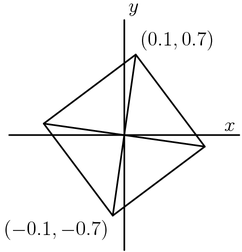
Let $S$ be the square one of whose diagonals has endpoints $(1/10,7/10)$ and $(-1/10,-7/10)$. A point $v=(x,y)$ is chosen uniformly at random over all pairs of real numbers $x$ and $y$ such that $0 \le x \le 2012$ and $0\le y\le 2012$. Let $T(v)$ be a translated copy of $S$ centered at $v$. What is the probability that the square region determined by $T(v)$ contains exactly two points with integer coefficients in its interior?
设 $S$ 是一个正方形,其一条对角线的端点为 $(1/10,7/10)$ 和 $(-1/10,-7/10)$。点 $v=(x,y)$ 在所有满足 $0 \le x \le 2012$ 且 $0\le y\le 2012$ 的实数对 $(x,y)$ 中均匀随机选取。设 $T(v)$ 为以 $v$ 为中心的 $S$ 的平移拷贝。由 $T(v)$ 确定的正方形区域在其内部恰好包含两个整数坐标点的概率是多少?
Correct Answer: C
The unit square's diagonal has a length of $\sqrt{0.2^2 + 1.4^2} = \sqrt{2}$. Because $S$ square is not parallel to the axis, the two points must be adjacent. Now consider the unit square $U$ with vertices $(0,0), (1,0), (1,1)$ and $(0,1)$. Let us first consider only two vertices, $(0,0)$ and $(1,0)$. We want to find the area of the region within $U$ that the point $v=(x,y)$ will create the translation of $S$, $T(v)$ such that it covers both $(0,0)$ and $(1,0)$. By symmetry, there will be three equal regions that cover the other pairs of adjacent vertices. For $T(v)$ to contain the point $(0,0)$, $v$ must be inside square $S$. Similarly, for $T(v)$ to contain the point $(1,0)$, $v$ must be inside a translated square $S$ with center at $(1,0)$, which we will call $S'$. Therefore, the area we seek is Area$(U \cap S \cap S')$. To calculate the area, we notice that Area$(U \cap S \cap S') = \frac{1}{2} \cdot$ Area$(S \cap S')$ by symmetry. Let $S_1 = (0.1, 0.7), S_2 = (0.7, -0.1), S'_1 = (1.1, 0.7), S'_2 = (0.3, 0.1)$. Let $M = (0.7, 0.4)$ be the midpoint of $S'_1S'_2$, and $N = (0.7, 0.7)$ along the line $S_1S'_1$. Let $I$ be the intersection of $S$ and $S'$ within $U$, and $J$ be the intersection of $S$ and $S'$ outside $U$. Therefore, the area we seek is $\frac{1}{2} \cdot$ Area$(S \cap S') = \frac{1}{2} [IS'_2JS_2]$. Because $S_2, M, N$ all have $x$ coordinate $0.7$, they are collinear. Noting that the side length of $S$ and $S'$ is $1$ (as shown above), we also see that $S_2M = MS'_1 = 0.5$, so $\triangle{S'_1NM} \cong \triangle{S_2IM}$. If follows that $IS_2 = NS'_1 = 1.1 - 0.7 = 0.4$ and $IS'_2 = MS'_2 - MI = MS'_2 - MN = 0.5 - 0.3 = 0.2$. Therefore, the area is $\frac{1}{2} \cdot$ Area$(S \cap S') = \frac{1}{2} [IS'_2JS_2] = \frac{1}{2} \cdot 0.2 \cdot 0.4 = 0.04$. Because there are three other regions in the unit square $U$ that we need to count, the total area of $v$ within $U$ such that $T(v)$ contains two adjacent lattice points is $0.04 \cdot 4 = 0.16$. By periodicity, this probability is the same for all $0 \le x \le 2012$ and $0 \le y \le 2012$. Therefore, the answer is $0.16 = \boxed{\frac{4}{25} \textbf{(C)} }$
单位正方形的对角线长度为 $\sqrt{0.2^2 + 1.4^2} = \sqrt{2}$。由于正方形 $S$ 不与坐标轴平行,这两个点必须是相邻的。 现在考虑单位正方形 $U$,其顶点为 $(0,0), (1,0), (1,1)$ 和 $(0,1)$。先只考虑两个顶点 $(0,0)$ 与 $(1,0)$。我们要找出 $U$ 内使得点 $v=(x,y)$ 所生成的平移正方形 $T(v)$ 同时覆盖 $(0,0)$ 与 $(1,0)$ 的区域面积。由对称性,覆盖其他三对相邻顶点的区域面积相同。 要使 $T(v)$ 包含点 $(0,0)$,$v$ 必须在正方形 $S$ 内。同理,要使 $T(v)$ 包含点 $(1,0)$,$v$ 必须在以 $(1,0)$ 为中心的平移正方形内,记为 $S'$。因此所求面积为 Area$(U \cap S \cap S')$。 为计算该面积,注意到由对称性 Area$(U \cap S \cap S') = \frac{1}{2} \cdot$ Area$(S \cap S')$。设 $S_1 = (0.1, 0.7), S_2 = (0.7, -0.1), S'_1 = (1.1, 0.7), S'_2 = (0.3, 0.1)$。令 $M = (0.7, 0.4)$ 为 $S'_1S'_2$ 的中点,$N = (0.7, 0.7)$ 在直线 $S_1S'_1$ 上。令 $I$ 为 $S$ 与 $S'$ 在 $U$ 内的交点,$J$ 为 $S$ 与 $S'$ 在 $U$ 外的交点。则所求面积为 $\frac{1}{2} \cdot$ Area$(S \cap S') = \frac{1}{2} [IS'_2JS_2]$。由于 $S_2, M, N$ 的 $x$ 坐标均为 $0.7$,它们共线。注意到 $S$ 与 $S'$ 的边长均为 $1$(如上所示),且 $S_2M = MS'_1 = 0.5$,所以 $\triangle{S'_1NM} \cong \triangle{S_2IM}$。因此 $IS_2 = NS'_1 = 1.1 - 0.7 = 0.4$,且 $IS'_2 = MS'_2 - MI = MS'_2 - MN = 0.5 - 0.3 = 0.2$。于是面积为 $\frac{1}{2} \cdot$ Area$(S \cap S') = \frac{1}{2} [IS'_2JS_2] = \frac{1}{2} \cdot 0.2 \cdot 0.4 = 0.04$。 由于在单位正方形 $U$ 中还有另外三个需要计数的相同区域,使得 $T(v)$ 包含两相邻格点的 $v$ 的总面积为 $0.04 \cdot 4 = 0.16$。 由周期性,这个概率对所有 $0 \le x \le 2012$ 且 $0 \le y \le 2012$ 都相同。因此答案为 $0.16 = \boxed{\frac{4}{25} \textbf{(C)} }$。
solution
Q24
Let $\{a_k\}_{k=1}^{2011}$ be the sequence of real numbers defined by $a_1=0.201,$ $a_2=(0.2011)^{a_1},$ $a_3=(0.20101)^{a_2},$ $a_4=(0.201011)^{a_3}$, and in general, \[a_k=\begin{cases}(0.\underbrace{20101\cdots 0101}_{k+2\text{ digits}})^{a_{k-1}}\qquad\text{if }k\text{ is odd,}\\(0.\underbrace{20101\cdots 01011}_{k+2\text{ digits}})^{a_{k-1}}\qquad\text{if }k\text{ is even.}\end{cases}\] Rearranging the numbers in the sequence $\{a_k\}_{k=1}^{2011}$ in decreasing order produces a new sequence $\{b_k\}_{k=1}^{2011}$. What is the sum of all integers $k$, $1\le k \le 2011$, such that $a_k=b_k?$
设 $\{a_k\}_{k=1}^{2011}$ 为实数序列,定义为 $a_1=0.201,$ $a_2=(0.2011)^{a_1},$ $a_3=(0.20101)^{a_2},$ $a_4=(0.201011)^{a_3}$,一般地, \[a_k=\begin{cases}(0.\underbrace{20101\cdots 0101}_{k+2\text{ digits}})^{a_{k-1}}\qquad\text{if }k\text{ is odd,}\\(0.\underbrace{20101\cdots 01011}_{k+2\text{ digits}})^{a_{k-1}}\qquad\text{if }k\text{ is even.}\end{cases}\] 将序列 $\{a_k\}_{k=1}^{2011}$ 中的数按降序重排得到新序列 $\{b_k\}_{k=1}^{2011}$。所有满足 $a_k=b_k$ 的整数 $k$($1\le k \le 2011$)之和是多少?
Correct Answer: C
First, we must understand two important functions: $f(x) = b^x$ for $0 < b < 1$(decreasing exponential function), and $g(x) = x^k$ for $k > 0$(increasing power function for positive $x$). $f(x)$ is used to establish inequalities when we change the exponent and keep the base constant. $g(x)$ is used to establish inequalities when we change the base and keep the exponent constant. We will now examine the first few terms. Comparing $a_1$ and $a_2$, $0 < a_1 = (0.201)^1 < (0.201)^{a_1} < (0.2011)^{a_1} = a_2 < 1 \Rightarrow 0 < a_1 < a_2 < 1$. Therefore, $0 < a_1 < a_2 < 1$. Comparing $a_2$ and $a_3$, $0 < a_3 = (0.20101)^{a_2} < (0.20101)^{a_1} < (0.2011)^{a_1} = a_2 < 1 \Rightarrow 0 < a_3 < a_2 < 1$. Comparing $a_1$ and $a_3$, $0 < a_1 = (0.201)^1 < (0.201)^{a_2} < (0.20101)^{a_2} = a_3 < 1 \Rightarrow 0 < a_1 < a_3 < 1$. Therefore, $0 < a_1 < a_3 < a_2 < 1$. Comparing $a_3$ and $a_4$, $0 < a_3 = (0.20101)^{a_2} < (0.20101)^{a_3} < (0.201011)^{a_3} = a_4 < 1 \Rightarrow 0 < a_3 < a_4 < 1$. Comparing $a_2$ and $a_4$, $0 < a_4 = (0.201011)^{a_3} < (0.201011)^{a_1} < (0.2011)^{a_1} = a_2 < 1 \Rightarrow 0 < a_4 < a_2 < 1$. Therefore, $0 < a_1 < a_3 < a_4 < a_2 < 1$. Continuing in this manner, it is easy to see a pattern(see Note 1). Therefore, the only $k$ when $a_k = b_k$ is when $2(k-1006) = 2011 - k$. Solving gives $\boxed{\textbf{(C)} 1341}$. Note 1: We claim that $0 < a_1 < a_3 < ... < a_{2011} < a_{2010} < ... < a_4 < a_2 < 1$. We can use induction to prove this statement. (not necessary for AMC): Base Case: We have already shown the base case above, where $0 < a_1 < a_2 < 1$. Inductive Step: Rearranging in decreasing order gives $1 > b_1 = a_2 > b_2 = a_4 > ... > b_{1005} = a_{2010} > b_{1006} = a_{2011} > ... > b_{2010} = a_3 > b_{2011} = a_1 > 0$.
首先,我们必须理解两个重要函数:当 $0 < b < 1$ 时,$f(x) = b^x$(递减的指数函数);当 $k > 0$ 时,$g(x) = x^k$(对正 $x$ 递增的幂函数)。当改变指数而保持底数不变时,用 $f(x)$ 建立不等式;当改变底数而保持指数不变时,用 $g(x)$ 建立不等式。 现在考察前几项。 比较 $a_1$ 与 $a_2$,有 $0 < a_1 = (0.201)^1 < (0.201)^{a_1} < (0.2011)^{a_1} = a_2 < 1 \Rightarrow 0 < a_1 < a_2 < 1$。 因此,$0 < a_1 < a_2 < 1$。 比较 $a_2$ 与 $a_3$,有 $0 < a_3 = (0.20101)^{a_2} < (0.20101)^{a_1} < (0.2011)^{a_1} = a_2 < 1 \Rightarrow 0 < a_3 < a_2 < 1$。 比较 $a_1$ 与 $a_3$,有 $0 < a_1 = (0.201)^1 < (0.201)^{a_2} < (0.20101)^{a_2} = a_3 < 1 \Rightarrow 0 < a_1 < a_3 < 1$。 因此,$0 < a_1 < a_3 < a_2 < 1$。 比较 $a_3$ 与 $a_4$,有 $0 < a_3 = (0.20101)^{a_2} < (0.20101)^{a_3} < (0.201011)^{a_3} = a_4 < 1 \Rightarrow 0 < a_3 < a_4 < 1$。 比较 $a_2$ 与 $a_4$,有 $0 < a_4 = (0.201011)^{a_3} < (0.201011)^{a_1} < (0.2011)^{a_1} = a_2 < 1 \Rightarrow 0 < a_4 < a_2 < 1$。 因此,$0 < a_1 < a_3 < a_4 < a_2 < 1$。 继续这样比较下去,很容易看出一个规律(见注 1)。 因此,满足 $a_k = b_k$ 的 $k$ 只能在 $2(k-1006) = 2011 - k$ 时出现。解得 $\boxed{\textbf{(C)} 1341}$。 注 1: 我们断言 $0 < a_1 < a_3 < ... < a_{2011} < a_{2010} < ... < a_4 < a_2 < 1$。 可用归纳法证明该结论(AMC 不要求): 基础情形:上面已证明 $0 < a_1 < a_2 < 1$。 归纳步骤: 按降序重排得到 $1 > b_1 = a_2 > b_2 = a_4 > ... > b_{1005} = a_{2010} > b_{1006} = a_{2011} > ... > b_{2010} = a_3 > b_{2011} = a_1 > 0$。
Q25
Let $f(x)=|2\{x\}-1|$ where $\{x\}$ denotes the fractional part of $x$. The number $n$ is the smallest positive integer such that the equation \[nf(xf(x))=x\] has at least $2012$ real solutions. What is $n$? Note: the fractional part of $x$ is a real number $y=\{x\}$ such that $0\le y<1$ and $x-y$ is an integer.
设 $f(x)=|2\{x\}-1|$,其中 $\{x\}$ 表示 $x$ 的小数部分。$n$ 是使得方程 \[nf(xf(x))=x\] 至少有 $2012$ 个实数解的最小正整数。求 $n$。注:$x$ 的小数部分是实数 $y=\{x\}$,满足 $0\le y<1$ 且 $x-y$ 是整数。
Correct Answer: C
Our goal is to determine how many times the graph of $nf(xf(x))=x$ intersects the graph of $y=x$. (Conversely, we can also divide the equation by $n$ to get $f(xf(x))=\frac{x}{n}$ and look at the graph $y=\frac{x}{n}$) We begin by analyzing the behavior of $\{x\}$. It increases linearly with a slope of one, then when it reaches the next integer, it repeats itself. We can deduce that the function is like a sawtooth wave, with a period of one. We then analyze the function $f(x)=|2\{x\}-1|$. The slope of the teeth is multiplied by 2 to get 2, and the function is moved one unit downward. The function can then be described as starting at -1, moving upward with a slope of 2 to get to 1, and then repeating itself, still with a period of 1. The absolute value of the function is then taken. This results in all the negative segments becoming flipped in the Y direction. The positive slope starting at -1 of the function ranging from $u$ to $u.5$, where u is any arbitrary integer, is now a negative slope starting at positive 1. The function now looks like the letter V repeated within every square in the first row. It is now that we address the goal of this, which is to determine how many times the function intersects the line $y=x$. Since there are two line segments per box, the function has two chances to intersect the line $y=x$ for every integer. If the height of the function is higher than $y=x$ for every integer on an interval, then every chance within that interval intersects the line. Returning to analyzing the function, we note that it is multiplied by $x$, and then fed into $f(x)$. Since $f(x)$ is a periodic function, we can model it as multiplying the function's frequency by $x$. This gives us $2x$ chances for every integer, which is then multiplied by 2 once more to get $4x$ chances for every integer. The amplitude of this function is initially 1, and then it is multiplied by $n$, to give an amplitude of $n$. The function intersects the line $y=x$ for every chance in the interval of $0\leq x \leq n$, since the function is n units high. The function ceases to intersect $y=x$ when $n < x$, since the height of the function is lower than $y=x$. The number of times the function intersects $y=x$ is then therefore equal to $4+8+12...+4n$. We want this sum to be greater than 2012 which occurs when $n=32 \Rightarrow \boxed{(C)}$ .
我们的目标是确定图像 $nf(xf(x))=x$ 与图像 $y=x$ 相交的次数。(等价地,也可以将方程两边除以 $n$ 得到 $f(xf(x))=\frac{x}{n}$,并考察图像 $y=\frac{x}{n}$。) 先分析 $\{x\}$ 的行为。它以斜率 1 线性增加,当达到下一个整数时又重复。可知该函数像锯齿波,周期为 1。再分析 $f(x)=|2\{x\}-1|$。锯齿的斜率乘以 2 变为 2,并整体下移 1 个单位。该函数可描述为从 -1 开始,以斜率 2 上升到 1,然后仍以周期 1 重复。接着取绝对值,使所有负的部分关于 $x$ 轴翻折。原来从 $u$ 到 $u.5$($u$ 为任意整数)那段从 -1 开始的正斜率线段,变成从正 1 开始的负斜率线段。于是函数在每个单位方格内都呈现重复的字母 V 形。 现在回到目标:确定该函数与直线 $y=x$ 相交的次数。由于每个方格内有两段线段,所以对每个整数区间函数有两次机会与 $y=x$ 相交。若在某个区间内函数的高度对每个整数都高于 $y=x$,则该区间内的每一次机会都会与直线相交。 继续分析该函数:它先乘以 $x$,再代入 $f(x)$。由于 $f(x)$ 是周期函数,可将其视为把函数的频率乘以 $x$,从而每个整数区间有 $2x$ 次机会,再乘以 2 得到每个整数区间有 $4x$ 次机会。该函数的振幅最初为 1,再乘以 $n$ 后振幅为 $n$。当 $0\leq x \leq n$ 时,由于函数高度为 $n$,每一次机会都会与直线 $y=x$ 相交;当 $x>n$ 时,函数高度低于 $y=x$,不再相交。 因此与 $y=x$ 的交点总数为 $4+8+12+\cdots+4n$。要求该和大于 2012,满足时 $n=32 \Rightarrow \boxed{(C)}$。