A power boat and a raft both left dock $A$ on a river and headed downstream. The raft drifted at the speed of the river current. The power boat maintained a constant speed with respect to the river. The power boat reached dock $B$ downriver, then immediately turned and traveled back upriver. It eventually met the raft on the river 9 hours after leaving dock $A.$ How many hours did it take the power boat to go from $A$ to $B$?
一艘机动船和一个木筏都从河上的码头 $A$ 出发,向下游行驶。木筏以河水流速漂流。机动船相对于河水保持恒定速度。机动船到达下游码头 $B$ 后立刻掉头向上游行驶。它在离开码头 $A$ 后 $9$ 小时在河上与木筏相遇。机动船从 $A$ 到 $B$ 用了多少小时?
WLOG, let the speed of the river be 0. This is allowed because the problem never states that the speed of the current has to have a magnitude greater than 0. In this case, when the powerboat travels from $A$ to $B$, the raft remains at $A$. Thus the trip from $A$ to $B$ takes the same time as the trip from $B$ to the raft. Since these times are equal and sum to $9$ hours, the trip from $A$ to $B$ must take half this time, or $4.5$ hours. The answer is thus $\boxed{\textbf{D}}$.
Remark: This is equivalent to viewing the problem from the raft's perspective.
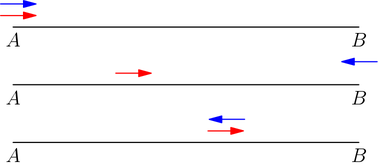
What's important in this problem is to consider everything in terms of the power boat and the raft, since that is how the problem is given to us. Think of the blue arrow as the power boat and the red arrow as the raft in the following three diagrams, which represent different time intervals of the problem.
Thinking about the distance covered as their distances with respect to each other, they are $0$ distance apart in the first diagram when they haven't started to move yet, some distance $d$ apart in the second diagram when the power boat reaches $B$, and again $0$ distance apart in the third diagram when they meet. Therefore, with respect to each other, the boat and the raft cover a distance of $d$ on the way there, and again cover a distance of $d$ on when drawing closer. This makes sense, because from the 1st diagram to the second, the raft moves in the same direction as the boat, while from the 2nd to the 3rd, the boat and raft move in opposite directions.
Let $b$ denote the speed of the power boat (only the power boat, not factoring in current) and $r$ denote the speed of the raft, which, as given by the problem, is also equal to the speed of the current. Thus, from $A$ to $B$, the boat travels at a velocity of $b+r$, and on the way back, travels at a velocity of $-(b-r)=r-b$, since the current aids the boat on the way there, and goes against the boat on the way back. With respect to the raft then, the boat's velocity from $A$ to $B$ becomes $(r+b)-r=b$, and on the way back it becomes $(r-b)-r=-b$. Since the boat's velocities with respect to the raft are exact opposites, $b$ and $-b$, we therefore know that the boat and raft travel apart from each other at the same rate that they travel toward each other.
From this, we have that the boat travels a distance $d$ at rate $b$ with respect to the raft both on the way to $B$ and on the way back. Thus, using $\dfrac{distance}{speed}=time$, we have $\dfrac{2d}{b}=9\text{ hours}$, and to see how long it took to travel half the distance, we have $\dfrac{d}{b}=4.5\text{ hours}\implies\boxed{\textbf{D}}$
Let $t$ be the time it takes the power boat to go from $A$ to $B$ in hours, $r$ be the speed of the river current (and thus also the raft), and $p$ to be the speed of the power boat with respect to the river.
Using $d = rt$, the raft covers a distance of $9r$, the distance from $A$ to $B$ is $(p + r)t$, and the distance from $B$ to where the raft and power boat met up is $(9 - t)(p - r)$.
Then, $9r + (9 - t)(p - r) = (p + r)t$. Solving for $t$, we get $t = 4.5$, which is $\boxed{\textbf{D}}$.
不失一般性,令河水流速为 $0$。这是允许的,因为题目并未说明水流速度必须大于 $0$。在这种情况下,机动船从 $A$ 到 $B$ 时,木筏一直停在 $A$。因此机动船从 $A$ 到 $B$ 的时间与从 $B$ 到木筏的时间相同。两段时间相等且和为 $9$ 小时,所以从 $A$ 到 $B$ 的时间为其一半,即 $4.5$ 小时。答案为 $\boxed{\textbf{D}}$。
备注:这等价于从木筏的参考系观察该问题。
本题关键是用机动船与木筏之间的相对运动来考虑,因为题目就是这样给出的。把下面三个示意图中的蓝色箭头看作机动船、红色箭头看作木筏,它们分别表示题目的不同时间段。
从相对距离来看:第一幅图出发前两者相距 $0$;第二幅图机动船到达 $B$ 时两者相距某个距离 $d$;第三幅图相遇时两者又相距 $0$。因此相对于彼此,机动船与木筏先“分开”了距离 $d$,再“靠近”了距离 $d$。这也合理:从第一幅到第二幅,木筏与船同向运动;从第二幅到第三幅,船与木筏反向运动。
设 $b$ 为机动船相对于河水的速度(仅机动船自身速度,不计水流),设 $r$ 为木筏速度,而题意给出它也等于水流速度。则从 $A$ 到 $B$,船的速度为 $b+r$;返程时速度为 $-(b-r)=r-b$,因为去程水流助推,回程水流阻碍。相对于木筏而言,去程船的速度为 $(r+b)-r=b$,回程为 $(r-b)-r=-b$。由于相对于木筏的速度分别为 $b$ 与 $-b$,互为相反数,所以船与筏分开的速率与靠近的速率相同。
因此相对于木筏,船去程与回程都以速率 $b$ 走了距离 $d$。由 $\dfrac{distance}{speed}=time$,得 $\dfrac{2d}{b}=9\text{ hours}$,所以走一半距离所用时间为 $\dfrac{d}{b}=4.5\text{ hours}\implies\boxed{\textbf{D}}$
设 $t$ 为机动船从 $A$ 到 $B$ 的时间(小时),$r$ 为水流速度(也即木筏速度),$p$ 为机动船相对于河水的速度。
由 $d = rt$,木筏走过的距离为 $9r$;$A$ 到 $B$ 的距离为 $(p + r)t$;从 $B$ 到相遇点的距离为 $(9 - t)(p - r)$。
于是 $9r + (9 - t)(p - r) = (p + r)t$。解得 $t = 4.5$,即 $\boxed{\textbf{D}}$。