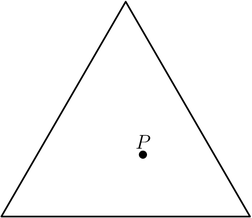
A point P is chosen at random in the interior of equilateral triangle $ABC$. What is the probability that $\triangle ABP$ has a greater area than each of $\triangle ACP$ and $\triangle BCP$?
在等边三角形 $ABC$ 的内部随机选择一点 $P$。$\triangle ABP$ 的面积大于 $\triangle ACP$ 和 $\triangle BCP$ 中每一个的概率是多少?
After we pick point $P$, we realize that $ABC$ is symmetric for this purpose, and so the probability that $ACP$ is the greatest area, or $ABP$ or $BCP$, are all the same. Since they add to $1$, the probability that $ABP$ has the greatest area is $\boxed{\mathrm{(C)}\ \dfrac{1}{3}}$
We will use geometric probability. Let us take point $P$, and draw the perpendiculars to $BC$, $CA$, and $AB$, and call the feet of these perpendiculars $D$, $E$, and $F$ respectively. The area of $\triangle ACP$ is simply $\frac{1}{2} * AC * PF$. Similarly we can find the area of triangles $BCP$ and $ABP$. If we add these up and realize that it equals the area of the entire triangle, we see that no matter where we choose $P, PD + PE + PF$ = the height of the triangle. Setting the area of triangle $ABP$ greater than $ACP$ and $BCP$, we want $PF$ to be the largest of $PF$, $PD$, and $PE$. We then realize that $PF = PD = PE$ when $P$ is the incenter of $\triangle ABC$. Let us call the incenter of the triangle $Q$. If we want $PF$ to be the largest of the three, by testing points we realize that $P$ must be in the interior of quadrilateral $QDCE$. So our probability (using geometric probability) is the area of $QDCE$ divided by the area of $ABC$. We will now show that the three quadrilaterals, $QDCE$, $QEAF$, and $QFBD$ are congruent. As the definition of point $Q$ yields, $QF$ = $QD$ = $QE$. Since $ABC$ is equilateral, $Q$ is also the circumcenter of $\triangle ABC$, so $QA = QB = QC$. By the Pythagorean Theorem, $BD = DC = CE = EA = AF = FB$. Also, angles $BDQ, BFQ, CEQ, CDQ, AFQ$, and $AEQ$ are all equal to $90^\circ$. Angles $DBF, FAE, ECD$ are all equal to $60$ degrees, so it is now clear that quadrilaterals $QDCE, QEAF, QFBD$ are all congruent. Summing up these areas gives us the area of $\triangle ABC$. $QDCE$ contributes to a third of that area so $\frac{[QDCE]}{[ABC]}=\boxed{\mathrm{(C)}\ \dfrac{1}{3}}$.
选定点 $P$ 后,由于 $ABC$ 关于此问题具有对称性,$\triangle ACP$ 的面积最大、或 $\triangle ABP$ 的面积最大、或 $\triangle BCP$ 的面积最大,这三种情况的概率相同。由于它们的概率之和为 $1$,所以 $\triangle ABP$ 的面积最大的概率为 $\boxed{\mathrm{(C)}\ \dfrac{1}{3}}$
我们用几何概率。取点 $P$,分别向 $BC$、$CA$、$AB$ 作垂线,垂足分别为 $D$、$E$、$F$。$\triangle ACP$ 的面积为 $\frac{1}{2} * AC * PF$。同理可得 $\triangle BCP$ 与 $\triangle ABP$ 的面积。将三者相加并注意到它等于整个三角形的面积,可知无论 $P$ 取在何处,$PD + PE + PF$ 等于三角形的高。要使 $\triangle ABP$ 的面积大于 $\triangle ACP$ 和 $\triangle BCP$,我们需要 $PF$ 在 $PF$、$PD$、$PE$ 中最大。又可知当 $P$ 为 $\triangle ABC$ 的内心时有 $PF = PD = PE$。设内心为 $Q$。若要使 $PF$ 为三者中最大,通过检验点的位置可知 $P$ 必须位于四边形 $QDCE$ 的内部。因此所求概率(用几何概率)为 $QDCE$ 的面积除以 $ABC$ 的面积。下面证明三个四边形 $QDCE$、$QEAF$、$QFBD$ 全等。由点 $Q$ 的定义,$QF$ = $QD$ = $QE$。由于 $ABC$ 为等边三角形,$Q$ 也是 $\triangle ABC$ 的外心,所以 $QA = QB = QC$。由勾股定理,$BD = DC = CE = EA = AF = FB$。并且 $BDQ, BFQ, CEQ, CDQ, AFQ, AEQ$ 这些角都等于 $90^\circ$。角 $DBF, FAE, ECD$ 都等于 $60$ 度,因此四边形 $QDCE, QEAF, QFBD$ 全等。它们面积之和为 $\triangle ABC$ 的面积,$QDCE$ 占其中三分之一,所以 $\frac{[QDCE]}{[ABC]}=\boxed{\mathrm{(C)}\ \dfrac{1}{3}}$。