/

AMC12 2003 A

You are not logged in. After submit, your report may not be available on other devices. Login

AMC12 · 2003 (A)

Q1
What is the difference between the sum of the first $2003$ even counting numbers and the sum of the first $2003$ odd counting numbers?
前 $2003$ 个偶计数数之和与前 $2003$ 个奇计数数之和的差是多少?
Correct Answer: D
The first $2003$ even counting numbers are $2,4,6,...,4006$. The first $2003$ odd counting numbers are $1,3,5,...,4005$. Thus, the problem is asking for the value of $(2+4+6+...+4006)-(1+3+5+...+4005)$. $(2+4+6+...+4006)-(1+3+5+...+4005) = (2-1)+(4-3)+(6-5)+...+(4006-4005)$ $= 1+1+1+...+1 = \boxed{\mathrm{(D)}\ 2003}$ The answer is 2003
前 $2003$ 个偶计数数是 $2,4,6,...,4006$。 前 $2003$ 个奇计数数是 $1,3,5,...,4005$。 因此,本题要求的是 $(2+4+6+...+4006)-(1+3+5+...+4005)$ 的值。 $(2+4+6+...+4006)-(1+3+5+...+4005) = (2-1)+(4-3)+(6-5)+...+(4006-4005)$ $= 1+1+1+...+1 = \boxed{\mathrm{(D)}\ 2003}$ 答案是 2003
Q2
Members of the Rockham Soccer League buy socks and T-shirts. Socks cost \$4 per pair and each T-shirt costs \$5 more than a pair of socks. Each member needs one pair of socks and a shirt for home games and another pair of socks and a shirt for away games. If the total cost is \$2366, how many members are in the League?
Rockham 足球联盟的成员购买袜子和 T 恤。袜子每双 $4 美元,每件 T 恤比一双袜子贵 $5 美元。每位成员需要一双袜子和一件上衣用于主场比赛,另外还需要一双袜子和一件上衣用于客场比赛。若总费用为 $2366 美元,联盟共有多少名成员?
Correct Answer: B
Since T-shirts cost $5$ dollars more than a pair of socks, T-shirts cost $5+4=9$ dollars. Since each member needs $2$ pairs of socks and $2$ T-shirts, the total cost for $1$ member is $2(4+9)=26$ dollars. Since $2366$ dollars was the cost for the club, and $26$ was the cost per member, the number of members in the League is $2366\div 26=\boxed{\mathrm{(B)}\ 91}$.
由于 T 恤比一双袜子贵 $5$ 美元,而袜子每双 $4$ 美元,所以 T 恤价格为 $5+4=9$ 美元。 每位成员需要 $2$ 双袜子和 $2$ 件 T 恤,因此 1 位成员的总费用为 $2(4+9)=26$ 美元。 俱乐部总费用为 $2366$ 美元,每位成员费用为 $26$ 美元,所以联盟成员人数为 $2366\div 26=\boxed{\mathrm{(B)}\ 91}$。
Q3
A solid box is $15$ cm by $10$ cm by $8$ cm. A new solid is formed by removing a cube $3$ cm on a side from each corner of this box. What percent of the original volume is removed?
一个实心长方体盒子的尺寸为 $15$ cm $\times 10$ cm $\times 8$ cm。从这个盒子的每个角上都切去一个边长为 $3$ cm 的立方体,形成一个新的实心体。被切去的体积占原体积的百分之多少?
Correct Answer: D
The volume of the original box is $15\cdot10\cdot8=1200.$ The volume of each cube that is removed is $3\cdot3\cdot3=27.$ Since there are $8$ corners on the box, $8$ cubes are removed. So the total volume removed is $8\cdot27=216$. Therefore, the desired percentage is $\frac{216}{1200}\cdot100 = \boxed{\mathrm{(D)}\ 18\%}.$
原盒子的体积为 $15\cdot10\cdot8=1200.$ 每个被切去的立方体体积为 $3\cdot3\cdot3=27.$ 由于盒子有 $8$ 个角,所以共切去 $8$ 个立方体。 因此被切去的总体积为 $8\cdot27=216$。 所求百分比为 $\frac{216}{1200}\cdot100 = \boxed{\mathrm{(D)}\ 18\%}.$
Q4
It takes Anna $30$ minutes to walk uphill $1$ km from her home to school, but it takes her only $10$ minutes to walk from school to her home along the same route. What is her average speed, in km/hr, for the round trip?
Anna 从家到学校沿同一路线上坡走 $1$ km 需要 $30$ 分钟,但从学校沿同一路线回家只需要 $10$ 分钟。她往返的平均速度是多少(单位:km/hr)?
Correct Answer: A
Since she walked $1$ km to school and $1$ km back home, her total distance is $1+1=2$ km. Since she spent $30$ minutes walking to school and $10$ minutes walking back home, her total time is $30+10=40$ minutes = $\frac{40}{60}=\frac{2}{3}$ hours. Therefore her average speed in km/hr is $\frac{2}{\left(\frac{2}{3}\right)}=\boxed{\mathrm{(A)}\ 3}$.
她去学校走了 $1$ km,回家又走了 $1$ km,所以总路程为 $1+1=2$ km。 她去学校用时 $30$ 分钟,回家用时 $10$ 分钟,所以总时间为 $30+10=40$ 分钟 = $\frac{40}{60}=\frac{2}{3}$ 小时。 因此她的平均速度(km/hr)为 $\frac{2}{\left(\frac{2}{3}\right)}=\boxed{\mathrm{(A)}\ 3}$。
Q5
The sum of the two 5-digit numbers $AMC10$ and $AMC12$ is $123422$. What is $A+M+C$?
两个五位数 $AMC10$ 和 $AMC12$ 的和为 $123422$。求 $A+M+C$。
Correct Answer: E
$AMC10+AMC12=123422$ $AMC00+AMC00=123400$ $AMC+AMC=1234$ $2\cdot AMC=1234$ $AMC=\frac{1234}{2}=617$ Since $A$, $M$, and $C$ are digits, $A=6$, $M=1$, $C=7$. Therefore, $A+M+C = 6+1+7 = \boxed{\mathrm{(E)}\ 14}$.
$AMC10+AMC12=123422$ $AMC00+AMC00=123400$ $AMC+AMC=1234$ $2\cdot AMC=1234$ $AMC=\frac{1234}{2}=617$ 由于 $A$、$M$、$C$ 都是数字,所以 $A=6$,$M=1$,$C=7$。 因此,$A+M+C = 6+1+7 = \boxed{\mathrm{(E)}\ 14}$。
Q6
Define $x \heartsuit y$ to be $|x-y|$ for all real numbers $x$ and $y$. Which of the following statements is not true?
定义 $x \heartsuit y$ 为 $|x-y|$,对所有实数 $x$ 和 $y$。以下哪个陈述不正确?
Correct Answer: C
We start by looking at the answers. Examining statement C, we notice: $x \heartsuit 0 = |x-0| = |x|$ $|x| eq x$ when $x<0$, but statement C says that it does for all $x$. Therefore the statement that is not true is $\boxed{\mathrm{(C)}\ x\heartsuit 0=x\ \text{for all}\ x}$
我们先看选项。检查陈述 C,我们注意到: $x \heartsuit 0 = |x-0| = |x|$ 当 $x<0$ 时,$|x| eq x$,但陈述 C 说对所有 $x$ 都成立。 因此不正确的陈述是 $\boxed{\mathrm{(C)}\ x\heartsuit 0=x\ \text{for all}\ x}$
Q7
How many non-congruent triangles with perimeter $7$ have integer side lengths?
周长为 $7$ 的非全等整数边三角形有多少个?
Correct Answer: B
By the triangle inequality, no side may have a length greater than the semiperimeter, which is $\frac{1}{2}\cdot7=3.5$. Since all sides must be integers, the largest possible length of a side is $3$. Therefore, all such triangles must have all sides of length $1$, $2$, or $3$. Since $2+2+2=6<7$, at least one side must have a length of $3$. Thus, the remaining two sides have a combined length of $7-3=4$. So, the remaining sides must be either $3$ and $1$ or $2$ and $2$. Therefore, the number of triangles is $\boxed{\mathrm{(B)}\ 2}$.
由三角形不等式,任一边长都不能大于半周长,即 $\frac{1}{2}\cdot7=3.5$。 由于三边都必须是整数,最大可能边长为 $3$。因此所有这样的三角形的边长只能是 $1$、$2$ 或 $3$。因为 $2+2+2=6<7$,至少有一条边长为 $3$。于是另外两边之和为 $7-3=4$,所以另外两边只能是 $3$ 和 $1$ 或 $2$ 和 $2$。因此三角形的个数为 $\boxed{\mathrm{(B)}\ 2}$。
Q8
What is the probability that a randomly drawn positive factor of $60$ is less than $7$?
随机抽取 $60$ 的一个正因数小于 $7$ 的概率是多少?
Correct Answer: E
For any positive integer $n$ which is not a perfect square, exactly half of its positive factors will be less than $\sqrt{n}$, since each such factor can be paired with one that is larger than $\sqrt{n}$. (By contrast, if $n$ is a perfect square, one of its factors will be exactly $\sqrt{n}$, which would therefore have to be paired with itself.) Since $60$ is indeed not a perfect square, it follows that half of its positive factors are less than $\sqrt{60} \approx 7.746$. This estimate clearly shows that there are not even any integers, let alone factors of $60$, between $7$ and $\sqrt{60}$. Accordingly, exactly half of the positive factors of $60$ are in fact less than $7$, so the answer is precisely $\boxed{\mathrm{(E)}\ \frac{1}{2}}$. Testing all positive integers less than $7$, we find that $1$, $2$, $3$, $4$, $5$, and $6$ all divide $60$. The prime factorization of $60$ is $2^2 \cdot 3 \cdot 5$, so using the standard formula for the number of divisors, the total number of divisors of $60$ is $3 \cdot 2 \cdot 2 = 12$. Therefore, the required probability is $\frac{6}{12} = \boxed{\mathrm{(E)}\ \frac{1}{2}}$. Though this is not recommended for reasons of time, one can simply write out all the factors of $60$, eventually finding that \[60 = 1 \cdot 60 = 2 \cdot 30 = 3 \cdot 20 = 4 \cdot 15 = 5 \cdot 12 = 6 \cdot 10.\] Hence $60$ has $12$ factors, of which $6$ are less than $7$ (namely, $1$, $2$, $3$, $4$, $5$, and $6$), so the answer is $\frac{6}{12} = \boxed{\mathrm{(E)}\ \frac{1}{2}}$.
对于任意不是完全平方数的正整数 $n$,其正因数中恰有一半小于 $\sqrt{n}$,因为每个这样的因数都可以与一个大于 $\sqrt{n}$ 的因数配对。(相反,如果 $n$ 是完全平方数,则有一个因数恰为 $\sqrt{n}$,因此它必须与自身配对。) 由于 $60$ 不是完全平方数,所以它的正因数中有一半小于 $\sqrt{60} \approx 7.746$。这个估计清楚地表明在 $7$ 与 $\sqrt{60}$ 之间甚至没有整数,更不用说 $60$ 的因数了。因此,$60$ 的正因数中恰有一半实际上小于 $7$,答案正是 $\boxed{\mathrm{(E)}\ \frac{1}{2}}$。
Q9
A set $S$ of points in the $xy$-plane is symmetric about the origin, both coordinate axes, and the line $y=x$. If $(2,3)$ is in $S$, what is the smallest number of points in $S$?
在 $xy$ 平面上的点集 $S$ 关于原点、两条坐标轴以及直线 $y=x$ 都对称。若 $(2,3)$ 在 $S$ 中,则 $S$ 中点的最小个数是多少?
Correct Answer: D
If $(2,3)$ is in $S$, then its reflection in the line $y = x$, i.e. $(3,2)$, is also in $S$. Now by reflecting these points in both coordinate axes, we quickly deduce that every point of the form $(\pm 2, \pm 3)$ or $(\pm 3, \pm 2)$ must be in $S$. Moreover, by drawing out this set of $8$ points, we observe that it satisfies all of the required symmetry conditions, so no more points need to be added to $S$. Accordingly, the smallest possible number of points in $S$ is precisely $\boxed{\mathrm{(D)}\ 8}$.
若 $(2,3)$ 在 $S$ 中,则它关于直线 $y = x$ 的对称点,即 $(3,2)$,也在 $S$ 中。再将这些点分别关于两条坐标轴对称,我们很快可推出所有形如 $(\pm 2, \pm 3)$ 或 $(\pm 3, \pm 2)$ 的点都必须在 $S$ 中。此外,把这 $8$ 个点画出来可观察到它们满足所有所需的对称条件,因此不需要再向 $S$ 中添加更多点。于是,$S$ 中点的最小可能个数为 $\boxed{\mathrm{(D)}\ 8}$。
Q10
Al, Bert, and Carl are the winners of a school drawing for a pile of Halloween candy, which they are to divide in a ratio of $3:2:1$, respectively. Due to some confusion they come at different times to claim their prizes, and each assumes he is the first to arrive. If each takes what he believes to be the correct share of candy, what fraction of the candy goes unclaimed?
Al、Bert 和 Carl 是学校一次万圣节糖果堆抽奖的获胜者,他们将分别按 $3:2:1$ 的比例分糖果。由于一些混乱,他们在不同时间来领取奖品,并且每个人都以为自己是第一个到的。如果每个人都拿走他认为正确的那份糖果,那么有多少比例的糖果无人领取?
Correct Answer: D
Because the ratios are $3:2:1$, Al, Bert, and Carl believe that they need to take $1/2$, $1/3$, and $1/6$ of the pile when they each arrive, respectively. After each person comes, $1/2$, $2/3$, and $5/6$ of the pile's size (just before each came) remains. The pile starts at $1$, and at the end $\frac{1}{2}\cdot \frac{2}{3}\cdot \frac{5}{6}\cdot 1 = \frac{5}{18}$ of the original pile goes unclaimed. (Note that because of the properties of multiplication, it does not matter what order the three come in.) Hence the answer is $\boxed{\mathrm{(D)}\ \dfrac{5}{18}}$.
因为比例是 $3:2:1$,所以 Al、Bert 和 Carl 分别认为自己需要拿走糖果堆的 $1/2$、$1/3$ 和 $1/6$。每个人来过之后,糖果堆(相对于他来之前的大小)分别剩下 $1/2$、$2/3$ 和 $5/6$。糖果堆初始为 $1$,最后无人领取的部分为 $\frac{1}{2}\cdot \frac{2}{3}\cdot \frac{5}{6}\cdot 1 = \frac{5}{18}$。 (注意由于乘法的性质,三人到达的顺序并不影响结果。)因此答案是 $\boxed{\mathrm{(D)}\ \dfrac{5}{18}}$。
Q11
A square and an equilateral triangle have the same perimeter. Let $A$ be the area of the circle circumscribed about the square and $B$ the area of the circle circumscribed around the triangle. Find $A/B$.
一个正方形和一个正三角形具有相同的周长。设 $A$ 为外接该正方形的圆的面积,$B$ 为外接该三角形的圆的面积。求 $A/B$。
Correct Answer: C
Suppose that the common perimeter is $P$. Then the side lengths of the square and the triangle are $\frac{P}{4}$ and $\frac{P}{3}$, respectively. The circle circumscribed about the square has a diameter equal to the diagonal of the square, which is therefore $\frac{P}{4} \cdot \sqrt{2} = \frac{P\sqrt{2}}{4}$, and so its radius is $\frac{\left(\frac{P\sqrt{2}}{4}\right)}{2} = \frac{P\sqrt{2}}{8}$. Hence the area of the circle is \[A = \pi\left(\frac{P\sqrt{2}}{8}\right)^2 = \pi \cdot \frac{2P^2}{64} = \frac{\pi P^2}{32}.\] Now consider the circle circumscribed around the equilateral triangle. By symmetry, its center must be the same as that of the triangle, so its radius is simply the distance from the center of the triangle to a vertex. Recalling that the centroid of any triangle divides its medians in the ratio $2:1$, and that the medians of an equilateral triangle are the same as its altitudes, we deduce that the radius is $\frac{2}{3}$ of the total length of an altitude. Since the side length of this triangle is $\frac{P}{3}$, the length of an altitude is $\frac{P}{3}\sin\left(60^{\circ}\right) = \frac{P}{3} \cdot \frac{\sqrt{3}}{2} = \frac{P\sqrt{3}}{6}$, so finally the radius is \[\frac{2}{3} \cdot \frac{P\sqrt{3}}{6} = \frac{P\sqrt{3}}{9},\] and thus the area of this circle is \[B = \pi\left(\frac{P\sqrt{3}}{9}\right)^2 = \pi \cdot \frac{3P^2}{81} = \frac{\pi P^2}{27}.\] This gives \[\frac{A}{B}=\frac{\left(\frac{\pi P^2}{32}\right)}{\left(\frac{\pi P^2}{27}\right)} = \frac{\pi P^2}{32} \cdot \frac{27}{\pi P^2}= \boxed{\mathrm{(C) \ } \frac{27}{32}}.\]
设共同的周长为 $P$。则正方形与三角形的边长分别为 $\frac{P}{4}$ 和 $\frac{P}{3}$。 外接正方形的圆的直径等于正方形的对角线,因此直径为 $\frac{P}{4} \cdot \sqrt{2} = \frac{P\sqrt{2}}{4}$,半径为 $\frac{\left(\frac{P\sqrt{2}}{4}\right)}{2} = \frac{P\sqrt{2}}{8}$。因此圆的面积为 \[A = \pi\left(\frac{P\sqrt{2}}{8}\right)^2 = \pi \cdot \frac{2P^2}{64} = \frac{\pi P^2}{32}.\] 再看外接正三角形的圆。由对称性,其圆心与三角形的中心重合,因此半径就是从三角形中心到一个顶点的距离。记得任意三角形的重心将中线按 $2:1$ 分割,而正三角形的中线与高相同,所以该半径等于高的总长度的 $\frac{2}{3}$。该三角形边长为 $\frac{P}{3}$,其高为 $\frac{P}{3}\sin\left(60^{\circ}\right) = \frac{P}{3} \cdot \frac{\sqrt{3}}{2} = \frac{P\sqrt{3}}{6}$,因此半径为 \[\frac{2}{3} \cdot \frac{P\sqrt{3}}{6} = \frac{P\sqrt{3}}{9},\] 从而该圆的面积为 \[B = \pi\left(\frac{P\sqrt{3}}{9}\right)^2 = \pi \cdot \frac{3P^2}{81} = \frac{\pi P^2}{27}.\] 于是 \[\frac{A}{B}=\frac{\left(\frac{\pi P^2}{32}\right)}{\left(\frac{\pi P^2}{27}\right)} = \frac{\pi P^2}{32} \cdot \frac{27}{\pi P^2}= \boxed{\mathrm{(C) \ } \frac{27}{32}}.\]
Q12
Sally has five red cards numbered $1$ through $5$ and four blue cards numbered $3$ through $6$. She stacks the cards so that the colors alternate and so that the number on each red card divides evenly into the number on each neighboring blue card. What is the sum of the numbers on the middle three cards?
Sally 有五张红色卡片,编号 $1$ 到 $5$,以及四张蓝色卡片,编号 $3$ 到 $6$。她将卡片堆叠,使得颜色交替,并且每张红色卡片上的数字都能整除与其相邻的每张蓝色卡片上的数字。中间三张卡片上的数字之和是多少?
Correct Answer: E
Let $R_i$ and $B_j$ designate the red card numbered $i$ and the blue card numbered $j$, respectively. $B_5$ is the only blue card that $R_5$ evenly divides, so $R_5$ must be at one end of the stack and $B_5$ must be the card next to it. $R_1$ is the only other red card that evenly divides $B_5$, so $R_1$ must be the other card next to $B_5$. $B_4$ is the only blue card that $R_4$ evenly divides, so $R_4$ must be at one end of the stack and $B_4$ must be the card next to it. $R_2$ is the only other red card that evenly divides $B_4$, so $R_2$ must be the other card next to $B_4$. $R_2$ doesn't evenly divide $B_3$, so $B_3$ must be next to $R_1$, $B_6$ must be next to $R_2$, and $R_3$ must be in the middle. This yields the following arrangement from top to bottom: $\{R_5,B_5,R_1,B_3,R_3,B_6,R_2,B_4,R_4\}$ Therefore, the sum of the numbers on the middle three cards is $3+3+6=\boxed{\mathrm{(E)}\ 12}$.
设 $R_i$ 表示编号为 $i$ 的红色卡片,$B_j$ 表示编号为 $j$ 的蓝色卡片。 $B_5$ 是唯一一张能被 $R_5$ 整除的蓝色卡片,所以 $R_5$ 必须在牌堆的一端,且 $B_5$ 必须紧挨着它。 $R_1$ 是唯一另一张能整除 $B_5$ 的红色卡片,所以 $R_1$ 必须是紧挨着 $B_5$ 的另一张卡片。 $B_4$ 是唯一一张能被 $R_4$ 整除的蓝色卡片,所以 $R_4$ 必须在牌堆的一端,且 $B_4$ 必须紧挨着它。 $R_2$ 是唯一另一张能整除 $B_4$ 的红色卡片,所以 $R_2$ 必须是紧挨着 $B_4$ 的另一张卡片。 $R_2$ 不能整除 $B_3$,所以 $B_3$ 必须挨着 $R_1$,$B_6$ 必须挨着 $R_2$,而 $R_3$ 必须在中间。 于是从上到下的排列为:$\{R_5,B_5,R_1,B_3,R_3,B_6,R_2,B_4,R_4\}$ 因此,中间三张卡片上的数字之和为 $3+3+6=\boxed{\mathrm{(E)}\ 12}$。
Q13
The polygon enclosed by the solid lines in the figure consists of 4 congruent squares joined edge-to-edge. One more congruent square is attached to an edge at one of the nine positions indicated. How many of the nine resulting polygons can be folded to form a cube with one face missing?
图中由实线围成的多边形由 $4$ 个全等的正方形边对边连接而成。再将一个全等正方形附着在所示九个位置之一的边上。九种得到的多边形中,有多少种可以折叠成一个缺少一个面的立方体?
stem
Correct Answer: E
Let the squares be labeled $A$, $B$, $C$, and $D$. When the polygon is folded, the "right" edge of square $A$ becomes adjacent to the "bottom edge" of square $C$, and the "bottom" edge of square $A$ becomes adjacent to the "bottom" edge of square $D$. So, any "new" square that is attatched to those edges will prevent the polygon from becoming a cube with one face missing. Therefore, squares $1$, $2$, and $3$ will prevent the polygon from becoming a cube with one face missing. Squares $4$, $5$, $6$, $7$, $8$, and $9$ will allow the polygon to become a cube with one face missing when folded. Thus the answer is $\boxed{\mathrm{(E)}\ 6}$. Another way to think of it is that a cube missing one face has $5$ of its $6$ faces. Since the shape has $4$ faces already, we need another face. The only way to add another face is if the added square does not overlap any of the others. $1$,$2$, and $3$ overlap, while squares $4$ to $9$ do not. The answer is $\boxed{\mathrm{(E)}\ 6}$ If you're good at visualizing, you can imagine each box and fold up the shape into a 3D shape. This solution is only recommended if you are either in a hurry or extremely skilled at visualizing. We find out that $4,5,6,7,8$ and $9$ work. Therefore, the answer is $\boxed{\mathrm{(E)}\ 6}$. ~Sophia866
将这四个正方形标记为 $A$、$B$、$C$、$D$。 当该多边形折叠时,正方形 $A$ 的“右边”会与正方形 $C$ 的“下边”相邻,而正方形 $A$ 的“下边”会与正方形 $D$ 的“下边”相邻。 因此,任何附着在这些边上的“新”正方形都会阻止该多边形折叠成一个缺少一个面的立方体。 所以,位置 $1$、$2$、$3$ 的正方形会阻止该多边形折叠成一个缺少一个面的立方体。 位置 $4$、$5$、$6$、$7$、$8$、$9$ 的正方形在折叠时都允许该多边形成为一个缺少一个面的立方体。 因此答案是 $\boxed{\mathrm{(E)}\ 6}$。 另一种思路是:缺少一个面的立方体有 $6$ 个面中的 $5$ 个。该图形已有 $4$ 个面,因此还需要再加一个面。添加一个面的唯一方式是所加的正方形在折叠后不与其他面重叠。位置 $1$、$2$、$3$ 会重叠,而位置 $4$ 到 $9$ 不会。答案是 $\boxed{\mathrm{(E)}\ 6}$ 如果你很擅长空间想象,可以把每种情况都想象成折成三维形状。我们发现 $4,5,6,7,8$ 和 $9$ 可行。因此答案是 $\boxed{\mathrm{(E)}\ 6}$. ~Sophia866
solution
Q14
Points $K, L, M,$ and $N$ lie in the plane of the square $ABCD$ such that $AKB$, $BLC$, $CMD$, and $DNA$ are equilateral triangles. If $ABCD$ has an area of 16, find the area of $KLMN$.
点 $K, L, M,$ 和 $N$ 位于正方形 $ABCD$ 的平面内,使得 $AKB$、$BLC$、$CMD$ 和 $DNA$ 都是正三角形。若 $ABCD$ 的面积为 16,求 $KLMN$ 的面积。
stem
Correct Answer: D
Since the area of square $\text{ABCD}$ is 16, the side length must be 4. Thus, the side length of triangle AKB is 4, and the height of $\text{AKB}$, and thus $\text{DMC}$, is $2\sqrt{3}$. The diagonal of the square $\text{KNML}$ will then be $4+4\sqrt{3}$. From here there are 2 ways to proceed: First: Since the diagonal is $4+4\sqrt{3}$, the side length is $\frac{4+4\sqrt{3}}{\sqrt{2}}$, and the area is thus $\frac{16+48+32\sqrt{3}}{2}=\boxed{\textbf{(D) } 32+16\sqrt{3}}$. Second: Since a square is a rhombus, the area of the square is $\frac{d_1d_2}{2}$, where $d_1$ and $d_2$ are the diagonals of the rhombus. Since the diagonal is $4+4\sqrt{3}$, the area is $\frac{(4+4\sqrt{3})^2}{2}=\boxed{\textbf{(D) } 32+16\sqrt{3}}$. Because $ABCD$ has area $16$, its side length is simply $\sqrt{16}\implies 4$. Angle chasing, we find that the angle of $KBL=360-(90+2(60))=360-(210)=150$. We also know that $KB=4, BL=4$. Using Law of Cosines, we find that side $(KL)^2=16+16-2(16)cos{150}\implies (KL)^2=32+\frac{32\sqrt{3}}{2}\implies (KL)^2=32+16\sqrt{3}$. However, the area of $KLMN$ is simply $(KL)^2$, hence the answer is $\boxed{\textbf{(D) } 32+16\sqrt{3}}$ First we show that $KLMN$ is a square. How? Show that it is a rhombus that has a right angle. $\angle{NAK}=\angle{KBL}=\angle{LCM}=\angle{DNM}=150^\circ$. All the sides of the equilateral triangles are equal, so the triangles are congruent. Notice that $\angle{KNL}=45^\circ$, etc, so $\angle{KNM}=90^\circ$. So we have a square. Instead of going to find $KN$ using Law of Cosines, we can inscribe the square in another bigger one and then subtract the four right triangles in the corners, so after all of this, we find that the answer is $\boxed{\textbf{(D) } 32+16\sqrt{3}}$
由于正方形 $\text{ABCD}$ 的面积为 16,其边长必为 4。因此,三角形 AKB 的边长为 4,而 $\text{AKB}$ 的高(也即 $\text{DMC}$ 的高)为 $2\sqrt{3}$。 于是正方形 $\text{KNML}$ 的对角线长度为 $4+4\sqrt{3}$。接下来有两种方法: 第一种:对角线为 $4+4\sqrt{3}$,则边长为 $\frac{4+4\sqrt{3}}{\sqrt{2}}$,面积为 $\frac{16+48+32\sqrt{3}}{2}=\boxed{\textbf{(D) } 32+16\sqrt{3}}$。 第二种:正方形也是菱形,其面积为 $\frac{d_1d_2}{2}$,其中 $d_1$、$d_2$ 为菱形的两条对角线。由于对角线为 $4+4\sqrt{3}$,面积为 $\frac{(4+4\sqrt{3})^2}{2}=\boxed{\textbf{(D) } 32+16\sqrt{3}}$。 因为 $ABCD$ 的面积为 $16$,其边长为 $\sqrt{16}\implies 4$。 通过追角可得 $\angle of\ KBL=360-(90+2(60))=360-(210)=150$。 又知 $KB=4, BL=4$。 用余弦定理得边长 $(KL)^2=16+16-2(16)cos{150}\implies (KL)^2=32+\frac{32\sqrt{3}}{2}\implies (KL)^2=32+16\sqrt{3}$。 而 $KLMN$ 的面积正是 $(KL)^2$,因此答案为 $\boxed{\textbf{(D) } 32+16\sqrt{3}}$ 首先证明 $KLMN$ 是正方形。方法:证明它是一个具有直角的菱形。 $\angle{NAK}=\angle{KBL}=\angle{LCM}=\angle{DNM}=150^\circ$。所有正三角形的边都相等,因此这些三角形全等。注意到 $\angle{KNL}=45^\circ$ 等,从而 $\angle{KNM}=90^\circ$。因此它是正方形。 不必用余弦定理求 $KN$,也可以把该正方形嵌入另一个更大的正方形中,再减去四个角上的直角三角形。最终得到答案 $\boxed{\textbf{(D) } 32+16\sqrt{3}}$。
Q15
A semicircle of diameter $1$ sits at the top of a semicircle of diameter $2$, as shown. The shaded area inside the smaller semicircle and outside the larger semicircle is called a lune. Determine the area of this lune.
如图所示,一个直径为 $1$ 的半圆放在一个直径为 $2$ 的半圆的顶部。小半圆内部且大半圆外部的阴影区域称为月牙形(lune)。求该月牙形的面积。
stem
Correct Answer: C
The shaded area $[A]$ is equal to the area of the smaller semicircle $[A+B]$ minus the area of a sector of the larger circle $[B+C]$ plus the area of a triangle formed by two radii of the larger semicircle and the diameter of the smaller semicircle $[C]$. The area of the smaller semicircle is $[A+B] = \frac{1}{2}\pi\cdot\left(\frac{1}{2}\right)^{2}=\frac{1}{8}\pi$. Since the radius of the larger semicircle is equal to the diameter of the smaller half circle, the triangle is an equilateral triangle and the sector measures $60^\circ$. The area of the $60^\circ$ sector of the larger semicircle is $[B+C] = \frac{60}{360}\pi\cdot\left(\frac{2}{2}\right)^{2}=\frac{1}{6}\pi$. The area of the triangle is $[C] = \frac{1^{2}\sqrt{3}}{4}=\frac{\sqrt{3}}{4}$. So the shaded area is $[A] = [A+B]-[B+C]+[C] = \left(\frac{1}{8}\pi\right)-\left(\frac{1}{6}\pi\right)+\left(\frac{\sqrt{3}}{4}\right)=\boxed{\mathrm{(C)}\ \frac{\sqrt{3}}{4}-\frac{1}{24}\pi}$. We have thus solved the problem.
阴影面积 $[A]$ 等于小半圆的面积 $[A+B]$ 减去大圆的一个扇形面积 $[B+C]$,再加上由大半圆的两条半径与小半圆的直径构成的三角形面积 $[C]$。 小半圆面积为 $[A+B] = \frac{1}{2}\pi\cdot\left(\frac{1}{2}\right)^{2}=\frac{1}{8}\pi$。 由于大半圆的半径等于小半圆的直径,该三角形为正三角形,且对应扇形的圆心角为 $60^\circ$。 大半圆中 $60^\circ$ 扇形的面积为 $[B+C] = \frac{60}{360}\pi\cdot\left(\frac{2}{2}\right)^{2}=\frac{1}{6}\pi$。 三角形面积为 $[C] = \frac{1^{2}\sqrt{3}}{4}=\frac{\sqrt{3}}{4}$。 因此阴影面积为 $[A] = [A+B]-[B+C]+[C] = \left(\frac{1}{8}\pi\right)-\left(\frac{1}{6}\pi\right)+\left(\frac{\sqrt{3}}{4}\right)=\boxed{\mathrm{(C)}\ \frac{\sqrt{3}}{4}-\frac{1}{24}\pi}$。
solution
Q16
A point P is chosen at random in the interior of equilateral triangle $ABC$. What is the probability that $\triangle ABP$ has a greater area than each of $\triangle ACP$ and $\triangle BCP$?
在等边三角形 $ABC$ 的内部随机选择一点 $P$。$\triangle ABP$ 的面积大于 $\triangle ACP$ 和 $\triangle BCP$ 中每一个的概率是多少?
Correct Answer: C
After we pick point $P$, we realize that $ABC$ is symmetric for this purpose, and so the probability that $ACP$ is the greatest area, or $ABP$ or $BCP$, are all the same. Since they add to $1$, the probability that $ABP$ has the greatest area is $\boxed{\mathrm{(C)}\ \dfrac{1}{3}}$ We will use geometric probability. Let us take point $P$, and draw the perpendiculars to $BC$, $CA$, and $AB$, and call the feet of these perpendiculars $D$, $E$, and $F$ respectively. The area of $\triangle ACP$ is simply $\frac{1}{2} * AC * PF$. Similarly we can find the area of triangles $BCP$ and $ABP$. If we add these up and realize that it equals the area of the entire triangle, we see that no matter where we choose $P, PD + PE + PF$ = the height of the triangle. Setting the area of triangle $ABP$ greater than $ACP$ and $BCP$, we want $PF$ to be the largest of $PF$, $PD$, and $PE$. We then realize that $PF = PD = PE$ when $P$ is the incenter of $\triangle ABC$. Let us call the incenter of the triangle $Q$. If we want $PF$ to be the largest of the three, by testing points we realize that $P$ must be in the interior of quadrilateral $QDCE$. So our probability (using geometric probability) is the area of $QDCE$ divided by the area of $ABC$. We will now show that the three quadrilaterals, $QDCE$, $QEAF$, and $QFBD$ are congruent. As the definition of point $Q$ yields, $QF$ = $QD$ = $QE$. Since $ABC$ is equilateral, $Q$ is also the circumcenter of $\triangle ABC$, so $QA = QB = QC$. By the Pythagorean Theorem, $BD = DC = CE = EA = AF = FB$. Also, angles $BDQ, BFQ, CEQ, CDQ, AFQ$, and $AEQ$ are all equal to $90^\circ$. Angles $DBF, FAE, ECD$ are all equal to $60$ degrees, so it is now clear that quadrilaterals $QDCE, QEAF, QFBD$ are all congruent. Summing up these areas gives us the area of $\triangle ABC$. $QDCE$ contributes to a third of that area so $\frac{[QDCE]}{[ABC]}=\boxed{\mathrm{(C)}\ \dfrac{1}{3}}$.
选定点 $P$ 后,由于 $ABC$ 关于此问题具有对称性,$\triangle ACP$ 的面积最大、或 $\triangle ABP$ 的面积最大、或 $\triangle BCP$ 的面积最大,这三种情况的概率相同。由于它们的概率之和为 $1$,所以 $\triangle ABP$ 的面积最大的概率为 $\boxed{\mathrm{(C)}\ \dfrac{1}{3}}$ 我们用几何概率。取点 $P$,分别向 $BC$、$CA$、$AB$ 作垂线,垂足分别为 $D$、$E$、$F$。$\triangle ACP$ 的面积为 $\frac{1}{2} * AC * PF$。同理可得 $\triangle BCP$ 与 $\triangle ABP$ 的面积。将三者相加并注意到它等于整个三角形的面积,可知无论 $P$ 取在何处,$PD + PE + PF$ 等于三角形的高。要使 $\triangle ABP$ 的面积大于 $\triangle ACP$ 和 $\triangle BCP$,我们需要 $PF$ 在 $PF$、$PD$、$PE$ 中最大。又可知当 $P$ 为 $\triangle ABC$ 的内心时有 $PF = PD = PE$。设内心为 $Q$。若要使 $PF$ 为三者中最大,通过检验点的位置可知 $P$ 必须位于四边形 $QDCE$ 的内部。因此所求概率(用几何概率)为 $QDCE$ 的面积除以 $ABC$ 的面积。下面证明三个四边形 $QDCE$、$QEAF$、$QFBD$ 全等。由点 $Q$ 的定义,$QF$ = $QD$ = $QE$。由于 $ABC$ 为等边三角形,$Q$ 也是 $\triangle ABC$ 的外心,所以 $QA = QB = QC$。由勾股定理,$BD = DC = CE = EA = AF = FB$。并且 $BDQ, BFQ, CEQ, CDQ, AFQ, AEQ$ 这些角都等于 $90^\circ$。角 $DBF, FAE, ECD$ 都等于 $60$ 度,因此四边形 $QDCE, QEAF, QFBD$ 全等。它们面积之和为 $\triangle ABC$ 的面积,$QDCE$ 占其中三分之一,所以 $\frac{[QDCE]}{[ABC]}=\boxed{\mathrm{(C)}\ \dfrac{1}{3}}$。
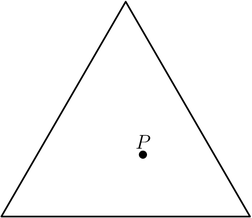
solution
Q17
Square $ABCD$ has sides of length $4$, and $M$ is the midpoint of $\overline{CD}$. A circle with radius $2$ and center $M$ intersects a circle with radius $4$ and center $A$ at points $P$ and $D$. What is the distance from $P$ to $\overline{AD}$?
正方形 $ABCD$ 的边长为 $4$,$M$ 是 $\overline{CD}$ 的中点。以 $M$ 为圆心、半径为 $2$ 的圆与以 $A$ 为圆心、半径为 $4$ 的圆相交于点 $P$ 和 $D$。点 $P$ 到 $\overline{AD}$ 的距离是多少?
stem
Correct Answer: B
$APMD$ obviously forms a kite. Let the intersection of the diagonals be $E$. $AE+EM=AM=2\sqrt{5}$ Let $AE=x$. Then, $EM=2\sqrt{5}-x$. By Pythagorean Theorem, $DE^2=4^2-AE^2=2^2-EM^2$. Thus, $16-x^2=4-(2\sqrt{5}-x)^2$. Simplifying, $x=\frac{8}{\sqrt{5}}$. By Pythagoras again, $DE=\frac{4}{\sqrt{5}}$. Then, the area of $ADP$ is $DE\cdot AE=\frac{32}{5}$. Using $4$ instead as the base, we can drop a altitude from P. $\frac{32}{5}=\frac{bh}{2}$. $\frac{32}{5}=\frac{4h}{2}$. Thus, the horizontal distance is $\frac{16}{5} \implies \boxed{\textbf{(B)}\frac{16}{5}}$
$APMD$ 显然构成一个风筝形。设两条对角线的交点为 $E$。$AE+EM=AM=2\sqrt{5}$。令 $AE=x$,则 $EM=2\sqrt{5}-x$。 由勾股定理,$DE^2=4^2-AE^2=2^2-EM^2$。因此,$16-x^2=4-(2\sqrt{5}-x)^2$。化简得 $x=\frac{8}{\sqrt{5}}$。再由勾股定理,$DE=\frac{4}{\sqrt{5}}$。于是,$\triangle ADP$ 的面积为 $DE\cdot AE=\frac{32}{5}$。 以 $4$ 为底,从 $P$ 作高,则 $\frac{32}{5}=\frac{bh}{2}$,即 $\frac{32}{5}=\frac{4h}{2}$。因此所求距离为 $\frac{16}{5} \implies \boxed{\textbf{(B)}\frac{16}{5}}$。
Q18
Let $n$ be a $5$-digit number, and let $q$ and $r$ be the quotient and the remainder, respectively, when $n$ is divided by $100$. For how many values of $n$ is $q+r$ divisible by $11$?
设 $n$ 是一个 $5$ 位数,当 $n$ 除以 $100$ 时,商为 $q$,余数为 $r$。有多少个 $n$ 使得 $q+r$ 能被 $11$ 整除?
Correct Answer: B
When a $5$-digit number is divided by $100$, the first $3$ digits become the quotient, $q$, and the last $2$ digits become the remainder, $r$. Therefore, $q$ can be any integer from $100$ to $999$ inclusive, and $r$ can be any integer from $0$ to $99$ inclusive. For each of the $9\cdot10\cdot10=900$ possible values of $q$, there are at least $\left\lfloor \frac{100}{11} \right\rfloor = 9$ possible values of $r$ such that $q+r \equiv 0\pmod{11}$. Since there is $1$ "extra" possible value of $r$ that is congruent to $0\pmod{11}$, each of the $\left\lfloor \frac{900}{11} \right\rfloor = 81$ values of $q$ that are congruent to $0\pmod{11}$ have $1$ more possible value of $r$ such that $q+r \equiv 0\pmod{11}$. Therefore, the number of possible values of $n$ such that $q+r \equiv 0\pmod{11}$ is $900\cdot9+81\cdot1=8181 \Rightarrow\boxed{(B)}$.
当一个 $5$ 位数除以 $100$ 时,前三位数字成为商 $q$,后两位数字成为余数 $r$。 因此,$q$ 可以是从 $100$ 到 $999$(含端点)的任意整数,而 $r$ 可以是从 $0$ 到 $99$(含端点)的任意整数。 对于 $q$ 的 $9\cdot10\cdot10=900$ 种可能取值中的每一个,至少有 $\left\lfloor \frac{100}{11} \right\rfloor = 9$ 个 $r$ 的取值使得 $q+r \equiv 0\pmod{11}$。 由于还存在 $1$ 个“额外”的 $r$ 取值也满足 $\equiv 0\pmod{11}$,所以对于 $\left\lfloor \frac{900}{11} \right\rfloor = 81$ 个满足 $q \equiv 0\pmod{11}$ 的 $q$ 值,各自会多出 $1$ 个 $r$ 取值使得 $q+r \equiv 0\pmod{11}$。 因此满足 $q+r \equiv 0\pmod{11}$ 的 $n$ 的个数为 $900\cdot9+81\cdot1=8181 \Rightarrow\boxed{(B)}$。
Q19
A parabola with equation $y=ax^2+bx+c$ is reflected about the $x$-axis. The parabola and its reflection are translated horizontally five units in opposite directions to become the graphs of $y=f(x)$ and $y=g(x)$, respectively. Which of the following describes the graph of $y=(f+g)(x)?$
将方程为 $y=ax^2+bx+c$ 的抛物线关于 $x$ 轴反射。然后将该抛物线与其反射图像分别向相反方向水平平移 $5$ 个单位,得到 $y=f(x)$ 与 $y=g(x)$ 的图像。下列哪一项描述了 $y=(f+g)(x)$ 的图像?
Correct Answer: D
If we take the parabola $ax^2 + bx + c$ and reflect it over the x - axis, we have the parabola $-ax^2 - bx - c$. Without loss of generality, let us say that the parabola is translated 5 units to the left, and the reflection to the right. Then: \begin{align*} f(x) = a(x+5)^2 + b(x+5) + c = ax^2 + (10a+b)x + 25a + 5b + c \\ g(x) = -a(x-5)^2 - b(x-5) - c = -ax^2 + 10ax -bx - 25a + 5b - c \end{align*} Adding them up produces: \begin{align*} (f + g)(x) = ax^2 + (10a+b)x + 25a + 5b + c - ax^2 + 10ax -bx - 25a + 5b - c = 20ax + 10b \end{align*} This is a line with slope $20a$. Since $a$ cannot be $0$ (because $ax^2 + bx + c$ would be a line) we end up with $\boxed{\textbf{(D)} \text{ a non-horizontal line }}$
将抛物线 $ax^2 + bx + c$ 关于 $x$ 轴反射,得到抛物线 $-ax^2 - bx - c$。不失一般性,设原抛物线向左平移 $5$ 个单位,而反射后的抛物线向右平移 $5$ 个单位。则: \begin{align*} f(x) = a(x+5)^2 + b(x+5) + c = ax^2 + (10a+b)x + 25a + 5b + c \\ g(x) = -a(x-5)^2 - b(x-5) - c = -ax^2 + 10ax -bx - 25a + 5b - c \end{align*} 将它们相加得到: \begin{align*} (f + g)(x) = ax^2 + (10a+b)x + 25a + 5b + c - ax^2 + 10ax -bx - 25a + 5b - c = 20ax + 10b \end{align*} 这是一条斜率为 $20a$ 的直线。由于 $a$ 不能为 $0$(否则 $ax^2 + bx + c$ 将是一条直线),因此图像为 $\boxed{\textbf{(D)} \text{一条非水平直线}}$。
Q20
How many $15$-letter arrangements of $5$ A's, $5$ B's, and $5$ C's have no A's in the first $5$ letters, no B's in the next $5$ letters, and no C's in the last $5$ letters?
由 $5$ 个 A、$5$ 个 B 和 $5$ 个 C 组成的 $15$ 字母排列中,有多少个满足:前 $5$ 个字母中没有 A,接下来的 $5$ 个字母中没有 B,最后 $5$ 个字母中没有 C?
Correct Answer: A
The answer is $\boxed{\textrm{(A)}}$. Note that the first five letters must be B's or C's, the next five letters must be C's or A's, and the last five letters must be A's or B's. If there are $k$ B's in the first five letters, then there must be $5-k$ C's in the first five letters, so there must be $k$ C's and $5-k$ A's in the next five letters, and $k$ A's and $5-k$ B's in the last five letters. Therefore the number of each letter in each group of five is determined completely by the number of B's in the first 5 letters, and the number of ways to arrange these 15 letters with this restriction is $\binom{5}{k}^3$ (since there are $\binom{5}{k}$ ways to arrange $k$ B's and $5-k$ C's). Therefore the answer is $\sum_{k=0}^{5}\binom{5}{k}^{3}$.
答案是 $\boxed{\textrm{(A)}}$。 注意前五个字母必须是 B 或 C,接下来的五个字母必须是 C 或 A,最后五个字母必须是 A 或 B。若前五个字母中有 $k$ 个 B,则前五个字母中必有 $5-k$ 个 C,因此接下来的五个字母中必有 $k$ 个 C 和 $5-k$ 个 A,最后五个字母中必有 $k$ 个 A 和 $5-k$ 个 B。于是,每组五个字母中各字母的数量完全由前五个字母中 B 的个数决定。在此限制下安排这 $15$ 个字母的方式数为 $\binom{5}{k}^3$(因为安排 $k$ 个 B 与 $5-k$ 个 C 有 $\binom{5}{k}$ 种方式)。因此答案为 $\sum_{k=0}^{5}\binom{5}{k}^{3}$。
Q21
The graph of the polynomial \[P(x) = x^5 + ax^4 + bx^3 + cx^2 + dx + e\] has five distinct $x$-intercepts, one of which is at $(0,0)$. Which of the following coefficients cannot be zero?
多项式 \[P(x) = x^5 + ax^4 + bx^3 + cx^2 + dx + e\] 的图像有五个不同的 $x$ 截距,其中一个在 $(0,0)$。以下哪个系数不可能为零?
Correct Answer: D
Let the roots be $r_1=0, r_2, r_3, r_4, r_5$. According to Viète's formulae, we have $d=r_1r_2r_3r_4 + r_1r_2r_3r_5 + r_1r_2r_4r_5 + r_1r_3r_4r_5 + r_2r_3r_4r_5$. The first four terms contain $r_1=0$ and are therefore zero, thus $d=r_2r_3r_4r_5$. This is a product of four non-zero numbers, therefore $d$ must be non-zero $\Longrightarrow \mathrm{(D)}$. Clearly, since $(0,0)$ is an intercept, $e$ must be $0$. But if $d$ was $0$, $x^2$ would divide the polynomial, which means it would have a double root at $0$, which is impossible, since all five roots are distinct.
设其根为 $r_1=0, r_2, r_3, r_4, r_5$。根据韦达定理,有 $d=r_1r_2r_3r_4 + r_1r_2r_3r_5 + r_1r_2r_4r_5 + r_1r_3r_4r_5 + r_2r_3r_4r_5$。 前四项都含有 $r_1=0$,因此都为 $0$,所以 $d=r_2r_3r_4r_5$。这是四个非零数的乘积,因此 $d$ 必须非零 $\Longrightarrow \mathrm{(D)}$。 显然,由于 $(0,0)$ 是截距,$e$ 必须为 $0$。但如果 $d$ 为 $0$,则 $x^2$ 会整除该多项式,这意味着在 $0$ 处有重根,这不可能,因为五个根都互不相同。
Q22
Objects $A$ and $B$ move simultaneously in the coordinate plane via a sequence of steps, each of length one. Object $A$ starts at $(0,0)$ and each of its steps is either right or up, both equally likely. Object $B$ starts at $(5,7)$ and each of its steps is either to the left or down, both equally likely. Which of the following is closest to the probability that the objects meet?
物体 $A$ 和 $B$ 同时在坐标平面中通过一系列步长为 1 的步子移动。物体 $A$ 从 $(0,0)$ 出发,每一步要么向右要么向上,两种等可能。物体 $B$ 从 $(5,7)$ 出发,每一步要么向左要么向下,两种等可能。以下哪个最接近两物体相遇的概率?
Correct Answer: C
If $A$ and $B$ meet, their paths connect $(0,0)$ and $(5,7).$ There are $\binom{12}{5}=792$ such paths. Since the path is $12$ units long, they must meet after each travels $6$ units, so the probability is $\frac{792}{2^{6}\cdot 2^{6}} \approx 0.20 \Rightarrow \boxed{C}$. Note: The number of paths, $\binom{12}{5}$ comes from the fact that there must be 5 ups/downs and 7 lefts/rights in one path. WLOG, for Object A, the number of paths would be the amount of combinations of the sequence of letters with 5 "U"s 7 "R"s (i.e. UUUUURRRRRRR). This is $\frac{12!}{5!7!}$, which is equivalent to $\binom{12}{5}$.
若 $A$ 与 $B$ 相遇,则它们的路径连接 $(0,0)$ 与 $(5,7).$ 这样的路径共有 $\binom{12}{5}=792$ 条。由于该路径长度为 $12$,它们必须在各自走了 $6$ 个单位后相遇,因此所求概率为 $\frac{792}{2^{6}\cdot 2^{6}} \approx 0.20 \Rightarrow \boxed{C}$。 注:路径条数 $\binom{12}{5}$ 来自于一条路径中必须有 5 次上/下与 7 次左/右。无损失一般性地,对物体 $A$,路径数等于由 5 个 "U" 与 7 个 "R" 组成的序列的排列数(例如 UUUUURRRRRRR)的组合数,即 $\frac{12!}{5!7!}$,这等于 $\binom{12}{5}$。
Q23
How many perfect squares are divisors of the product $1!\cdot 2!\cdot 3!\cdots 9!$?
乘积 $1!\cdot 2!\cdot 3!\cdots 9!$ 的因数中,有多少个是完全平方数?
Correct Answer: B
We want to find the number of perfect square factors in the product of all the factorials of numbers from $1 - 9$. We can write this out and take out the factorials, and then find a prime factorization of the entire product. We can also find this prime factorization by finding the number of times each factor is repeated in each factorial. This comes out to be equal to $2^{30} \cdot 3^{13} \cdot 5^5 \cdot 7^3$. To find the amount of perfect square factors, we realize that each exponent in the prime factorization must be even: $2^{15} \cdot 3^{6}\cdot 5^2 \cdot 7^1$. To find the total number of possibilities, we add $1$ to each exponent and multiply them all together. This gives us $16 \cdot 7 \cdot 3 \cdot 2 = 672$ $\Rightarrow\boxed{\mathrm{(B)}}$.
我们要找从 $1 - 9$ 的所有阶乘之积中,完全平方因数的个数。可以将其展开并提取阶乘,然后对整个乘积做质因数分解;也可以通过统计每个质因数在各个阶乘中出现的次数来得到该分解。结果为 $2^{30} \cdot 3^{13} \cdot 5^5 \cdot 7^3$。要成为完全平方数,其质因数分解中的每个指数必须为偶数:$2^{15} \cdot 3^{6}\cdot 5^2 \cdot 7^1$。为求总的可能数,对每个指数加 $1$ 后相乘,得到 $16 \cdot 7 \cdot 3 \cdot 2 = 672$ $\Rightarrow\boxed{\mathrm{(B)}}$。
Q24
If $a\geq b > 1,$ what is the largest possible value of $\log_{a}(a/b) + \log_{b}(b/a)?$
若 $a\geq b > 1,$ 则 $\log_{a}(a/b) + \log_{b}(b/a)$ 的最大可能值是多少?
Correct Answer: B
Using logarithmic rules, we see that \[\log_{a}a-\log_{a}b+\log_{b}b-\log_{b}a = 2-(\log_{a}b+\log_{b}a)\] \[=2-\left(\log_{a}b+\frac {1}{\log_{a}b}\right)\] Since $a$ and $b$ are both greater than $1$, using AM-GM gives that the term in parentheses must be at least $2$, so the largest possible values is $2-2=0 \Rightarrow \boxed{\textbf{B}}.$ Note that the maximum occurs when $a=b$.
利用对数运算规则,有 \[\log_{a}a-\log_{a}b+\log_{b}b-\log_{b}a = 2-(\log_{a}b+\log_{b}a)\] \[=2-\left(\log_{a}b+\frac {1}{\log_{a}b}\right)\] 由于 $a$ 与 $b$ 都大于 $1$,用 AM-GM 可知括号内的量至少为 $2$,因此最大值为 $2-2=0 \Rightarrow \boxed{\textbf{B}}.$ 注意最大值在 $a=b$ 时取得。
Q25
Let $f(x)= \sqrt{ax^2+bx}$. For how many real values of $a$ is there at least one positive value of $b$ for which the domain of $f$ and the range of $f$ are the same set?
设 $f(x)= \sqrt{ax^2+bx}$。有多少个实数 $a$,使得存在至少一个正实数 $b$,使得 $f$ 的定义域与值域是同一个集合?
Correct Answer: C
The function $f(x) = \sqrt{x(ax+b)}$ has a codomain of all non-negative numbers, or $0 \le f(x)$. Since the domain and the range of $f$ are the same, it follows that the domain of $f$ also satisfies $0 \le x$. The function has two zeroes at $x = 0, \frac{-b}{a}$, which must be part of the domain. Since the domain and the range are the same set, it follows that $\frac{-b}{a}$ is in the codomain of $f$, or $0 \le \frac{-b}{a}$. This implies that one (but not both) of $a,b$ is non-positive. The problem states that there is at least one positive value of b that works, thus $a$ must be non-positive, $b$ is non-negative, and the domain of the function occurs when $x(ax+b) > 0$, or $0 \le x \le \frac{-b}{a}.$ Completing the square, $f(x) = \sqrt{a\left(x + \frac{b}{2a}\right)^2 - \frac{b^2}{4a}} \le \sqrt{\frac{-b^2}{4a}}$ by the Trivial Inequality (remember that $a \le 0$). Since $f$ is continuous and assumes this maximal value at $x = \frac{-b}{2a}$, it follows that the range of $f$ is $0 \le f(x) \le \sqrt{\frac{-b^2}{4a}}.$ As the domain and the range are the same, we have that $\frac{-b}{a} = \sqrt{\frac{-b^2}{4a}} = \frac{b}{2\sqrt{-a}} \Longrightarrow a(a+4) = 0$ (we can divide through by $b$ since it is given that $b$ is positive). Hence $a = 0, -4$, which both we can verify work, and the answer is $\mathbf{(C)}$.
函数 $f(x) = \sqrt{x(ax+b)}$ 的陪域为所有非负数,即 $0 \le f(x)$。由于 $f$ 的定义域与值域相同,可知 $f$ 的定义域也满足 $0 \le x$。 该函数在 $x = 0, \frac{-b}{a}$ 处有两个零点,它们必须属于定义域。由于定义域与值域是同一集合,可知 $\frac{-b}{a}$ 也在 $f$ 的陪域中,即 $0 \le \frac{-b}{a}$。这意味着 $a,b$ 中恰有一个(但不能两个都)非正。题目说明存在至少一个正的 $b$ 可行,因此 $a$ 必须非正,$b$ 非负,且函数的定义域由 $x(ax+b) > 0$ 给出,即 $0 \le x \le \frac{-b}{a}.$ 配方得 $f(x) = \sqrt{a\left(x + \frac{b}{2a}\right)^2 - \frac{b^2}{4a}} \le \sqrt{\frac{-b^2}{4a}}$(注意 $a \le 0$)。由于 $f$ 连续并在 $x = \frac{-b}{2a}$ 处取得该最大值,可知 $f$ 的值域为 $0 \le f(x) \le \sqrt{\frac{-b^2}{4a}}.$ 因为定义域与值域相同,有 $\frac{-b}{a} = \sqrt{\frac{-b^2}{4a}} = \frac{b}{2\sqrt{-a}} \Longrightarrow a(a+4) = 0$ (由于题设 $b$ 为正,可两边同除以 $b$)。因此 $a = 0, -4$,两者都可验证可行,答案为 $\mathbf{(C)}$。