AMC12 2020 A
AMC12 2020 A · Q25
AMC12 2020 A · Q25. It mainly tests Vieta / quadratic relationships (basic), Inequalities with floors/ceilings (basic).
The number $a = \frac{p}{q}$, where $p$ and $q$ are relatively prime positive integers, has the property that the sum of all real numbers $x$ satisfying $\lfloor x \rfloor \cdot \{x\} = a \cdot x^2$ is 420, where $\lfloor x \rfloor$ denotes the greatest integer less than or equal to $x$ and $\{x\} = x - \lfloor x \rfloor$ denotes the fractional part of $x$. What is $p + q$?
数$a = \frac{p}{q}$,其中$p$和$q$互质正整数,具有所有满足$\lfloor x \rfloor \cdot \{x\} = a \cdot x^2$的实数$x$之和为420,其中$\lfloor x \rfloor$表示小于等于$x$的最大整数,$\{x\} = x - \lfloor x \rfloor$表示$x$的分数部分。求$p + q$?
(A)
245
245
(B)
593
593
(C)
929
929
(D)
1331
1331
(E)
1332
1332
Answer
Correct choice: (C)
正确答案:(C)
Solution
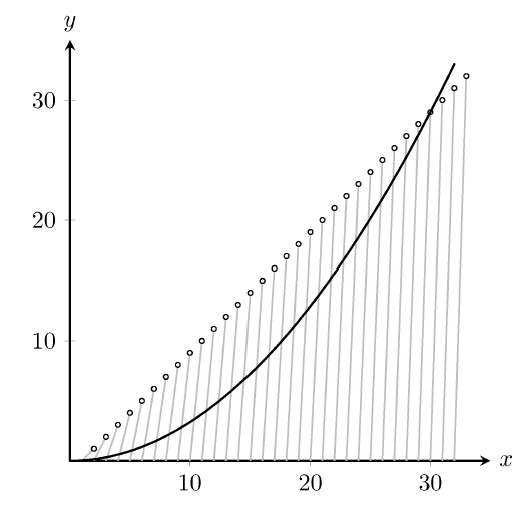
Answer (C): Note that $x>0$, and the only solution with $[x]=0$ is $x=0$, so it follows that $x\ge 1$. The graph of $y=[x]\{x\}$, for $x\ge 1$, consists of line segments $\ell_k$ from $(k,0)$ to $(k+1,k)$ for $k=1,2,\ldots$ with the right endpoint of each segment excluded. If $[x]\{x\}=ax^2$ has no solutions, then the graph of $y=ax^2$ must intersect all the segments $\ell_1,\ell_2,\ldots,\ell_n$, but not $\ell_{n+1}$. Then
$$1+2+\cdots+n\le 420<2+3+\cdots+(n+1),$$
which forces $n=28$. Also, note that it must be that $a<\frac14$ for there to be solutions other than $x=0$. The following figure gives an idea of what is happening.
Writing $x=[x]+\{x\}$, it follows that $[x]\{x\}=a([x]+\{x\})^2$, so
$$0=a\{x\}^2+(2a-1)[x]\{x\}+a[x]^2.$$
Then by the quadratic formula,
$$\{x\}=\frac{-(2a-1)[x]\pm\sqrt{(2a-1)^2[x]^2-4a^2[x]^2}}{2a}$$
$$=\left(\frac{(1-2a)\pm\sqrt{1-4a}}{2a}\right)[x].$$
The minus sign must be chosen, because for $x\ge 1$,
$$\{x\}=\left(\frac{(1-2a)+\sqrt{1-4a}}{2a}\right)[x]$$
$$\ge \frac{1-2a}{2a}$$
$$=\frac{1}{2a}-1$$
$$>\frac{1}{2\cdot\frac14}-1$$
$$=1,$$
which is impossible. Therefore the solutions are
$$x=[x]+\{x\}=\left(\frac{1-\sqrt{1-4a}}{2a}\right)[x]$$
for $1\le [x]\le 28$. Note that this equation implies that for each positive integer $k$, there is at most one solution with $k\le x<k+1$. It follows that the sum of the solutions is
$$420=\left(\frac{1-\sqrt{1-4a}}{2a}\right)(1+2+\cdots+28)=\left(\frac{1-\sqrt{1-4a}}{2a}\right)\cdot 14\cdot 29.$$
Thus
$$\frac{1-\sqrt{1-4a}}{2a}=\frac{30}{29}.$$
Writing this in the form $29\sqrt{1-4a}=29-60a$, then squaring and simplifying gives $3600a^2-116a=0,$ so
答案(C):注意 $x>0$,且满足 $[x]=0$ 的唯一解是 $x=0$,因此可得 $x\ge 1$。当 $x\ge 1$ 时,$y=[x]\{x\}$ 的图像由线段 $\ell_k$ 组成:对 $k=1,2,\ldots$,$\ell_k$ 从 $(k,0)$ 到 $(k+1,k)$,并且每条线段的右端点不取到。若方程 $[x]\{x\}=ax^2$ 没有解,则 $y=ax^2$ 的图像必须与线段 $\ell_1,\ell_2,\ldots,\ell_n$ 都相交,但不与 $\ell_{n+1}$ 相交。于是
$$1+2+\cdots+n\le 420<2+3+\cdots+(n+1),$$
从而迫使 $n=28$。另外,要存在除 $x=0$ 以外的解,必有 $a<\frac14$。下图说明了这一现象的大致情况。
写成 $x=[x]+\{x\}$,则由 $[x]\{x\}=a([x]+\{x\})^2$ 得
$$0=a\{x\}^2+(2a-1)[x]\{x\}+a[x]^2.$$
由求根公式,
$$\{x\}=\frac{-(2a-1)[x]\pm\sqrt{(2a-1)^2[x]^2-4a^2[x]^2}}{2a}$$
$$=\left(\frac{(1-2a)\pm\sqrt{1-4a}}{2a}\right)[x].$$
必须选择减号,因为当 $x\ge 1$ 时,
$$\{x\}=\left(\frac{(1-2a)+\sqrt{1-4a}}{2a}\right)[x]$$
$$\ge \frac{1-2a}{2a}$$
$$=\frac{1}{2a}-1$$
$$>\frac{1}{2\cdot\frac14}-1$$
$$=1,$$
这不可能(因为 $\{x\}<1$)。因此解为
$$x=[x]+\{x\}=\left(\frac{1-\sqrt{1-4a}}{2a}\right)[x]$$
其中 $1\le [x]\le 28$。注意该式意味着:对每个正整数 $k$,在区间 $k\le x<k+1$ 内至多有一个解。因此所有解的和为
$$420=\left(\frac{1-\sqrt{1-4a}}{2a}\right)(1+2+\cdots+28)=\left(\frac{1-\sqrt{1-4a}}{2a}\right)\cdot 14\cdot 29.$$
从而
$$\frac{1-\sqrt{1-4a}}{2a}=\frac{30}{29}.$$
将其写为 $29\sqrt{1-4a}=29-60a$,两边平方并化简得到 $3600a^2-116a=0$,所以
Topics
Related Questions
Practice full AMC exams on amcdrill.
Try full-length practice and diagnostics at www.amcdrill.com.