AMC12 2017 A
AMC12 2017 A · Q24
AMC12 2017 A · Q24. It mainly tests Similarity, Circle theorems.
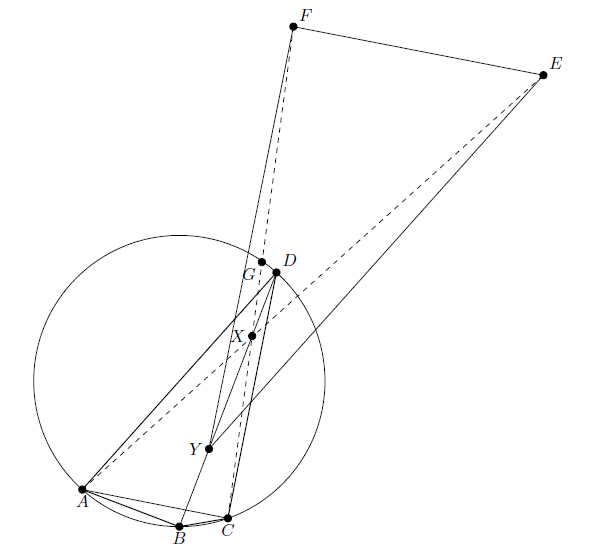
Quadrilateral ABCD is inscribed in circle O and has sides AB = 3, BC = 2, CD = 6, and DA = 8. Let X and Y be points on BD such that DX / BD = 1/4 and BY / BD = 11/36. Let E be the intersection of line AX and the line through Y parallel to AD. Let F be the intersection of line CX and the line through E parallel to AC. Let G be the point on circle O other than C that lies on line CX. What is XF · XG?
四边形 ABCD 内接于圆 O,且边长 AB = 3,BC = 2,CD = 6,DA = 8。令 X 和 Y 为 BD 上的点,使得 DX / BD = 1/4 和 BY / BD = 11/36。令 E 为直线 AX 与通过 Y 平行于 AD 的直线的交点。令 F 为直线 CX 与通过 E 平行于 AC 的直线的交点。令 G 为圆 O 上除 C 外位于直线 CX 上的点。求 XF · XG?
(A)
17
17
(B)
$59 - 5\sqrt{2}/3$
$59 - 5\sqrt{2}/3$
(C)
$91 - 12\sqrt{3}/4$
$91 - 12\sqrt{3}/4$
(D)
$67 - 10\sqrt{2}/3$
$67 - 10\sqrt{2}/3$
(E)
18
18
Answer
Correct choice: (A)
正确答案:(A)
Solution
Answer (A): Because $\overline{YE}$ and $\overline{EF}$ are parallel to $\overline{AD}$ and $\overline{AC}$, respectively, $\triangle XEY \sim \triangle XAD$ and $\triangle XEF \sim \triangle XAC$. Therefore
$$\frac{XY}{XE}=\frac{XD}{XA}\quad\text{and}\quad \frac{XF}{XE}=\frac{XC}{XA}.$$
It follows that
$$\frac{XC}{XD}=\frac{XF}{XY}.$$
The Power of a Point Theorem applied to circle $O$ and point $X$ implies that $XC\cdot XG=XD\cdot XB$. Together with the previous equation this implies that $XF\cdot XG=XB\cdot XY$. Let $d=BD$; then $DX=\frac14 d$ and $BY=\frac{11}{36}d$. It follows that
$$\begin{array}{rcl}
XF\cdot XG&=&XB\cdot XY=(BD-DX)\cdot(BD-DX-BY)\\[4pt]
&=&\left(d-\frac14 d\right)\left(d-\frac14 d-\frac{11}{36}d\right)\\[6pt]
&=&\frac34\cdot\frac49 d^2=\frac{d^2}{3}.
\end{array}$$
To determine $d$, note that because $ABCD$ is a cyclic quadrilateral it follows that $\alpha=\angle BAD=\pi-\angle DCB$. Applying the Law of Cosines to $\triangle ABD$ and $\triangle BCD$ yields
$$\cos\alpha=\frac{AB^2+AD^2-BD^2}{2\cdot AB\cdot AD}
=\frac{3^2+8^2-d^2}{2\cdot3\cdot8}
=\frac{73-d^2}{48},$$
and
$$-\cos\alpha=\cos(\pi-\alpha)
=\frac{CB^2+CD^2-BD^2}{2\cdot CB\cdot CD}
=\frac{2^2+6^2-d^2}{2\cdot2\cdot6}
=\frac{40-d^2}{24}.$$
Therefore
$$\frac{73-d^2}{48}=\frac{d^2-40}{24},$$
and solving for $d^2$ gives $d^2=51$. Hence $XF\cdot XG=\frac13 d^2=17$.
答案(A):因为 $\overline{YE}$ 和 $\overline{EF}$ 分别与 $\overline{AD}$ 和 $\overline{AC}$ 平行,所以 $\triangle XEY \sim \triangle XAD$ 且 $\triangle XEF \sim \triangle XAC$。因此
$$\frac{XY}{XE}=\frac{XD}{XA}\quad\text{且}\quad \frac{XF}{XE}=\frac{XC}{XA}.$$
由此得到
$$\frac{XC}{XD}=\frac{XF}{XY}.$$
对圆 $O$ 和点 $X$ 应用点的幂定理可知 $XC\cdot XG=XD\cdot XB$。结合上式可推出 $XF\cdot XG=XB\cdot XY$。令 $d=BD$;则 $DX=\frac14 d$ 且 $BY=\frac{11}{36}d$。于是
$$\begin{array}{rcl}
XF\cdot XG&=&XB\cdot XY=(BD-DX)\cdot(BD-DX-BY)\\[4pt]
&=&\left(d-\frac14 d\right)\left(d-\frac14 d-\frac{11}{36}d\right)\\[6pt]
&=&\frac34\cdot\frac49 d^2=\frac{d^2}{3}.
\end{array}$$
为求 $d$,注意到因为 $ABCD$ 是圆内接四边形,所以 $\alpha=\angle BAD=\pi-\angle DCB$。对 $\triangle ABD$ 和 $\triangle BCD$ 应用余弦定理得到
$$\cos\alpha=\frac{AB^2+AD^2-BD^2}{2\cdot AB\cdot AD}
=\frac{3^2+8^2-d^2}{2\cdot3\cdot8}
=\frac{73-d^2}{48},$$
以及
$$-\cos\alpha=\cos(\pi-\alpha)
=\frac{CB^2+CD^2-BD^2}{2\cdot CB\cdot CD}
=\frac{2^2+6^2-d^2}{2\cdot2\cdot6}
=\frac{40-d^2}{24}.$$
因此
$$\frac{73-d^2}{48}=\frac{d^2-40}{24},$$
解得 $d^2=51$。故 $XF\cdot XG=\frac13 d^2=17$。
Topics
Related Questions
Practice full AMC exams on amcdrill.
Try full-length practice and diagnostics at www.amcdrill.com.