AMC12 2010 A
AMC12 2010 A · Q13
AMC12 2010 A · Q13. It mainly tests Quadratic equations, Coordinate geometry.
For how many integer values of $k$ do the graphs of $x^2+y^2=k^2$ and $xy = k$ not intersect?
对于多少个整数 $k$ 值,$x^2+y^2=k^2$ 和 $xy = k$ 的图像不相交?
(A)
0
0
(B)
1
1
(C)
2
2
(D)
4
4
(E)
8
8
Answer
Correct choice: (C)
正确答案:(C)
Solution
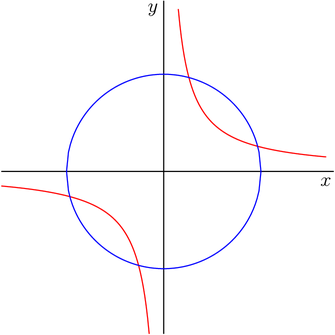
The image below shows the two curves for $k=4$. The blue curve is $x^2+y^2=k^2$, which is clearly a circle with radius $k$, and the red curve is a part of the curve $xy=k$.
In the special case $k=0$ the blue curve is just the point $(0,0)$, and as $0\cdot 0=0$, this point is on the red curve as well, hence they intersect.
The case $k<0$ is symmetric to $k>0$: the blue curve remains the same and the red curve is flipped according to the $x$ axis. Hence we just need to focus on $k>0$.
Clearly, on the red curve there will always be points arbitrarily far from the origin: for example, as $x$ approaches 0, $y$ approaches $\infty$. Hence the red curve intersects the blue one if and only if it contains a point whose distance from the origin is at most $k$.
At this point we can guess that on the red curve the point where $x=y$ is always closest to the origin, and skip the rest of this solution.
For an exact solution, fix $k$ and consider any point $(x,y)$ on the red curve. Its distance from the origin is $\sqrt{ x^2 + (k/x)^2 }$. To minimize this distance, it is enough to minimize $x^2 + (k/x)^2$. By the Arithmetic Mean-Geometric Mean Inequality we get that this value is at least $2k$, and that equality holds whenever $x^2 = (k/x)^2$, i.e., $x=\pm\sqrt k$.
Now recall that the red curve intersects the blue one if and only if its closest point is at most $k$ from the origin. We just computed that the distance between the origin and the closest point on the red curve is $\sqrt{2k}$. Therefore, we want to find all positive integers $k$ such that $\sqrt{2k} > k$.
Clearly the only such integer is $k=1$, hence the two curves are only disjoint for $k=1$ and $k=-1$.
This is a total of $\boxed{2\ \textbf{(C)}}$ values.
下图展示了 $k=4$ 时的两条曲线。蓝色曲线是 $x^2+y^2=k^2$,显然是半径为 $k$ 的圆;红色曲线是 $xy=k$ 的一部分。
在特殊情况 $k=0$ 时,蓝色曲线只是点 $(0,0)$,且 $0\cdot 0=0$,该点也在红色曲线上,因此它们相交。
$k<0$ 的情况与 $k>0$ 对称:蓝色曲线不变,红色曲线关于 $x$ 轴翻折。因此只需关注 $k>0$。
显然,在红色曲线上总存在离原点任意远的点:例如当 $x$ 趋近于 0 时,$y$ 趋近于 $\infty$。因此红色曲线与蓝色曲线相交当且仅当红色曲线上存在到原点距离不超过 $k$ 的点。
此时我们可以猜测红色曲线上 $x=y$ 的点总是离原点最近的点,并跳过后续解答。
为得到精确解,固定 $k$ 并考虑红色曲线上任意点 $(x,y)$。它到原点的距离为 $\sqrt{ x^2 + (k/x)^2 }$。要最小化该距离,只需最小化 $x^2 + (k/x)^2$。由均值不等式可得该值至少为 $2k$,且当 $x^2 = (k/x)^2$(即 $x=\pm\sqrt k$)时取等号。
回忆红色曲线与蓝色曲线相交当且仅当红色曲线最近点到原点的距离不超过 $k$。我们刚算出红色曲线最近点到原点的距离为 $\sqrt{2k}$。因此我们要找所有正整数 $k$ 使得 $\sqrt{2k} > k$。
显然唯一满足的整数是 $k=1$,因此两条曲线仅在 $k=1$ 和 $k=-1$ 时不相交。
总共有 $\boxed{2\ \textbf{(C)}}$ 个取值。
Topics
Related Questions
Practice full AMC exams on amcdrill.
Try full-length practice and diagnostics at www.amcdrill.com.