AMC12 2003 B
AMC12 2003 B · Q20
AMC12 2003 B · Q20. It mainly tests Linear equations, Systems of equations.
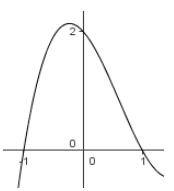
Part of the graph of $f(x) = ax^3 + bx^2 + cx + d$ is shown. What is $b$?
函数 $f(x) = ax^3 + bx^2 + cx + d$ 的图像如图所示的一部分。求 $b$。
(A)
-4
-4
(B)
-2
-2
(C)
0
0
(D)
2
2
(E)
4
4
Answer
Correct choice: (B)
正确答案:(B)
Solution
Since
\begin{align*} -f(-1) = a - b + c - d = 0 = f(1) = a + b + c + d \end{align*}
It follows that $b + d = 0$. Also, $d = f(0) = 2$, so $b = -2 \Rightarrow \mathrm{(B)}$.
Two of the roots of $f(x) = 0$ are $\pm 1$, and we let the third one be $n$. Then
\[a(x-1)(x+1)(x-n) = ax^3-anx^2-ax+an = ax^3 + bx^2 + cx + d = 0\]
Notice that $f(0) = d = an = 2$, so $b = -an = -2 \Rightarrow \mathrm{(B)}$.
Notice that if $g(x) = 2 - 2x^2$, then $f - g$ vanishes at $x = -1, 0, 1$ and so
\[f(x) - g(x) = ax(x-1)(x+1) = ax^3 - ax\]
implies by $x^2$ coefficient, $b + 2 = 0, b = -2 \Rightarrow \mathrm{(B)}$.
The roots of this equation are $-1, 1, \text{ and } x$, letting $x$ be the root not shown in the graph. By Vieta, we know that $-1+1+x=x=-\frac{b}{a}$ and $-1\cdot 1\cdot x=-x=-\frac{d}{a}$. Therefore, $x=\frac{d}{a}$. Setting the two equations for $x$ equal to each other, $\frac{d}{a}=-\frac{b}{a}$. We know that the y-intercept of the polynomial is $d$, so $d=2$. Plugging in for $d$, $\frac{2}{a}=-\frac{b}{a}$.
Therefore, $b=-2 \Rightarrow \boxed{B}$
From the graph, we have $f(0)=2$ so $d=2$. Also from the graph, we have $f(1)=a+b+c+2=0$. But we also have from the graph $f(-1)=-a+b-c+2=0$. Summing $f(1)+f(2)$ we get $2b+4=0$ so $b = -2 \Rightarrow \mathrm{(B)}$.
Solution by franzliszt
因为
\begin{align*} -f(-1) = a - b + c - d = 0 = f(1) = a + b + c + d \end{align*}
可得 $b + d = 0$。又 $d = f(0) = 2$,所以 $b = -2 \Rightarrow \mathrm{(B)}$。
$ f(x) = 0$ 的两个根为 $\pm 1$,设第三个根为 $n$。则
\[a(x-1)(x+1)(x-n) = ax^3-anx^2-ax+an = ax^3 + bx^2 + cx + d = 0\]
注意到 $f(0) = d = an = 2$,所以 $b = -an = -2 \Rightarrow \mathrm{(B)}$。
注意若 $g(x) = 2 - 2x^2$,则 $f - g$ 在 $x = -1, 0, 1$ 处为零,因此
\[f(x) - g(x) = ax(x-1)(x+1) = ax^3 - ax\]
implies 由 $x^2$ 的系数得 $b + 2 = 0, b = -2 \Rightarrow \mathrm{(B)}$。
该方程的根为 $-1, 1, \text{ and } x$,其中令 $x$ 为图中未显示的那个根。由韦达定理,$-1+1+x=x=-\frac{b}{a}$ 且 $-1\cdot 1\cdot x=-x=-\frac{d}{a}$。因此 $x=\frac{d}{a}$。令两式中的 $x$ 相等,得 $\frac{d}{a}=-\frac{b}{a}$。我们知道该多项式的 $y$ 轴截距为 $d$,所以 $d=2$。代入 $d$ 得 $\frac{2}{a}=-\frac{b}{a}$。
因此 $b=-2 \Rightarrow \boxed{B}$
由图可知 $f(0)=2$,所以 $d=2$。又由图可知 $f(1)=a+b+c+2=0$。同时由图可知 $f(-1)=-a+b-c+2=0$。将 $f(1)+f(2)$ 相加得到 $2b+4=0$,所以 $b = -2 \Rightarrow \mathrm{(B)}$。
Solution by franzliszt
Topics
Related Questions
Practice full AMC exams on amcdrill.
Try full-length practice and diagnostics at www.amcdrill.com.