AMC10 2020 B
AMC10 2020 B · Q17
AMC10 2020 B · Q17. It mainly tests Combinations, Polygons.
There are 10 people standing equally spaced around a circle. Each person knows exactly 3 of the other 9 people: the 2 people standing next to her or him, as well as the person directly across the circle. How many ways are there for the 10 people to split up into 5 pairs so that the members of each pair know each other?
有 10 个人等间距站在一个圆周上。每人确切认识其他 9 人中的 3 人:站在他/她旁边 2 人和圆周正对面的人。有多少种方法让这 10 人分成 5 对,使得每对成员互相认识?
(A)
11
11
(B)
12
12
(C)
13
13
(D)
14
14
(E)
15
15
Answer
Correct choice: (C)
正确答案:(C)
Solution
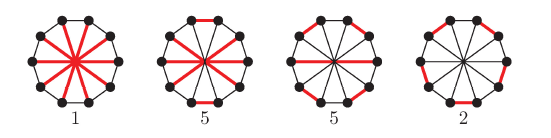
Answer (C): This problem can be modeled by a regular decagon with the 5 diagonals connecting each point to the point opposite to it. A line segment between two vertices indicates that the people represented by those vertices know each other. See the figure below. The required pairings are then sets of 5 of the 15 line segments in this figure such that no 2 line segments in a set share an endpoint. (This is known as a perfect matching in graph theory.) The number of pairings can be counted by focusing on the number of diagonals used in the pairing.
• There is 1 pairing using all 5 diagonals, and any pairing that includes 4 of the diagonals must use all of them.
• Suppose a pairing uses exactly 3 diagonals. If 3 of the endpoints of these diagonals are consecutive points on the decagon, then a pairing can be formed by including sides of the decagon as the other 2 segments. There are 5 different pairings of this form. On the other hand, any pairing that includes 3 of the diagonals whose endpoints are not consecutive points on the decagon must use all the diagonals.
• There are no pairings using exactly 2 of the diagonals, because any pairing that includes 2 of the diagonals will force at least 3 of the diagonals to be used.
• If a pairing uses exactly 1 diagonal, then the rest of the pairing is uniquely determined. There are 5 different pairings of this form.
• If a pairing uses no diagonals, then it must use nonadjacent sides of the decagon, and there are 2 different pairings of this form.
As shown in the figure, the requested number of pairings is $1+5+5+2=13$.
答案(C):这个问题可以用一个正十边形来建模,并画出5条对角线,每条连接一个顶点与其对面顶点。两顶点之间的一条线段表示由这些顶点代表的人彼此认识。见下图。所需的配对就是从图中15条线段中选出5条组成一组,并且同一组中任意两条线段不共享端点。(这在图论中称为完美匹配。)配对的数量可以通过关注配对中使用的对角线条数来计数。
• 使用全部5条对角线的配对有1种;并且任何包含4条对角线的配对都必须包含全部5条。
• 假设一个配对恰好使用3条对角线。如果这3条对角线的端点中有3个是十边形上的连续顶点,那么可以通过再选取十边形的边作为另外2条线段来形成一个配对。这种形式共有5种不同的配对。另一方面,任何包含3条对角线且其端点不是十边形上的连续顶点的配对,都必须使用全部对角线。
• 恰好使用2条对角线的配对不存在,因为任何包含2条对角线的配对都会迫使至少使用3条对角线。
• 如果一个配对恰好使用1条对角线,那么其余部分被唯一确定。这种形式共有5种不同的配对。
• 如果一个配对不使用对角线,那么它必须使用十边形中互不相邻的边,这种形式共有2种不同的配对。
如图所示,所求配对数为 $1+5+5+2=13$。
Topics
Related Questions
Practice full AMC exams on amcdrill.
Try full-length practice and diagnostics at www.amcdrill.com.